Alan Moore - Jerusalem
Здесь есть возможность читать онлайн «Alan Moore - Jerusalem» весь текст электронной книги совершенно бесплатно (целиком полную версию без сокращений). В некоторых случаях можно слушать аудио, скачать через торрент в формате fb2 и присутствует краткое содержание. Год выпуска: 2016, Издательство: Liveright Publishing Corporation, Жанр: Современная проза, на английском языке. Описание произведения, (предисловие) а так же отзывы посетителей доступны на портале библиотеки ЛибКат.
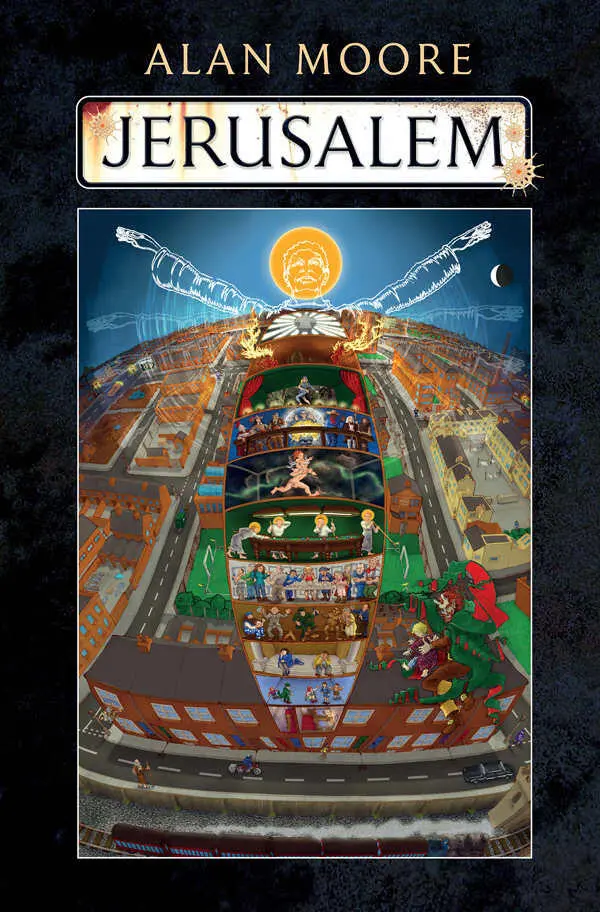
- Название:Jerusalem
- Автор:
- Издательство:Liveright Publishing Corporation
- Жанр:
- Год:2016
- ISBN:нет данных
- Рейтинг книги:4 / 5. Голосов: 1
-
Избранное:Добавить в избранное
- Отзывы:
-
Ваша оценка:
Jerusalem: краткое содержание, описание и аннотация
Предлагаем к чтению аннотацию, описание, краткое содержание или предисловие (зависит от того, что написал сам автор книги «Jerusalem»). Если вы не нашли необходимую информацию о книге — напишите в комментариях, мы постараемся отыскать её.
Disappeared lanes yield their own voices, built from lost words and forgotten dialect, to speak their broken legends and recount their startling genealogies, family histories of shame and madness and the marvellous. There is a conversation in the thunderstruck dome of St. Paul’s cathedral, childbirth on the cobblestones of Lambeth Walk, an estranged couple sitting all night on the cold steps of a Gothic church-front, and an infant choking on a cough drop for eleven chapters. An art exhibition is in preparation, and above the world a naked old man and a beautiful dead baby race along the Attics of the Breath towards the heat death of the universe.
An opulent mythology for those without a pot to piss in, through the labyrinthine streets and pages of Jerusalem tread ghosts that sing of wealth and poverty; of Africa, and hymns, and our threadbare millennium. They discuss English as a visionary language from John Bunyan to James Joyce, hold forth on the illusion of mortality post-Einstein, and insist upon the meanest slum as Blake’s eternal holy city. Fierce in its imagining and stupefying in its scope, this is the tale of everything, told from a vanished gutter.
Jerusalem — читать онлайн бесплатно полную книгу (весь текст) целиком
Ниже представлен текст книги, разбитый по страницам. Система сохранения места последней прочитанной страницы, позволяет с удобством читать онлайн бесплатно книгу «Jerusalem», без необходимости каждый раз заново искать на чём Вы остановились. Поставьте закладку, и сможете в любой момент перейти на страницу, на которой закончили чтение.
Интервал:
Закладка:
“ ‘I should be pleased to hear of how the garden comes along, for it is a fine thing about this time of year, and with the present tumult I am feared I shall miss all of it if you will not describe it for me. In a like vein, tell me of your least affairs, your travels to and fro about the town and your most minor inconveniences, that I may pretend I hear again your voice and its familiar turns of phrase. Tell little Frances that her father promises to bring her a fine pair of shoes back from Northampton, and tell Henry I am confident that he will do his duty and make sure the dogs are exercised. Now that I think on it, I wish that you would send me a good wooden pipe, for all the clay ones to be had about these parts are easy broken and …’ That’s more or less how far he’s got, and it seems he’s just going on about his home and family. To be honest, he don’t strike me as a bad bloke, not from reading this.”
John straightened up, beginning to view Cromwell with a different attitude. Across the room with its pitch-painted beams and copper ornaments, Marjorie shook her head.
“Well, I don’t know. He don’t sound as if he’s all there to me. I mean, he knows how rough this battle’s gunna be tomorrow, and just look at him: as calm as anything, asking her how the garden’s getting on. It’s like he don’t think any of it’s real, like it’s a play he’s watching through to see the end. You ask me, he’s got summat missin’.”
Everybody gaped at Marjorie, astonished less by the perceptive point she’d made than by the sheer amount of words she’d used in making it. No one had ever heard her say so much before, and nor had they suspected her of harbouring such strongly held opinions. John considered what she’d said for a few moments and concluded that the tubby little girl was more than likely right. In his own letters home, John had sometimes made light of his grim circumstances, it was true, but not to the extent that Cromwell was engaged in doing. John had never written to his mam about attending ‘some small matter’ off in Normandy, or rattled on about bake-pudden to the point where you forgot there was a war on. Cromwell’s writings were those of a normal man in normal times, and on both counts you couldn’t help but feel that this was knowing misrepresentation. Gazing at Drowned Marjorie across the chamber through the failing light, John nodded soberly.
“I think you might have something there, Marge. Anyway, it doesn’t look like he’ll be doing much in the next little while. Why don’t we go outside while it’s still light and see what’s happening?”
There was a mutter of assent. Leaving the statue-still lieutenant-general to his writings, a dark shape losing its definition in a darkening room, the children flocked out through Hazelrigg House’s thick walls of coursed rubble to the street beyond, where there was much activity. Marefair, with low but well-appointed buildings to each side of it, bustled with life in a tin sunset. The last drip of daylight glinted from the points atop iron helmets, from the bundled blades of the long pikes that an old man was just then carrying into Pike Lane for sharpening. It flashed upon the bridles of fatigued and steaming horses, sparked from the tall mullioned windows of Hazelrigg House, dotting the ghost-seam’s murk with points of brightness, dabs of white relieving thick umber impasto on the day’s completed canvas. Delicately beautiful and subtly disturbing; it was the fragile illumination just before a summer storm, or during an eclipse. Tired Roundhead soldiers slogged through the well-trodden mud of the main concourse, looking for a tavern or else stabling their bony mounts, while such few local men and women as there were about Marefair did all they could to keep out of the troopers’ way. John saw a dog kicked with a Parliamentary boot; a pock-marked youth cuffed to one side by a stout leather glove.
On every countenance, both military and civilian, was the same look of profound and paralysing dread. It only underlined Marjorie’s point about the calmness of the man who still sat writing in the room they’d just vacated, with his face like a heraldic beast and his detachment in stark contrast to the fearfulness afflicting everybody else upon this otherwise serene June evening. These were monstrous times, in which only a monster might feel comfortable. Somewhere behind John, Bill began to sing what sounded like a fragment from a catchy song, although it wasn’t one that John had ever heard before.
“… and I would rather be anywhere else than here today.”
Bill broke off with a rueful, knowing chuckle. He and Reggie Bowler wandered over to the street’s far side where they distracted themselves with the manufacture of small dust devils by racing round in circles. They weren’t doing very well until Drowned Marjorie went over to assist them, at which point they raised a whirlwind big enough to make at least one burly Roundhead step back in surprise and cross himself. Meanwhile, Phyllis and John were left in charge of Michael Warren, standing on the funny wooden duckboards outside Cromwell House. The infant turned his curly blonde head back and forth, trying to work out where he was. Finally he looked up at John and Phyllis.
“Wiz this Marefair? I can’t tell what bit of it I’m looking at.”
Phyllis took Michael’s hand — she had a way with kids, John thought, as if she might have had a couple of her own — and crouched beside the infant as she turned him round until he faced due west.
“Don’t be so daft. O’ course yer can. Look, that dayn on the left wiz Peter’s Church. Yer know that, don’t yer? And next door, even this long agoo, there’s the Black Lion.”
John peered in the same direction that the toddler was being pointed to. A little further down Marefair on their side of the street, St. Peter’s Church seemed much the way it had during John’s life, sombrely overlooking Parliamentary battle preparations with the same impartiality that it would show three centuries later as it watched the unmanned bomber plunging towards Gold Street. Next door to the church on the same side, as Phyllis had just pointed out, stood a two-storey wooden hostelry from which there hung a signboard that declared the place to be the Black Lyon Inne, although the animal depicted on the board looked more like a charred dog.
Only when John allowed his eyes to wander past the tavern, down the slope on which it stood and on towards the town’s west bridge, was he presented with a view markedly different from the same scene in the twentieth century. The bridge itself, a wooden structure as opposed to the stone hump that would come later, had been pulled down and rebuilt a year or two ago on Cromwell’s orders. It was now a massive drawbridge that had iron chains and winding mechanisms so that it could be pulled up if Royalists should attempt to cross the Nene. As the three young spooks stood and watched, a heavy-laden wagon creaked across its timbers and rolled on towards what looked to be a mill in the southwest while all the day bled from the sky above. As odd as this fortification seemed to modern eyes, however, it was instantly forgotten as the ghost-kids’ gaze crept further right, until they overlooked the site on which the railway station would one day be raised. Both John and Phyllis were familiar with the spectacle, but Michael Warren gasped aloud.
“What wiz it? It black-blocks the sky out so I can’t see the Victorious Park.”
Phyll laughed and shook her head, so that the after-image of her swinging bangs transformed it briefly to that of a wilted dandelion.
“Victoria Park won’t be there for abayt two ’undred years, and neither will the railway station. That’s Northampton Castle, what they named the station after. Get a good look at it while yer can. It’s been ’ere since eleven-’undred, by this bridge for ’alf a thousand years, and in another sixteen it’ll be knocked down.”
Читать дальшеИнтервал:
Закладка:
Похожие книги на «Jerusalem»
Представляем Вашему вниманию похожие книги на «Jerusalem» списком для выбора. Мы отобрали схожую по названию и смыслу литературу в надежде предоставить читателям больше вариантов отыскать новые, интересные, ещё непрочитанные произведения.







Обсуждение, отзывы о книге «Jerusalem» и просто собственные мнения читателей. Оставьте ваши комментарии, напишите, что Вы думаете о произведении, его смысле или главных героях. Укажите что конкретно понравилось, а что нет, и почему Вы так считаете.