Харуки Мураками - Killing Commendatore
Здесь есть возможность читать онлайн «Харуки Мураками - Killing Commendatore» весь текст электронной книги совершенно бесплатно (целиком полную версию без сокращений). В некоторых случаях можно слушать аудио, скачать через торрент в формате fb2 и присутствует краткое содержание. Город: New York, Год выпуска: 2018, ISBN: 2018, Издательство: Alfred A. Knopf, Жанр: Современная проза, на английском языке. Описание произведения, (предисловие) а так же отзывы посетителей доступны на портале библиотеки ЛибКат.
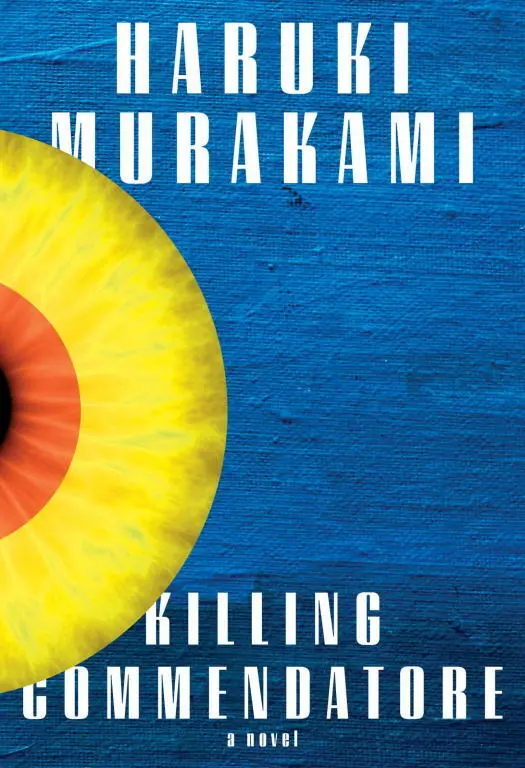
- Название:Killing Commendatore
- Автор:
- Издательство:Alfred A. Knopf
- Жанр:
- Год:2018
- Город:New York
- ISBN:978-0-5255-2005-4
- Рейтинг книги:5 / 5. Голосов: 1
-
Избранное:Добавить в избранное
- Отзывы:
-
Ваша оценка:
Killing Commendatore: краткое содержание, описание и аннотация
Предлагаем к чтению аннотацию, описание, краткое содержание или предисловие (зависит от того, что написал сам автор книги «Killing Commendatore»). Если вы не нашли необходимую информацию о книге — напишите в комментариях, мы постараемся отыскать её.
In Killing Commendatore, a thirty-something portrait painter in Tokyo is abandoned by his wife and finds himself holed up in the mountain home of a famous artist, Tomohiko Amada. When he discovers a previously unseen painting in the attic, he unintentionally opens a circle of mysterious circumstances. To close it, he must complete a journey that involves a mysterious ringing bell, a two-foot-high physical manifestation of an Idea, a dapper businessman who lives across the valley, a precocious thirteen-year-old girl, a Nazi assassination attempt during World War II in Vienna, a pit in the woods behind the artist’s home, and an underworld haunted by Double Metaphors.
A tour de force of love and loneliness, war and art—as well as a loving homage to The Great Gatsby—Killing Commendatore is a stunning work of imagination from one of our greatest writers.
Killing Commendatore — читать онлайн бесплатно полную книгу (весь текст) целиком
Ниже представлен текст книги, разбитый по страницам. Система сохранения места последней прочитанной страницы, позволяет с удобством читать онлайн бесплатно книгу «Killing Commendatore», без необходимости каждый раз заново искать на чём Вы остановились. Поставьте закладку, и сможете в любой момент перейти на страницу, на которой закончили чтение.
Интервал:
Закладка:
Masahiko called Friday night to say he was coming the next afternoon. He’d buy fresh fish from the market nearby, so I needn’t worry about dinner. I could look forward to a special treat.
“Anything more I should bring?” he asked. “I can pick up what you want on my way.”
“Can’t think of anything,” I answered. Then I remembered. “Now that you mention it, I’m out of whiskey. A friend and I polished off what you brought last time. Could you pick up another bottle? Any brand is okay.”
“I like Chivas myself. Would that do?”
“You bet,” I said. Masahiko had always been picky about food and drink. I was a different story. I ate and drank whatever was put in front of me.
When our phone call ended, I went to the studio, took Killing Commendatore down from the wall, carried it to my bedroom, and covered it. It wouldn’t do to have Tomohiko Amada’s son see the painting his father had hidden in the attic. For the time being, at least.
Now a visitor to the studio would see only A Portrait of Mariye Akikawa and The Pit in the Woods . I stood there looking back and forth at the two works in progress, comparing them. An image rose to my mind: I could see Mariye walking behind the shrine to the pit. I had a distinct sense that something might begin then. The lid was half open. The darkness was calling. Was Long Face there waiting for her? Or the Commendatore?
Could these two paintings be connected in some way?
Since moving to this house, I had been painting almost nonstop. I had completed Menshiki’s portrait on commission, then started The Man with the White Subaru Forester (brought to a halt when I had just begun to add color), and now was working on A Portrait of Mariye Akikawa and The Pit in the Woods in tandem. It struck me that the four paintings might fit together to form the beginning of a story of some kind.
Then again, perhaps I was documenting the story through my painting. That’s what it felt like, anyway. Had someone given me the role or the right to be that chronicler? If so, who ? Why was I chosen, of all people?
Masahiko’s black Volvo station wagon came trundling up the slope shortly before four o’clock on Saturday afternoon. He loved the toughness and reliability of those old boxy cars. He’d driven this one seemingly forever, put a ton of miles on it, yet showed no inclination to trade it in for a new one. On this occasion, he brought along the special carving knife he used for fish. As always, it was razor sharp. In my kitchen, he used it to prepare the large, fresh sea bream he had just bought in Itoh. Masahiko had always been good with his hands, a man of many talents. Without a wasted motion, he filleted the fish, sliced the flesh into sashimi, and boiled the bones for broth. He lightly grilled the skin to nibble on with our drinks. I just stood there, enjoying the show. Who knows, he might have been a famous chef had he taken that route.
“Actually, it’s best to let sashimi sit a day until the flesh softens and the flavor comes out, but what the hell,” he said, deftly plying the knife. “You can handle it, right?”
“No problem—I’m not picky,” I said.
“You can eat any leftovers tomorrow.”
“Will do.”
“Hey, do you mind if I crash here tonight?” Masahiko asked. “I’d like to stay the evening so we can hang out and drink without feeling rushed. Drinking and driving is no good, right? I can sleep on the sofa in the living room.”
“Sure,” I said. “It’s your house, after all. Stay as long as you like.”
“Are you sure some woman won’t show up in the middle of the night?”
“No plans as of now,” I replied, shaking my head.
“Okay, then I’ll stay.”
“You don’t have to crash on the sofa—there’s a bed in the guest room.”
“No, I prefer the sofa. It’s a lot more comfortable than it looks. Slept like a baby on it back in the old days.”
He pulled out a bottle of Chivas Regal, cut the seal, and opened it. I brought ice from the refrigerator and two glasses. The gurgle of whiskey pouring into the glass was music to my ears. Like an old friend opening his heart to me. We sipped the whiskey as we finished preparing dinner.
“It’s been a hell of a long time since you and I drank like this,” Masahiko said.
“It sure feels that way. I remember us putting back a lot.”
“ I put back a lot, you mean,” he said. “You never drank that much.”
I laughed. “Maybe not from your point of view, but it was a lot for me.”
I never got totally drunk. I always fell asleep first. But he was a different kind of drinker. Once he settled in for the long haul, he went all the way.
We sat across from each other at the table, sipping whiskey and eating the seafood. For starters, we shared the eight raw oysters he had bought with the sea bream. Then we dug into the sashimi. It was a bit too firm, as he had predicted, but it was delicious nonetheless, especially with the whiskey. By the end, we had polished it all off. We were already pretty full. The only other food was the crispy fish skin, small chunks of wasabi mixed with sake lees, and a dish of tofu. We topped off the meal with the soup he had prepared.
“I haven’t had a feast like this in ages,” I said.
“You can’t eat like this in Tokyo,” he said. “Living around here wouldn’t be half bad. Fresh fish anytime.”
“I bet you’d find life here boring eventually, though.”
“Are you bored?”
“Am I? I guess I’ve never found boredom that painful. And besides, there’s quite a lot going on here.”
That was for sure. I had met Menshiki soon after my arrival in early summer, we had dug up the pit behind the shrine, then the Commendatore had made his appearance, and finally Mariye Akikawa and her aunt Shoko had entered my life. I had a girlfriend, a housewife in her sexual prime, who came to comfort me. Tomohiko Amada’s living spirit had paid me a visit. There was hardly time to be bored.
“I might not be bored here either,” Masahiko said. “Did you know I used to be into surfing? I rode the waves all up and down this coast.”
That was news to me, I told him. He’d never mentioned it before.
“I’ve been thinking of leaving Tokyo, of going back to that kind of life. I’d check out the ocean when I woke up, then grab my board and head out if the surf was up.”
The idea of that kind of life left me cold.
“What about your job?” I asked.
“I only need to go to Tokyo twice a week to take care of business. Most of my work is done on computer anyway, so it wouldn’t be that hard to live outside the city. The world’s changing, right?”
“I wouldn’t know.”
He looked at me in amazement. “This is the twenty-first century, man. Haven’t you heard?”
“I’ve heard talk.”
After dinner, we moved to the living room to continue drinking. Autumn was almost over, but it wasn’t so cold that we needed to light a fire.
“So then, how’s your father doing these days?” I asked.
Masahiko let out a small sigh. “Same as always. His mind is shot. Can’t tell the difference between his balls and a pair of eggs.”
“If it breaks when you drop it, it’s an egg,” I said.
He laughed. “People are strange creatures, aren’t they? I mean, my father was as solid as a rock until just a few years ago. Mind as clear as the night sky in winter. To an almost disgusting degree. And now his memory is like a black hole. This dark, unfathomable hole that popped up out of nowhere in the middle of the cosmos.”
Masahiko shook his head.
“Who was it that said, ‘The greatest surprise in life is old age’?” he asked.
Читать дальшеИнтервал:
Закладка:
Похожие книги на «Killing Commendatore»
Представляем Вашему вниманию похожие книги на «Killing Commendatore» списком для выбора. Мы отобрали схожую по названию и смыслу литературу в надежде предоставить читателям больше вариантов отыскать новые, интересные, ещё непрочитанные произведения.






Обсуждение, отзывы о книге «Killing Commendatore» и просто собственные мнения читателей. Оставьте ваши комментарии, напишите, что Вы думаете о произведении, его смысле или главных героях. Укажите что конкретно понравилось, а что нет, и почему Вы так считаете.