Харуки Мураками - Killing Commendatore
Здесь есть возможность читать онлайн «Харуки Мураками - Killing Commendatore» весь текст электронной книги совершенно бесплатно (целиком полную версию без сокращений). В некоторых случаях можно слушать аудио, скачать через торрент в формате fb2 и присутствует краткое содержание. Город: New York, Год выпуска: 2018, ISBN: 2018, Издательство: Alfred A. Knopf, Жанр: Современная проза, на английском языке. Описание произведения, (предисловие) а так же отзывы посетителей доступны на портале библиотеки ЛибКат.
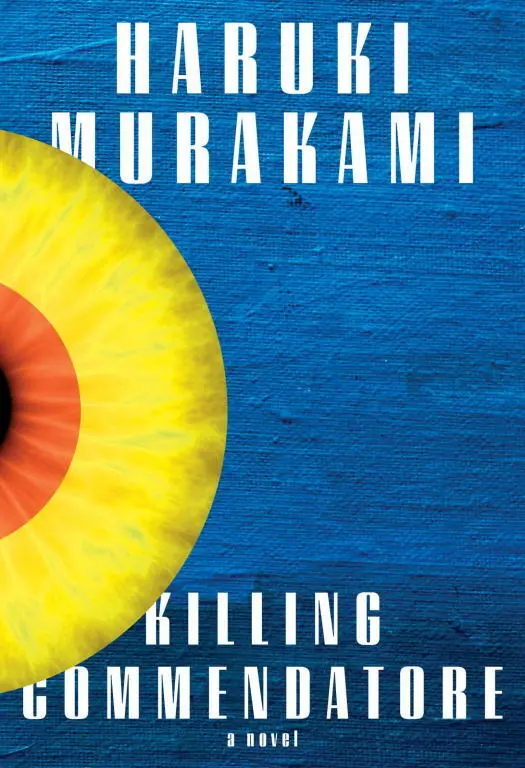
- Название:Killing Commendatore
- Автор:
- Издательство:Alfred A. Knopf
- Жанр:
- Год:2018
- Город:New York
- ISBN:978-0-5255-2005-4
- Рейтинг книги:5 / 5. Голосов: 1
-
Избранное:Добавить в избранное
- Отзывы:
-
Ваша оценка:
Killing Commendatore: краткое содержание, описание и аннотация
Предлагаем к чтению аннотацию, описание, краткое содержание или предисловие (зависит от того, что написал сам автор книги «Killing Commendatore»). Если вы не нашли необходимую информацию о книге — напишите в комментариях, мы постараемся отыскать её.
In Killing Commendatore, a thirty-something portrait painter in Tokyo is abandoned by his wife and finds himself holed up in the mountain home of a famous artist, Tomohiko Amada. When he discovers a previously unseen painting in the attic, he unintentionally opens a circle of mysterious circumstances. To close it, he must complete a journey that involves a mysterious ringing bell, a two-foot-high physical manifestation of an Idea, a dapper businessman who lives across the valley, a precocious thirteen-year-old girl, a Nazi assassination attempt during World War II in Vienna, a pit in the woods behind the artist’s home, and an underworld haunted by Double Metaphors.
A tour de force of love and loneliness, war and art—as well as a loving homage to The Great Gatsby—Killing Commendatore is a stunning work of imagination from one of our greatest writers.
Killing Commendatore — читать онлайн бесплатно полную книгу (весь текст) целиком
Ниже представлен текст книги, разбитый по страницам. Система сохранения места последней прочитанной страницы, позволяет с удобством читать онлайн бесплатно книгу «Killing Commendatore», без необходимости каждый раз заново искать на чём Вы остановились. Поставьте закладку, и сможете в любой момент перейти на страницу, на которой закончили чтение.
Интервал:
Закладка:
The path came to an abrupt end at a small, circular clearing. The overhanging trees thinned out, so I could see pieces of sky. I found a flat stone bathed in a small pool of light, sat down, and looked through the tree trunks at the valley below. I imagined that at any minute Mariye might pop up out of her secret passageway, wherever that was. But of course no one appeared. My only companions were birds, who hopped from limb to limb and then flew off again. They moved about in pairs, each chirping loudly to let the other know where they were. I had once read an article describing how certain birds mate for life, and how when one died, the survivor spent the rest of their days alone. It goes without saying that they never had to sign and seal official divorce papers sent by certified mail from a lawyer’s office.
A truck selling fresh produce passed in the distance, its driver listlessly broadcasting his wares over its loudspeaker. No sooner was his voice out of earshot than there was a loud rustle in the bushes nearby. What was it? It didn’t sound human. A wild animal was more likely. For a scary second I thought it might be a wild boar (boars and hornets were the most dangerous things in the area), but then the sound abruptly stopped.
I stood up and started walking back to the house. When I passed the small shrine I checked the pit, just to make sure. The planks were in place, the stone weights neatly arranged on top. They hadn’t been moved, as far as I could tell. Fallen leaves covered the boards. They had lost their bright colors and turned sodden in the rain. So young and fresh in spring, their quiet death had come now, in late autumn.
As I stared at the planks, I began to feel that Long Face might poke his elongated, eggplant-shaped head out of the pit at any minute. But the planks didn’t budge. Obviously. Long Face’s hole was square, not round, and was smaller and more personal in scale. Moreover, this hole was home to the Commendatore, not Long Face. Or at least home to the Idea that had borrowed the Commendatore’s form. It had been the Commendatore that had rung the bell to call me here, and had made me open the pit.
Everything started with this pit. After Menshiki and I had pried open the lid with a backhoe, strange things had started happening one after another. Then again, it might have all begun when I had found Killing Commendatore in the attic and removed it from its packaging. That was the correct sequence. Or perhaps the two events acted in tandem. Killing Commendatore could have been what called the Idea to the house. The appearance of the Commendatore could have been my reward for liberating the painting. Try as I might, I couldn’t tell what was the cause, and what was the result.
Menshiki’s Jaguar was gone when I got back to the house. He had probably come by taxi to pick it up. Or else sent one of the people who worked for him to collect it. Whichever the case, my mud-spattered Toyota Corolla was left there, parked forlornly outside my front door. Menshiki had been right—I should check the tires one of these days, though I hadn’t bought an air pressure gauge and probably never would.
I went to the kitchen to start making lunch, but no sooner had I picked up a knife than I realized I was no longer ravenously hungry. Instead, I was very sleepy. I got a blanket, stretched out on the living room sofa, and promptly drifted off. I had a dream, a short one. It was clear and very vivid. But I couldn’t remember anything about it. Just that it was clear and vivid. It felt as though a fragment of real life had slipped into my sleeping mind by mistake. Then the moment I awoke, it fled like a quick-footed animal, leaving no trace behind.
42
IF IT BREAKS WHEN YOU DROP IT, IT’S AN EGG
The next week flew by. I spent my mornings focused on my painting, and my afternoons reading, taking walks, and doing whatever housework needed to be done. One day blended into the next. My girlfriend showed up on Wednesday and we spent the afternoon making love. The constant creaking of my old bed really cracked her up.
“It’s going to fall to pieces before long,” she predicted during a pause in our exertions. “There’ll be nothing left but splinters—we won’t be able to tell if they’re wood or pretzel sticks.”
“Maybe we should try to make love more quietly.”
“Maybe Captain Ahab should have hunted sardines,” she said.
I thought about that for a moment. “Are you saying some things in this world can’t be changed?”
“Kind of.”
A short time later, we were back on the rolling seas, in pursuit of the great white whale. Some things really can’t be changed so easily.
Each day, I worked a little on Mariye Akikawa’s portrait. My initial sketch had established the skeleton, and now I was filling it out. I tried combining various colors to come up with the right tone for the background. Her face had to sit naturally over that foundation. These tasks tided me over as I waited for her next visit to the studio on Sunday. Some parts of my job were carried out while the model was present, while other preparatory work had to be done before the model’s arrival. I loved both. I could take my time mulling over the various elements, and experiment to find just the right color, just the right style. I enjoyed the hands-on nature of this work, and the challenge of creating an environment from which the subject would spring to life.
While preparing Mariye’s portrait, I began working on a different canvas—a painting of the pit behind the shrine. The pit had etched itself in my mind with such force that I didn’t need it in front of me. I painted the scene in minute detail. The style was purely realistic, the viewpoint objective. I avoided objective representation in my art (except, of course, the portraits that were my “day job”), but that didn’t mean I couldn’t do it. When I wanted to, I could paint so precisely that the result could be mistaken for a photograph. I used that hyperrealistic style occasionally to change my mood, or refresh the fundamentals of my craft. I never showed those paintings to anyone, though—they were for my private enjoyment, nothing more.
In this way, the pit in the woods began to appear before me, more vivid and alive with each passing day. A mysterious round aperture half covered by thick planks. This was the pit that had given birth to the Commendatore. There were no human figures in the painting, however, just a black hole. Fallen leaves covered the earth surrounding it. A scene of perfect tranquility. Yet it felt as if someone (or something) might come crawling out of that hole any minute. The longer I pictured the scene, the stronger that premonition grew. Looking at it made my spine tingle, although I was the one who had painted it.
I worked like this every day, spending all morning alone in the studio. Palette and brush in hand, I moved back and forth between A Portrait of Mariye Akikawa and The Pit in the Woods —two more different paintings would be hard to imagine—as the mood struck me. I applied myself to the canvases while sitting on the same stool Tomohiko Amada had occupied in the dead of night the previous Sunday. Perhaps because my focus was so great, the dense presence I had felt the next morning had at some point disappeared. The old stool was once again a mere piece of furniture, there for my use. It seemed that Tomohiko Amada had gone back to where he belonged.
There were nights that week when I opened the studio door a crack to peek inside. But no one was ever there. Not Tomohiko Amada, not the Commendatore. Just an old stool parked in front of two easels. The moon cast its dim light over the objects in the room. All was quiet. Killing Commendatore hung on one wall. My unfinished work, The Man with the White Subaru Forester, was turned around so no one could see it. The two paintings I was working on, A Portrait of Mariye Akikawa and The Pit in the Woods, sat side by side on two easels. The smell of oil paint, turpentine, and poppyseed oil hung in the air. It never left, no matter how long the windows were left open. It was a special aroma, one I breathed every day, and would probably go on breathing for the rest of my life. I inhaled the air of the studio as if to confirm its presence, then quietly closed the door.
Читать дальшеИнтервал:
Закладка:
Похожие книги на «Killing Commendatore»
Представляем Вашему вниманию похожие книги на «Killing Commendatore» списком для выбора. Мы отобрали схожую по названию и смыслу литературу в надежде предоставить читателям больше вариантов отыскать новые, интересные, ещё непрочитанные произведения.







Обсуждение, отзывы о книге «Killing Commendatore» и просто собственные мнения читателей. Оставьте ваши комментарии, напишите, что Вы думаете о произведении, его смысле или главных героях. Укажите что конкретно понравилось, а что нет, и почему Вы так считаете.