Харуки Мураками - Killing Commendatore
Здесь есть возможность читать онлайн «Харуки Мураками - Killing Commendatore» весь текст электронной книги совершенно бесплатно (целиком полную версию без сокращений). В некоторых случаях можно слушать аудио, скачать через торрент в формате fb2 и присутствует краткое содержание. Город: New York, Год выпуска: 2018, ISBN: 2018, Издательство: Alfred A. Knopf, Жанр: Современная проза, на английском языке. Описание произведения, (предисловие) а так же отзывы посетителей доступны на портале библиотеки ЛибКат.
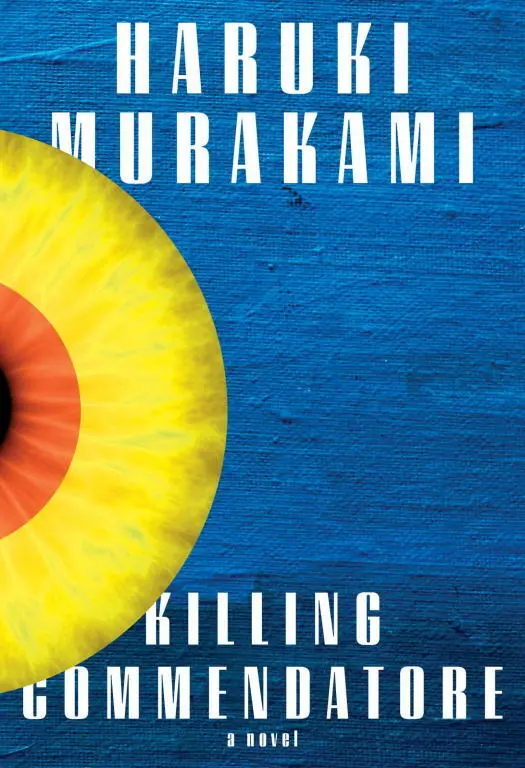
- Название:Killing Commendatore
- Автор:
- Издательство:Alfred A. Knopf
- Жанр:
- Год:2018
- Город:New York
- ISBN:978-0-5255-2005-4
- Рейтинг книги:5 / 5. Голосов: 1
-
Избранное:Добавить в избранное
- Отзывы:
-
Ваша оценка:
Killing Commendatore: краткое содержание, описание и аннотация
Предлагаем к чтению аннотацию, описание, краткое содержание или предисловие (зависит от того, что написал сам автор книги «Killing Commendatore»). Если вы не нашли необходимую информацию о книге — напишите в комментариях, мы постараемся отыскать её.
In Killing Commendatore, a thirty-something portrait painter in Tokyo is abandoned by his wife and finds himself holed up in the mountain home of a famous artist, Tomohiko Amada. When he discovers a previously unseen painting in the attic, he unintentionally opens a circle of mysterious circumstances. To close it, he must complete a journey that involves a mysterious ringing bell, a two-foot-high physical manifestation of an Idea, a dapper businessman who lives across the valley, a precocious thirteen-year-old girl, a Nazi assassination attempt during World War II in Vienna, a pit in the woods behind the artist’s home, and an underworld haunted by Double Metaphors.
A tour de force of love and loneliness, war and art—as well as a loving homage to The Great Gatsby—Killing Commendatore is a stunning work of imagination from one of our greatest writers.
Killing Commendatore — читать онлайн бесплатно полную книгу (весь текст) целиком
Ниже представлен текст книги, разбитый по страницам. Система сохранения места последней прочитанной страницы, позволяет с удобством читать онлайн бесплатно книгу «Killing Commendatore», без необходимости каждый раз заново искать на чём Вы остановились. Поставьте закладку, и сможете в любой момент перейти на страницу, на которой закончили чтение.
Интервал:
Закладка:
I didn’t really want to check the studio again. Of course, I was curious. Was Tomohiko Amada—or, more likely, his double—still there? Still sitting on his stool with his eyes riveted on Killing Commendatore ? Sure, the possibility intrigued me. I had encountered a most rare and precious event, had seen it with my own eyes. Might it provide the key—several keys, actually—to help unravel the secrets of Tomohiko Amada’s life?
All the same, I didn’t want to interfere with what he was doing. He had come so far, transcending space and reason, to reexamine his Killing Commendatore, poring over it to find—what? He had to have sacrificed much of his dwindling store of energy just to make it here. Drained his life force. Yet something had compelled him to return to the painting one last time, at whatever cost. To study it to his heart’s content.
When I opened my eyes it was already past ten o’clock. Rare for an early bird like me. I washed my face, brewed coffee, and ate breakfast. For some reason, I was famished. I ate nearly double my usual amount. Three slices of toast, two boiled eggs, and a tomato salad. Not to mention two big cups of coffee.
I checked the studio after breakfast just to be sure, but of course Tomohiko Amada was gone. What remained was the empty, silent room in the morning. An easel with a canvas (my painting of Mariye Akikawa), a round stool in front of it, and the straight-backed chair Mariye used when she posed for me. Killing Commendatore hanging on the wall. The bell still missing from the shelf. The sky over the valley blue, the air cold and crystal clear. The piercing calls of birds, awaiting winter’s arrival.
I picked up the phone and called Masahiko’s office. His voice was sleepy, though it was almost noon. A clear case of the Monday-morning blahs. After our hellos, I casually inquired about his father. I wanted to know if he had died, and if the apparition I had seen was his ghost. If Tomohiko Amada had passed away the night before, surely his son would have been notified.
“How’s your father?” I asked.
“I went to see him a few days ago. His mind has passed the point of no return, I’m afraid, but he’s all right physically, I guess. At least he doesn’t look like he’s at death’s door.”
So Tomohiko Amada was still alive. What I had seen wasn’t a ghost. It was the fleeting embodiment of a living person’s will.
“It’s a strange question, I know, but have you noticed anything unusual about your father recently?”
“My father?”
“Yeah.”
“Why do you want to know that all of a sudden?”
I followed the script I had prepared. “To tell the truth, I had this weird dream last night where your father visited this place. I bumped into him while he was here. It felt very real. Real enough to make me jump out of bed. That’s why I wondered if something had happened to him.”
“Wow,” he said. “That’s wild. What was my father doing while he was there?”
“He just sat on the stool in the studio.”
“That’s all?”
“That’s it. Nothing but that.”
“By stool you mean that old three-legged chair, the round one?”
“Yeah, that’s the one.”
Masahiko thought for a moment.
“Maybe he is reaching the end,” he said in a flat voice. “They say that in our last hours, our spirit returns to where we feel we’ve left something undone. From what I know of my father, that would be the studio.”
“But from what you’ve told me, he has no memory left.”
“Yes, memory in the conventional sense, anyway. But his spirit’s still there. His brain just can’t access it any longer. The circuit’s broken—his mind isn’t connected. But his spirit remains, behind the scenes. It’s probably the same as ever.”
“That makes sense,” I said.
“Weren’t you scared?”
“By the dream?”
“Yeah. I mean it sounds awfully real.”
“No, I wasn’t afraid. But it did feel very strange. Like the man himself was right there.”
“Maybe it really was him,” Masahiko said.
I didn’t say anything. I couldn’t let on that Tomohiko Amada had likely returned specifically to view Killing Commendatore (actually, I might have invited him—had I not unwrapped the painting, he might not have shown up). If I told his son, I would have had to explain the whole story, from the moment I stumbled across the painting in the attic to when I opened it without permission and, even more blatantly, chose to hang it on the studio wall. I knew I would have to let Masahiko know eventually, but I didn’t want to raise the issue at this juncture.
“Anyway,” he said, “last time we met I mentioned there was a matter I needed to talk to you about? But we didn’t have enough time then. Remember?”
“Yeah.”
“So why don’t I stop by one of these days and fill you in. Okay?”
“This house is yours, you know. Come whenever you like.”
“How about this weekend? I’m thinking of visiting my father in Izu Kogen, so I could stop by on my trip back. It’s right on the way.”
I told him he was welcome anytime except Wednesday and Friday nights and Sunday morning. My art class was on Wednesday and Friday and Mariye’s sitting was on Sunday.
He figured he’d be able to make it Saturday night. “I’ll let you know beforehand,” he said.
After our phone call, I went into the studio and sat on the stool. The wooden stool that Tomohiko Amada had occupied the night before. As soon as I sat down, it hit me—this stool was no longer mine . No, the long years Tomohiko Amada had spent sitting on it painting made it his, now and forever. To the uninformed, it looked like no more than an old dinged-up, three-legged chair, but it was infused with his will. I had borrowed it without permission, that was all.
I sat there and studied Killing Commendatore on the wall, as I had done countless times before. It rewarded multiple viewings—its depth allowed for so many different ways of looking at it. This time, though, I felt I wanted to inspect it from an entirely new angle. What was there that had made Tomohiko Amada return to it at the end of his life, to see it one last time?
I spent a long time sitting there, just studying the painting. I chose the same position, the same angle, even adopted the same posture that Tomohiko Amada’s living spirit or alter ego had taken the night before, and tried to focus on it with the same intense concentration. Yet I couldn’t find that something I had previously missed.
When I grew tired of thinking, I went outside. Menshiki’s silver Jaguar was still parked in front of my house, at a slight remove from my Toyota Corolla station wagon. It had been sitting there all night, waiting quietly for its master’s return, like an intelligent, well-trained pet.
I strolled on past the house, musing about Killing Commendatore in a vague sort of way. Walking the little path through the woods, I had the distinct impression that someone was spying on me from behind. As if Long Face had pushed up the square lid of his hole and was secretly observing me from the corner of the painting. I whipped around and looked back. But nothing was to be seen. No hole in the ground, no Long Face. Just a deserted leaf-strewn path wending through the quiet woods. This pattern repeated itself a number of times. But each time I spun around no one was there.
Then again, it might well be that the hole and Long Face were there only as long as I didn’t turn around . Perhaps they could tell when I was about to look back, and hid themselves at that moment. Like a child playing a game.
I passed through the woods to the very end of the path, the first time I’d gone that far. I figured the entrance to Mariye’s secret passageway had to be nearby. Yet I couldn’t locate it. “You really have to pay attention to find it,” she had said, and it did seem to be well camouflaged. In any case, she had taken the passageway after dark to reach my place from the adjoining mountain, alone and on foot. Past the thickets and through the woods.
Читать дальшеИнтервал:
Закладка:
Похожие книги на «Killing Commendatore»
Представляем Вашему вниманию похожие книги на «Killing Commendatore» списком для выбора. Мы отобрали схожую по названию и смыслу литературу в надежде предоставить читателям больше вариантов отыскать новые, интересные, ещё непрочитанные произведения.





Обсуждение, отзывы о книге «Killing Commendatore» и просто собственные мнения читателей. Оставьте ваши комментарии, напишите, что Вы думаете о произведении, его смысле или главных героях. Укажите что конкретно понравилось, а что нет, и почему Вы так считаете.