Харуки Мураками - Killing Commendatore
Здесь есть возможность читать онлайн «Харуки Мураками - Killing Commendatore» весь текст электронной книги совершенно бесплатно (целиком полную версию без сокращений). В некоторых случаях можно слушать аудио, скачать через торрент в формате fb2 и присутствует краткое содержание. Город: New York, Год выпуска: 2018, ISBN: 2018, Издательство: Alfred A. Knopf, Жанр: Современная проза, на английском языке. Описание произведения, (предисловие) а так же отзывы посетителей доступны на портале библиотеки ЛибКат.
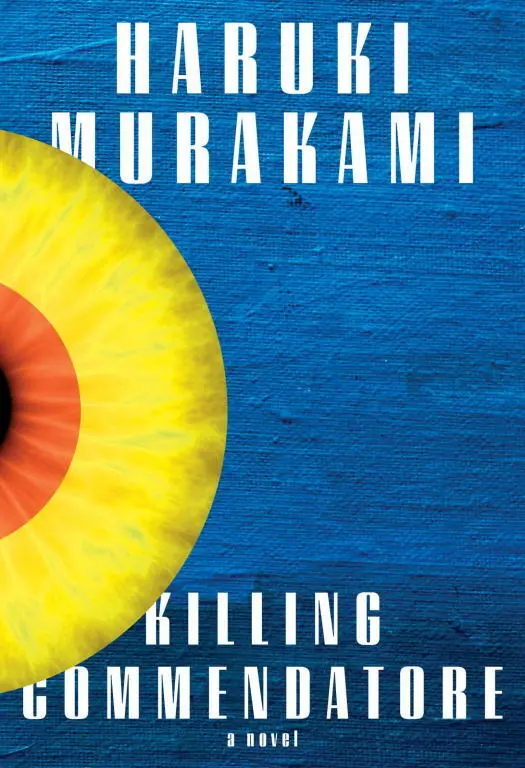
- Название:Killing Commendatore
- Автор:
- Издательство:Alfred A. Knopf
- Жанр:
- Год:2018
- Город:New York
- ISBN:978-0-5255-2005-4
- Рейтинг книги:5 / 5. Голосов: 1
-
Избранное:Добавить в избранное
- Отзывы:
-
Ваша оценка:
Killing Commendatore: краткое содержание, описание и аннотация
Предлагаем к чтению аннотацию, описание, краткое содержание или предисловие (зависит от того, что написал сам автор книги «Killing Commendatore»). Если вы не нашли необходимую информацию о книге — напишите в комментариях, мы постараемся отыскать её.
In Killing Commendatore, a thirty-something portrait painter in Tokyo is abandoned by his wife and finds himself holed up in the mountain home of a famous artist, Tomohiko Amada. When he discovers a previously unseen painting in the attic, he unintentionally opens a circle of mysterious circumstances. To close it, he must complete a journey that involves a mysterious ringing bell, a two-foot-high physical manifestation of an Idea, a dapper businessman who lives across the valley, a precocious thirteen-year-old girl, a Nazi assassination attempt during World War II in Vienna, a pit in the woods behind the artist’s home, and an underworld haunted by Double Metaphors.
A tour de force of love and loneliness, war and art—as well as a loving homage to The Great Gatsby—Killing Commendatore is a stunning work of imagination from one of our greatest writers.
Killing Commendatore — читать онлайн бесплатно полную книгу (весь текст) целиком
Ниже представлен текст книги, разбитый по страницам. Система сохранения места последней прочитанной страницы, позволяет с удобством читать онлайн бесплатно книгу «Killing Commendatore», без необходимости каждый раз заново искать на чём Вы остановились. Поставьте закладку, и сможете в любой момент перейти на страницу, на которой закончили чтение.
Интервал:
Закладка:
The night air was chilly. The leafless branches quivered in the wind. I went back to the living room and sat down.
“Can you forgive me?”
“It’s not like you meant to hurt me,” I said, shaking my head.
“I for one am sorry it turned out this way. You and Yuzu looked so well matched, and you seemed happy together. It’s sad that it fell apart.”
“You drop them both—the one that breaks is the egg,” I said.
Masahiko laughed weakly. “So how are things now? Is there a woman in your life?”
“Yeah, there’s someone.”
“But not the same as Yuzu?”
“It’s different. I’ve been looking for the same thing in women my whole life. Whatever that is, Yuzu had it.”
“And you can’t find that in anyone else?”
“Not so far,” I said, shaking my head again.
“You have my sympathy,” Masahiko said. “So what is it exactly that you’ve been looking for?”
“It’s hard to put into words. I feel as if I lost track of something along the way, and have been searching for it ever since. Don’t you think that’s how everyone falls in love?”
“I don’t think you can say ‘everyone,’” he said with a slight frown. “You may actually be in the minority. But if you can’t find the right words, why not paint it? You are an artist, after all.”
“If you can’t say it, paint it. That’s easy to say. Not so easy to do, though.”
“But it may be important to try, don’t you think?”
“And perhaps Captain Ahab should have set out after sardines.”
Masahiko laughed. “Sure, from a safety standpoint. But that’s not how art is born.”
“Hey, give me a break. Mention art, and the conversation comes to a screeching halt.”
“Looks like we need some more whiskey,” he said, shaking his head. He poured us another drink.
“I can’t drink too much. I’ve got to work tomorrow morning.”
“Tomorrow is tomorrow. Today is all we have right now,” Masahiko said.
I found this idea strangely compelling.
“Can I ask you a favor?” I said to Masahiko. Our conversation was wrapping up, and we were about to get ready for bed. The hands on the clock pointed to a little before eleven.
“Sure, anything at all.”
“I’d like to meet your father. Could you take me with you the next time you go to Izu?”
Masahiko regarded me as he might a strange animal. “You want to meet my father?”
“If it’s not too much trouble.”
“It’s no trouble at all. But my father’s in no shape to talk to you. He’s quite incoherent. His mind is chaotic—a mud swamp, really. So if you have any expectations—if you’re hoping to gain some insight into the person known as Tomohiko Amada—you’ll only be disappointed.”
“No, I’m not expecting anything like that. I just want to take one good look at him, that’s all.”
“But why?”
I took a breath and looked around the room. “I’ve been living in this house for six months now,” I said. “Sitting on the stool he sat on, painting in his studio. Eating off his dishes, listening to his records. I feel his presence all over the place. That’s why I have to meet the flesh-and-blood Tomohiko Amada. Once is enough. It doesn’t matter a bit if we can’t talk to each other.”
“Then it’s all right,” Masahiko said, seemingly persuaded. “He won’t be thrilled to see you, but he won’t be ticked off either. He can’t tell one person from another, you see. So there’s no problem if you come along. I plan to visit the nursing home again pretty soon. According to the doctor, he doesn’t have much longer—the end could come at any time. So join me on my next visit, if you’re free.”
I brought a spare blanket, pillow, and futon and made up a bed on the sofa in the living room. I looked around the room to make sure the Commendatore wasn’t there. If Masahiko woke up in the middle of the night and saw him—two feet tall and dressed in ancient Asuka garb—he’d freak out. He’d figure he had become a real alcoholic.
Besides the Commendatore, there was The Man with the White Subaru Forester to worry about. I had turned the painting around so no one could see it. Still, I had no idea what strangeness might happen without my knowledge in the middle of the night.
So I wasn’t kidding when I wished Masahiko a sound sleep.
I gave him a spare pair of pajamas to wear. He and I were more or less the same size, so there was no problem with the fit. He took off his clothes, put on the pajamas, and climbed under the bedding I had laid out. The air in the room was a bit chilly, but he looked snug and warm under the covers.
“You’re sure you’re not angry?” he asked before I left.
“No, I’m not angry,” I answered.
“It must hurt a little, though.”
“Maybe a little.” I had the right to be a little hurt, I thought.
“But the cup is still one-sixteenth full.”
“You’ve got it there,” I said.
I turned off the living room light and retired to my bedroom. Before long I had fallen asleep, together with my slightly wounded feelings.
43
IT COULDN’T END LIKE ANY OTHER DREAM
When I woke it was already light outside. Thin gray clouds covered the sky from end to end, but the sun’s benevolent rays still quietly filtered through. It was not quite seven.
I washed my face, turned on the coffee maker, and went to check the living room. Wrapped in blankets, Masahiko was fast asleep on the sofa. He appeared unlikely to wake up any time soon. The almost empty bottle of Chivas Regal sat on the table. I managed to tidy up the bottle and glasses without disturbing him.
I must have drunk quite a lot the night before, but I wasn’t a bit hungover. My mind was as sharp as it was every morning. No heartburn, either. I’ve never had a hangover in my life. Why, I don’t know. Probably it’s just the way I was born. One night’s sleep and all traces of alcohol vanish from my system, however much I drink. I eat breakfast and I’m ready to go.
I toasted two slices of bread, fried two eggs, and ate them while listening to the news and weather on the radio. The stock market was fluctuating wildly, a new parliamentary scandal had been uncovered, and a terrorist bombing in the Middle East had killed and wounded many people. Nothing to brighten my day. Yet none of these events was likely to affect my immediate circumstances. For now, at least, they were limited to distant places and people I had never met. I felt bad, but there was nothing I could do. The weather forecast promised nothing new either. Not a particularly gorgeous day, but not particularly awful either. Overcast, but no rain. Maybe not, anyway. But the forecasters and media types were clever—they never used vague words like “maybe.” No, they stuck with convenient terms for which no one could be held accountable, like “probability of precipitation.”
When the news and weather ended, I turned off the radio and cleaned up the breakfast dishes. Then I sat down again at the table, drank a second cup of coffee, and thought. Most people would have used that time to read the Sunday paper, but I didn’t subscribe. So I just sipped my coffee, looked at the magnificent willow tree outside the window, and thought.
First, I thought about my wife, who, I had been told, was about to give birth. Then it hit me—she wasn’t my wife any longer. No connection between us remained. Not contractual, not personal. From where she stood, I was now in all likelihood a virtual stranger, a person of no special consequence. It felt weird. Until a few months ago we had eaten breakfast together, shared the same soap and towel, walked around naked in front of each other, slept in the same bed. Now our lives bore no relationship to each other.
Читать дальшеИнтервал:
Закладка:
Похожие книги на «Killing Commendatore»
Представляем Вашему вниманию похожие книги на «Killing Commendatore» списком для выбора. Мы отобрали схожую по названию и смыслу литературу в надежде предоставить читателям больше вариантов отыскать новые, интересные, ещё непрочитанные произведения.






Обсуждение, отзывы о книге «Killing Commendatore» и просто собственные мнения читателей. Оставьте ваши комментарии, напишите, что Вы думаете о произведении, его смысле или главных героях. Укажите что конкретно понравилось, а что нет, и почему Вы так считаете.