Joanna Rakoff - A Fortunate Age
Здесь есть возможность читать онлайн «Joanna Rakoff - A Fortunate Age» весь текст электронной книги совершенно бесплатно (целиком полную версию без сокращений). В некоторых случаях можно слушать аудио, скачать через торрент в формате fb2 и присутствует краткое содержание. Город: London, Год выпуска: 2015, ISBN: 2015, Издательство: Bloomsbury, Жанр: Современная проза, на английском языке. Описание произведения, (предисловие) а так же отзывы посетителей доступны на портале библиотеки ЛибКат.
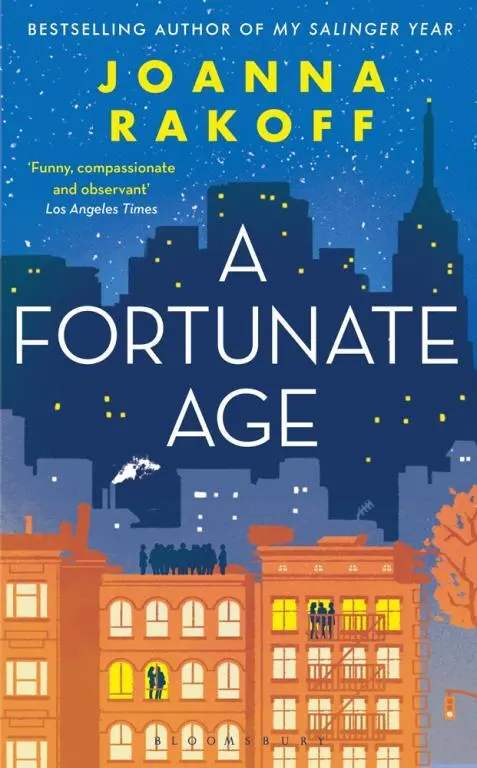
- Название:A Fortunate Age
- Автор:
- Издательство:Bloomsbury
- Жанр:
- Год:2015
- Город:London
- ISBN:978-1-4088-6239-1
- Рейтинг книги:4 / 5. Голосов: 1
-
Избранное:Добавить в избранное
- Отзывы:
-
Ваша оценка:
A Fortunate Age: краткое содержание, описание и аннотация
Предлагаем к чтению аннотацию, описание, краткое содержание или предисловие (зависит от того, что написал сам автор книги «A Fortunate Age»). Если вы не нашли необходимую информацию о книге — напишите в комментариях, мы постараемся отыскать её.
When the group come together to celebrate a marriage, anything seems possible. But soon the reality of rent, marriage and family will test them all. For this fortunate age can’t last for ever, and the group must face adulthood, whether they are ready for it or not.
Sprawling and richly drawn, A Fortunate Age traces the lives of the group during some of the most defining years of modern America—from the decadence of the dot com boom through to the sobering events of September 11 and the trailing years that followed—this brilliant, ambitious debut novel perfectly captures the hopes, anxieties and dreams of a generation.
A Fortunate Age — читать онлайн бесплатно полную книгу (весь текст) целиком
Ниже представлен текст книги, разбитый по страницам. Система сохранения места последней прочитанной страницы, позволяет с удобством читать онлайн бесплатно книгу «A Fortunate Age», без необходимости каждый раз заново искать на чём Вы остановились. Поставьте закладку, и сможете в любой момент перейти на страницу, на которой закончили чтение.
Интервал:
Закладка:
There was truth to this. In the evenings, after she put Jack to bed, she felt almost giddy with freedom: She could take a bath! Eat cookies for dinner! Get into bed at eight o’clock and read, just as she’d done when she was single, in her little apartment on Baltic Street, but better , for then she’d always been consumed with work, with the endless piles of manuscripts to edit.
But on this June morning, as she deposited Jack in a swing and gave him a push, the evening and its small luxuries seemed very far away. Ed would be gone for four months, an inconceivable amount of time. She’d slept badly, anxious about Ed’s travel, anxious about the months without him, months of picking up the milk and purchasing birthday gifts, and doing the laundry, the endless laundry, and generally managing everything alone, and as she lifted Jack into the swing and gave him a push, she found herself prey to self-pity, an increasingly common phenomenon. The older Jack got, the more she realized that the difficulties of being alone with him for such long stretches were larger than just the everyday hassles: each day, she faced a million tiny choices—choices that would affect who Jack would become and how he regarded the world—and each day the repercussions of those choices grew larger and larger, swelling inside her head like a sponge, absorbing the material around it. Would she let him watch television? Eat candy? Drink juice? Wear the obnoxiously boyish clothing—with plasticky renderings of basketballs and trucks—purchased for him by her mother? Take a bath with her, now that he was more a boy and less a baby? And the smaller, more subtle things, too: if she grew impatient with him, if she snapped at Ed on the phone, if she seemed sad or angry or depressed. All of these things could somehow damage her son’s psyche. Or had she absorbed too much of the rhetoric of the mommies’ group? She should, perhaps, have gone with Ed.
“Down,” Jack said now, thrusting one sturdy arm out in front of him, like a little commandant. “Ga!” He’d barely been in the swing five minutes.
“You want to come out?” she asked doubtfully.
“ Yes ,” he said, tossing his arm out again. “Mama! Ga!” His eyes, she saw, were rimmed with red. Like her, he’d slept badly the night before. Today, she’d put him down for his nap early, before noon. “Mama, ga !” he said a third time, as an enormous blue pram materialized in front of the gate that led into the baby swings. At the helm of this outsized device stood a short young woman, her eyes covered in trendily large sunglasses, her diminutive form dwarfed by the girth of her haul, which she was having trouble maneuvering through the narrow entryway.
“Let me help you,” said Sadie, striding over and holding the door open.
“Mama!” Jack called.
“Mama will be right back, sweetie.” Awkwardly, the small woman attempted to guide the stroller past Sadie.
“Thanks,” she said irritably. “Could you hold my coffee?” She pulled off her sunglasses with a noisy clack—revealing the small, sharp face of Caitlin Green-Gold. Caitlin had changed. Her hair was blonde and her arms, which were bare, were sheathed in ropy muscles and tanned to fine cocoa. She wore a plain black dress, of matte jersey, in the wraparound style. On her left hand sat a disarmingly huge diamond embedded in the chunky platinum confines of a Tiffany Etoile band, much disparaged by Rose (“It’s masculine ”), who had been known to while away an afternoon expounding on the hideousness of Tiffany’s recent inventions.
“Caitlin,” said Sadie. “Do you live down here now? Wait, sorry”—she jogged a few steps back toward Jack, who was trying to fling himself out of the swing—“let me get this boy down.” Freed, Jack ran through the gate and off toward the slide, now abandoned by Ava, Sophia, and Maude. “Sorry,” she said to Caitlin. She was unsettled to find that she was glad to see her. “Do you mind chasing after him with me?”
“No,” said Caitlin. “We can sit down over there.”
“We can try.”
“So, that’s Jack, right?” said Caitlin, once they were installed on the bench under the fig trees, Jack occupied—if only momentarily—with the captain’s wheel atop the play structure.
“Yes,” said Sadie. “And this is…”
“Oh,” rasped Caitlin distractedly, as if she’d forgotten the contents of her stroller. “Ismael.” By rote, she pushed back the canopy to reveal the infant’s sleeping face, which was a lovely pale brown color.
“He’s beautiful,” said Sadie honestly. He had a long, attractive nose, rather than the usual infant gumdrop, and a head of wispy black ringlets. “How old is he?”
“Eight weeks. And Jack’s two?” Sadie nodded. “I heard about it from Lil. She was so jealous.”
“He’ll be two in August,” said Sadie, deciding that she would not be baited into talking about Lil.
“Is he going to school in the fall?” asked Caitlin. Sadie sighed. She’d been getting this question a lot lately. The mothers in the neighborhood—like the mothers of middle-class New York, in general—were single-minded in their pursuit of the perfect preschool, and the process of getting their Zoes and Maxes into it. Ava and Maude and Sophia, of course, were all going to school in the fall, and Sadie had listened wearily as their mothers detailed the chosen institutions’ educational philosophies and the celebrities with kids on the rosters.
“I don’t think so,” said Sadie. “I think we’re not going to send him until he’s four, when he can go to public pre-K. But we haven’t really talked about it much.” It was true. Somehow, they never had time.
“ Four ,” rasped Caitlin.
“Yeah, we just felt like he has the rest of his life to be in school. He can spend a few years at home with his parents.” There was also the fact that they couldn’t quite afford it.
“Oh,” said Caitlin, in such a way that it was clear she felt this to be utter nonsense. “So you both work at home now?”
Sadie sighed. Caitlin had not changed. She still traded on forced intimacies. As always, she’d proceeded right to the heart of the matter—that is, asked a leading question. For surely she knew, from Lil—who knew from Emily and Beth and Dave—that Ed was often away. “No, I stay at home with Jack. Ed’s a filmmaker, a producer.” She still felt odd, pretentious, saying this. It sounded so glamorous, so West Coast, though the reality was ludicrously far from it.
“I know,” said Caitlin. “I saw Command Enter .” She did not say whether she liked it or not, which, Sadie thought, was either an indication that she hadn’t or a Caitlin-style calculation, meant to keep Sadie on her guard. “What’s he doing now?”
“Actually, he just left this morning on a big shoot.”
“Where?”
“Bosnia. He’ll be gone for a few months.”
This seemed, strangely, to impress Caitlin. “Wow, but that’s rough. I start losing my mind if I’m alone with Ish for more than a few hours. But I guess it gets more fun when they’re older.”
“It does,” said Sadie, though she’d found those early months enjoyable, too, in a very different way. “Sorry, hold on—” She ran over to the play structure, where Jack stood at the edge of a too-high drop. “Jack, come to Mama,” she said, positioning herself by the toddler slide, which he promptly shot himself down, landing at her feet.
“Do you miss your job?” asked Caitlin. And though this question followed the line of their conversation, Sadie still felt somewhat startled by it. None of her friends had asked her this, not directly, nor had they questioned her when she’d decided that she couldn’t go back—or, rather, that she couldn’t stay. For she had gone back, when Jack was four months old, and stayed for three days, weeping into the phone, as the nanny—pretty, devout, with the lilting tones of the Caribbean—complained that Jack wouldn’t take the bottle (“I’ll just give him the formula, okay? Maybe he like that better”; “No!”) and Jack himself screamed. “Do you think you’ll go back?”
Читать дальшеИнтервал:
Закладка:
Похожие книги на «A Fortunate Age»
Представляем Вашему вниманию похожие книги на «A Fortunate Age» списком для выбора. Мы отобрали схожую по названию и смыслу литературу в надежде предоставить читателям больше вариантов отыскать новые, интересные, ещё непрочитанные произведения.










Обсуждение, отзывы о книге «A Fortunate Age» и просто собственные мнения читателей. Оставьте ваши комментарии, напишите, что Вы думаете о произведении, его смысле или главных героях. Укажите что конкретно понравилось, а что нет, и почему Вы так считаете.