Ольга Токарчук - Flights
Здесь есть возможность читать онлайн «Ольга Токарчук - Flights» весь текст электронной книги совершенно бесплатно (целиком полную версию без сокращений). В некоторых случаях можно слушать аудио, скачать через торрент в формате fb2 и присутствует краткое содержание. Город: Melbourne, Год выпуска: 2017, ISBN: 2017, Издательство: Text Publishing Company, Жанр: Современная проза, на английском языке. Описание произведения, (предисловие) а так же отзывы посетителей доступны на портале библиотеки ЛибКат.
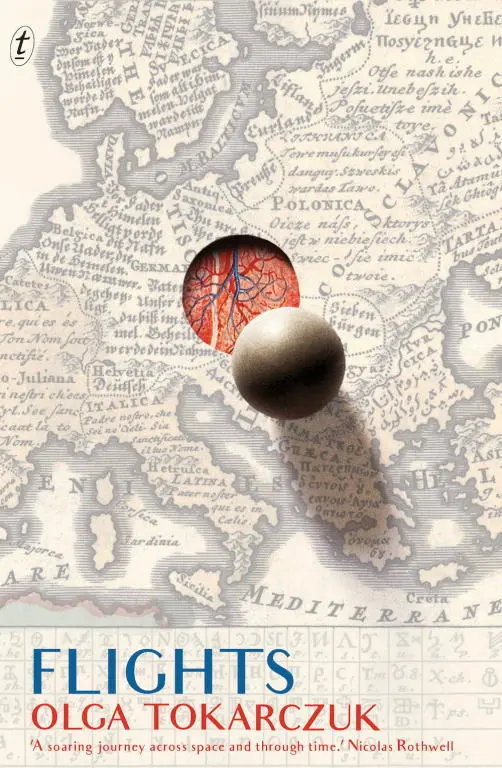
- Название:Flights
- Автор:
- Издательство:Text Publishing Company
- Жанр:
- Год:2017
- Город:Melbourne
- ISBN:978-1-925-60314-9
- Рейтинг книги:4.5 / 5. Голосов: 2
-
Избранное:Добавить в избранное
- Отзывы:
-
Ваша оценка:
Flights: краткое содержание, описание и аннотация
Предлагаем к чтению аннотацию, описание, краткое содержание или предисловие (зависит от того, что написал сам автор книги «Flights»). Если вы не нашли необходимую информацию о книге — напишите в комментариях, мы постараемся отыскать её.
‘A magnificent writer.’ Svetlana Alexievich, Nobel Prize in Literature laureate 2015
‘Tokarczuk examines questions of travel in our increasingly interconnected and fast-moving world… Trained as a psychologist, Tokarczuk is interested in what connects the human soul and body. It is a leitmotif that, despite the apparent lack of a single plot, tightly weaves the text’s different strands—of fiction, memoir and essay—into a whole.’ Spectator
‘Reading Flights is like finally hearing from a weird old best friend you lost touch with years ago and assumed was gone forever because people that amazing and inventive just don't last. Wrong—they were off rediscovering the world on your behalf, just as Olga Tokarczuk does.’ Toby Litt, author of Hospital
‘I have always considered her a person of great literary abilities. With Flights I have my proof. This is one of the most important Polish books I have read for years.’ Jerzy Sosnowski
‘A novel in essays, a world-exploration in words, a soaring journey across space and through time.’ Nicolas Rothwell
Flights — читать онлайн бесплатно полную книгу (весь текст) целиком
Ниже представлен текст книги, разбитый по страницам. Система сохранения места последней прочитанной страницы, позволяет с удобством читать онлайн бесплатно книгу «Flights», без необходимости каждый раз заново искать на чём Вы остановились. Поставьте закладку, и сможете в любой момент перейти на страницу, на которой закончили чтение.
Интервал:
Закладка:
‘Are you from the police?’
‘No,’ says Annushka.
‘Then what?’
‘I want to know what you’re saying. You’ve been saying something all this time, I see you every week as I go into town.’
To this the woman answers, more boldly:
‘I’m not saying anything. Leave me alone.’
Annushka leans over and extends her hand to help her stand, but her hand changes course and caresses the woman’s cheek. It is warm, nice, soft.
‘I didn’t want anything bad.’
At first the woman freezes, astonished by this touch, but then, seemingly mollified by Annushka’s gesture, she scrabbles and gets up.
‘I’m hungry,’ she says. ‘Let’s go, there’s a kiosk right here, they have cheap hot sandwiches, you can buy me something to eat.’
They walk silently, side by side. At the booth Annushka buys two long rolls with cheese and tomatoes, watching to make sure the woman doesn’t run away. She can’t eat anything. She holds her roll out in front of her like a flute about to play a winter melody. They sit on a wall. The woman eats her roll, and then wordlessly she takes Annushka’s. She is old, older than Annushka’s mother-in-law. Her cheeks are broken up by wrinkles that run diagonally from her forehead to her chin. It’s hard for her to eat because she’s lost her teeth. The tomato slices slip off of the bread, she grasps at them, saves them at the last minute and carefully puts them back in place. She tears off big bites with just her lips.
‘I can’t go home,’ Annushka says suddenly and looks down at her feet. She’s stunned she said something like this, and only now does she think in terror what it means. The woman murmurs something indistinct in response, but after swallowing her bite, she asks:
‘Do you have an address?’
‘Yes,’ says Annushka, and she recites it: ‘Kuznetskaya 46, apartment 78.’
‘So just forget it,’ blurts the woman, with her mouth full.
Vorkuta. She was born there in the late sixties, when the apartment blocks, which now seem age-old, were just going up. She remembers them as new – rough plaster, the smell of concrete and the asbestos used as insulation. The promising smoothness of the PVC tiles. But in a cold climate everything gets older faster, the frost breaks down the consistent structure of the walls, slows electrons in their ceaseless circulation.
She remembers the blinding whiteness of winters. The whiteness and the sharp edges of the light in exile. Such whiteness exists only in order to create a framework for the darkness, of which there is decidedly more.
Her father worked at a massive heating plant, and her mother in a cafeteria, which is how they got by – she always brought something home for them to eat. Now Annushka thinks that everybody there had a kind of weird illness, hidden deep inside the body, under clothing, a great sadness, or perhaps something vaster than sadness, but she can’t think of the right word.
They lived on the seventh floor of an eight-floor building, one of many identical buildings, but with time, as she grew up, the upper floors emptied out, people moved away to more amenable locales, usually to Moscow, but anywhere, as far away from there as possible. Those who stayed moved downwards, took up residence in the lowest-level apartments they could, where it was warmer, closer to people, to the earth. Living on the eighth floor during the many months of polar winter was like hanging from the concrete vaults of the world in a frozen drop of water, right in the middle of a frozen hell. When she’d last visited her sister and mother, they lived on the ground floor. Her father had died long ago.
It was fortunate that Annushka got into a good teaching school in Moscow; unfortunate she didn’t finish the course. If she had, she would be a teacher now, and perhaps she would never have met the man who had become her husband. Their genes would never have blended together in that toxic mix that was to blame for Petya coming into the world suffering from a disease that had no cure.
Many times Annushka had tried to barter with anyone she could, with God, with the Virgin, with Saint Parascheva, with the whole iconostasis, even with the closer, vaguer realm of fate. Take me instead of Petya, I’ll take his illness, I’ll die, just let him recover. She didn’t stop there – she threw in others’ lives: that of her reluctant husband (let him get shot) and of her mother-in-law (let her have a stroke). But of course, there was never any answer to her offer.
She buys a ticket and goes downstairs. There is still a crowd, people returning from the city centre to their beds, to sleep. Some already falling asleep in their carriages. Their sleepy breaths fog up the glass; you could draw something in those with your finger, anything, it wouldn’t matter because regardless it would vanish a moment later. Annushka gets to the final station, YugoZapadnaya, gets off and stands on the platform, only to realize a moment later that the train will go back, the same train. She sits back down in the same seat and from there returns, and then comes back again, until after several rides like this she switches to the Koltsevaya line. This line takes her in a circle, until around midnight she reaches Kievsky Station as though coming home. She sits on the platform until a menacing lady comes along, insisting that she leave, saying they’re about to close the metro. Annushka leaves, although she doesn’t want to – outside the frost is biting – but then she finds a small pub near the station, with a television up by the ceiling; the tables are peopled by a few lost travellers. She orders tea with lemon, one after another; then borscht, terrible, watery, and with her head propped up against her hand she drifts off briefly. She is happy, because she doesn’t have a single thought in her head, a single care, a single expectation or hope. It’s a good feeling.
The first train is still empty. Then at each station more and more people get on, until finally the crush is such that Annushka stands squashed between the backs of some kind of giants. Since she can’t reach the handles she’s condemned to having anonymous bodies hold her up. Then suddenly the throng thins out, and at the next station the train is empty. Only a couple of people remain. Now Annushka learns that some people don’t get off at the end stations. She alone gets off and switches trains. But she sees the others through the windows finding themselves spots at the ends of their carriages and setting out around their feet their plastic bags or their backpacks, usually old, made of hemp. They doze off with their eyes half-shut or unwrap the paper off some food and, excusing themselves over and over, mumbling, chewing reverentially.
She changes trains because she’s scared someone might spot her, might grab her by the arm and shake her or – worst of all – might lock her up somewhere. Sometimes she walks over to the other side of the platform, and sometimes she changes platforms; then she travels by escalator, by tunnel, but never reading any of the signs, completely free. She goes, for example, to Chistye Prudy, changes from Sokolnicheskaya to Kaluzhsko-Rizhskaya and goes to Medvedkovo and then back to the other side of the city. She stops in the toilets to check her appearance, to make sure she looks all right, not because she feels the need to (in truth she does not), but rather to avoid being spotted, due to unkemptness, by one of those cerberi that guard the escalators in their glass booths. She suspects that they have mastered the art of sleeping with their eyes open. At a kiosk she buys some pads, some soap, the cheapest toothpaste and toothbrush. She sleeps through the afternoon, on the Koltsevaya line. In the evening she emerges from the station by way of the stairs, so as to maybe meet the shrouded woman out front – but no, she isn’t there. It’s cold, even colder than the day before, so she’s relieved to be going back underground.
Читать дальшеИнтервал:
Закладка:
Похожие книги на «Flights»
Представляем Вашему вниманию похожие книги на «Flights» списком для выбора. Мы отобрали схожую по названию и смыслу литературу в надежде предоставить читателям больше вариантов отыскать новые, интересные, ещё непрочитанные произведения.




Обсуждение, отзывы о книге «Flights» и просто собственные мнения читателей. Оставьте ваши комментарии, напишите, что Вы думаете о произведении, его смысле или главных героях. Укажите что конкретно понравилось, а что нет, и почему Вы так считаете.