J.G. Ballard - Cocaine Nights
Здесь есть возможность читать онлайн «J.G. Ballard - Cocaine Nights» — ознакомительный отрывок электронной книги совершенно бесплатно, а после прочтения отрывка купить полную версию. В некоторых случаях можно слушать аудио, скачать через торрент в формате fb2 и присутствует краткое содержание. Жанр: Современная проза, на английском языке. Описание произведения, (предисловие) а так же отзывы посетителей доступны на портале библиотеки ЛибКат.
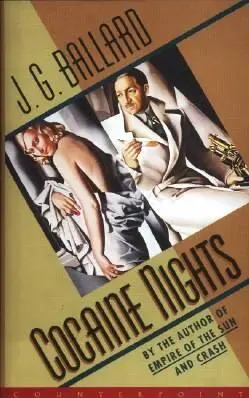
- Название:Cocaine Nights
- Автор:
- Жанр:
- Год:неизвестен
- ISBN:нет данных
- Рейтинг книги:5 / 5. Голосов: 1
-
Избранное:Добавить в избранное
- Отзывы:
-
Ваша оценка:
Cocaine Nights: краткое содержание, описание и аннотация
Предлагаем к чтению аннотацию, описание, краткое содержание или предисловие (зависит от того, что написал сам автор книги «Cocaine Nights»). Если вы не нашли необходимую информацию о книге — напишите в комментариях, мы постараемся отыскать её.
Outward appearances suggest the wholesale adoption of a new ethos of high-spirited, well-controlled collective exuberance. But there’s the matter of the fire: The house and household of an aged, wealthy industrialist has gone up in flames, claiming five lives, while virtually the entire town stood and watched. There’s the matter of the petty crime, the burglaries, muggings, and auto thefts which have begun to nibble away at the edges of Estrella Del Mar’s security despite the guardhouses and surveillance cameras. There’s the matter of the new, flourishing trade in drugs and pornography. And there’s the matter of Frank Prentice, who sits in Marbella jail awaiting trial for arson and five counts of murder, and who, despite being clearly innocent, has happily confessed.
It is up to Charles Prentice, Frank’s brother, to peel away the onionlike layers of denial and deceit which hide the rather ugly truth about this seaside idyll, its residents, and the horrific crime which brought him here. But as is usually the case in a J.G. Ballard book, the truth comes with a price tag attached, and likely without any easing of discomfort for his principal characters.
Cocaine Nights marks a partial return on Ballard’s part to the provocative, highly-successful mid-career methodology employed in novels such as Crash and High Rise: after establishing himself as a science fiction guru in the 1960s, Ballard stylistically shifted gears towards an unnerving, futuristic variant on social realism in the 1970s. Both Crash and High Rise were what-if novels, posing questions as to what the likely results would be if our collective fascination with such things as speed, violence, status, power, and sex were carried just a little bit further: How insane, how brutal could our world become if we really cut loose?
Cocaine Nights asks a question better suited to the ’90s, the age of gated communities and infrared home security systems: Does absolute security guarantee isolation and cultural death? Conversely, is a measure of crime an essential ingredient in a vibrant, living, properly functioning social system? Is it true, as a character asserts, that “Crime and creativity go together, always have done,” and that “total security is a disease of deprivation”? Suffice to say that the answers presented in Nights will be anathema to moral absolutists; the world of Ballard’s fiction, like life in the hyperkinetic, relativistic 1990s, abounds with uncomfortable grey areas.
On the surface, Cocaine Nights is a whodunit and a race against time, but as it proceeds – and as preconceived conceptions of good and evil begin to dissolve – it evolves into a thoughtful, faintly frightening look at under-examined aspects of 1990s western society. As is his wont, Ballard confronts his readers with some faintly outlandish hypotheses unlikely to be embraced by many, but which nonetheless serve to provoke both thought and a bit of paranoia; it’s a method that Ballard has developed and refined on his own, and as usual, it propels his novel along marvellously.
Cocaine Nights doesn’t have either the broad sweep or brute impact of the landmark Crash, but it retains enough social relevance and low-key creepiness to more than satisfy Ballardphiles. As is often the case in Ballard’s alternate reality, it’s a given that his most appealing, human characters turn out to be the most twisted, and that even the most normal of events turn out to be governed by a perverse, malformed logic; that this logic turns out to be grounded in sound sociological and psychological principles is its most horrific feature.
David B. Livingstone
Cocaine Nights — читать онлайн ознакомительный отрывок
Ниже представлен текст книги, разбитый по страницам. Система сохранения места последней прочитанной страницы, позволяет с удобством читать онлайн бесплатно книгу «Cocaine Nights», без необходимости каждый раз заново искать на чём Вы остановились. Поставьте закладку, и сможете в любой момент перейти на страницу, на которой закончили чтение.
Интервал:
Закладка:
'Crawford, it's time to leave-let's get back to Estrella de Mar…'
'You've seen enough?'
'I want to hear that tennis machine of yours and the laughter of tipsy women. I want to hear Mrs Shand telling off the waiters at the Club Nautico – if she invests here she'll lose everything.'
'Maybe. Before we go we'll look in at the sports club. It's semi-derelict but it has possibilities.'
We passed the marina and turned into the forecourt of the sports club. A single car was parked by the entrance, but no one seemed to be present in the empty building. We stepped from the Porsche and strolled around the drained swimming pool, looking down at the canted floor that exposed its dusty tiles to the sun. A collection of hair-clips and wine glasses lay around the drainage vent, as if waiting for a stream to flow.
Crawford sat back in a chair by the open-air bar, watching me while I tested the spring of the diving board. Handsome and affable, he gazed at me in a generous but canny way, like a junior officer selecting a raw recruit for a sensitive mission.
'So, Charles…' he said when I joined him at the bar. 'I'm glad you came on the tour. You've just seen the promotional video presented to all new owners at the Residencia Costasol. Compelling stuff?'
'Absolutely. It's very, very strange. Even so, most visitors driving around wouldn't notice anything odd. Apart from this pool and those empty shops it's extremely well-maintained, there's excellent security and not a trace of graffiti anywhere – most people's idea of paradise today. What happened?'
'Nothing happened.' Crawford sat forward, speaking quietly as if not wanting to unsettle the silence. 'Two and a half thousand people moved in, mostly well-off and with all the time in the world to do the things they'd dreamed about in London and Manchester and Edinburgh. Time for bridge and tennis, for cordon bleu and flower-arrangement classes. Time for having little affairs and for messing about in boats, learning Spanish and playing the Tokyo stock market. They sell up and buy their dream house, move everything down to the Costa del Sol. And then what happens? The dream switches itself off. Why?'
'They're too old? Or too lazy to bother? Doing nothing may secretly be just what they wanted.'
'But that isn't what they wanted. Plot for plot, villa for villa, the Residencia Costasol is far more expensive than similar developments in Calahonda and Los Monteros. They paid a fat extra premium to have all these sports facilities and leisure clubs. Anyway, the people here are not that old. This isn't a geriatric ward. Most of them are the right side of fifty – they took early retirement, cashed in their share options or sold their partnerships, made the most of a golden handshake. The Costasol complex isn't Sunset City, Arizona.'
'I've been there. Actually, it's a lively spot. Those seventy-year-olds can get pretty frisky.'
'Frisky…' Wearily, Crawford pressed his palms against his forehead. He stared at the silent villas around the plaza, their shaded balconies waiting for nothing to happen. I was tempted to make another flippant remark, but I could see that he felt an almost impatient concern for the people of the Residencia. He reminded me of a young district commissioner in the days of Empire, faced with a rich but torpid tribe that inexplicably refused to leave its huts. The bandage on his arm had leaked a little blood on to his shirtsleeve, but he was clearly uninterested in himself, driven by a zeal that seemed so out of place in this land of jacuzzis and plunge-pools.
'Crawford…' Trying to reassure him, I said: 'Does it matter? If they want to doze their lives away with the sound turned down, let them…'
'No…' Crawford paused and then reached forward to grip my hand. 'It does matter. Charles, this is the way the world is going. You've seen the future and it doesn't work or play. The Costasols of this planet are spreading outwards. I've toured them in Florida and New Mexico. You should visit the Fontainebleau Sud complex outside Paris – it's a replica of this, ten times the size. The Residencia Costasol wasn't thrown together by some gimcrack developer; it was carefully planned to give people the chance of a better life. And what have they got? Brain-death 'Not brain-death, Bobby. That's Paula-speak. The Costa del Sol is the longest afternoon in the world, and they've decided to sleep through it.'
'You're right.' Crawford spoke softly, as if accepting my point. He took off his aviator glasses and stared at the harsh light reflected from the pool tiles. 'But I intend to wake them up. That's my job, Charles – why I was picked I don't know, but I stumbled on a way of saving people and bringing them back to life. I tried it at Estrella de Mar and it worked.'
'Perhaps. I'm not sure about that. But it won't work here. Estrella de Mar is a real place. It existed before you and Betty Shand arrived.'
'The Residencia Costasol is real. Too real.' Crawford doggedly recited his uncertain credo, rehearsing an argument that I guessed he had run through many times, an amalgam of alarmist best-sellers, Economist think-pieces and his own obsessive intuitions that he had put together on the windswept balcony of his apartment. 'Town-scapes are changing. The open-plan city belongs to the past-no more ramblas, no more pedestrian precincts, no more left banks and Latin quarters. We're moving into the age of security grilles and defensible space. As for living, our surveillance cameras can do that for us. People are locking their doors and switching off their nervous systems. I can free them, Charles. With your help. We can make a start here, in the Residencia Costasol.'
'Bobby…' I met his engaging, sea-blue eyes, fixed on me with their curious mix of threat and hope. 'There's nothing I can do. I came here to help Frank.'
'I know, and you have helped him. But now help me, Charles. I need someone to hold the fort for me, keep an eye on the ground and warn me if I'm going too far-the role Frank played at the Club Nautico.'
'Look… Bobby, I can't-'
'You can!' Crawford held my wrists and drew me towards him across the table. Behind his pleading was a strange missionary fervour that seemed to float across his mind like the malarial visions of that young district officer he so resembled, reaching out for the aid of a passing traveller. 'We may fail but it's worth trying. The Residencia Costasol is a prison, just as much as Zarzuella jail. We're building prisons all over the world and calling them luxury condos. The amazing thing is that the keys are all on the inside. I can help people to snap the locks and step out into real air again. Think, Charles-if it works you can write a book about it, a warning to the rest of the world.'
'The kind of warning that no one is keen to hear. What do you want me to do?'
'Keep an eye on this club. Betty Shand has bought out the lease – we re-open in three weeks' time. We need someone to run the place for us.'
'I'm the wrong man. You need a trained manager. I can't hire and fire staff, keep accounts and run a restaurant.'
'You'll soon learn.' Confident that he had recruited me, Crawford gestured dismissively at the bar. 'Besides, there's no restaurant and Betty will do the hiring and firing. Don't worry about the accounts – David Hennessy has all that under control. Join us, Charles. Once we get the tennis club going everything else will follow. The Residencia Costasol will come alive again.'
'After a few games of tennis? You could stage Wimbledon here and no one would notice.'
'They will, Charles. Of course, there'll be more than tennis. When they set up the Costasol complex there was one ingredient missing.'
'Work?'
'Not work, Charles. No.'
I waited as he gazed at the silent villas around the plaza and the cameras on the lamp standards that tracked the cars leaving the shopping mall. His open and eager face was touched by a determination that Frank must have found equally intriguing.
Читать дальшеИнтервал:
Закладка:
Похожие книги на «Cocaine Nights»
Представляем Вашему вниманию похожие книги на «Cocaine Nights» списком для выбора. Мы отобрали схожую по названию и смыслу литературу в надежде предоставить читателям больше вариантов отыскать новые, интересные, ещё непрочитанные произведения.








Обсуждение, отзывы о книге «Cocaine Nights» и просто собственные мнения читателей. Оставьте ваши комментарии, напишите, что Вы думаете о произведении, его смысле или главных героях. Укажите что конкретно понравилось, а что нет, и почему Вы так считаете.