J.G. Ballard - Cocaine Nights
Здесь есть возможность читать онлайн «J.G. Ballard - Cocaine Nights» — ознакомительный отрывок электронной книги совершенно бесплатно, а после прочтения отрывка купить полную версию. В некоторых случаях можно слушать аудио, скачать через торрент в формате fb2 и присутствует краткое содержание. Жанр: Современная проза, на английском языке. Описание произведения, (предисловие) а так же отзывы посетителей доступны на портале библиотеки ЛибКат.
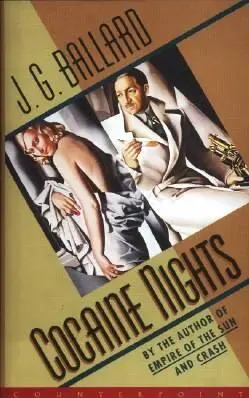
- Название:Cocaine Nights
- Автор:
- Жанр:
- Год:неизвестен
- ISBN:нет данных
- Рейтинг книги:5 / 5. Голосов: 1
-
Избранное:Добавить в избранное
- Отзывы:
-
Ваша оценка:
Cocaine Nights: краткое содержание, описание и аннотация
Предлагаем к чтению аннотацию, описание, краткое содержание или предисловие (зависит от того, что написал сам автор книги «Cocaine Nights»). Если вы не нашли необходимую информацию о книге — напишите в комментариях, мы постараемся отыскать её.
Outward appearances suggest the wholesale adoption of a new ethos of high-spirited, well-controlled collective exuberance. But there’s the matter of the fire: The house and household of an aged, wealthy industrialist has gone up in flames, claiming five lives, while virtually the entire town stood and watched. There’s the matter of the petty crime, the burglaries, muggings, and auto thefts which have begun to nibble away at the edges of Estrella Del Mar’s security despite the guardhouses and surveillance cameras. There’s the matter of the new, flourishing trade in drugs and pornography. And there’s the matter of Frank Prentice, who sits in Marbella jail awaiting trial for arson and five counts of murder, and who, despite being clearly innocent, has happily confessed.
It is up to Charles Prentice, Frank’s brother, to peel away the onionlike layers of denial and deceit which hide the rather ugly truth about this seaside idyll, its residents, and the horrific crime which brought him here. But as is usually the case in a J.G. Ballard book, the truth comes with a price tag attached, and likely without any easing of discomfort for his principal characters.
Cocaine Nights marks a partial return on Ballard’s part to the provocative, highly-successful mid-career methodology employed in novels such as Crash and High Rise: after establishing himself as a science fiction guru in the 1960s, Ballard stylistically shifted gears towards an unnerving, futuristic variant on social realism in the 1970s. Both Crash and High Rise were what-if novels, posing questions as to what the likely results would be if our collective fascination with such things as speed, violence, status, power, and sex were carried just a little bit further: How insane, how brutal could our world become if we really cut loose?
Cocaine Nights asks a question better suited to the ’90s, the age of gated communities and infrared home security systems: Does absolute security guarantee isolation and cultural death? Conversely, is a measure of crime an essential ingredient in a vibrant, living, properly functioning social system? Is it true, as a character asserts, that “Crime and creativity go together, always have done,” and that “total security is a disease of deprivation”? Suffice to say that the answers presented in Nights will be anathema to moral absolutists; the world of Ballard’s fiction, like life in the hyperkinetic, relativistic 1990s, abounds with uncomfortable grey areas.
On the surface, Cocaine Nights is a whodunit and a race against time, but as it proceeds – and as preconceived conceptions of good and evil begin to dissolve – it evolves into a thoughtful, faintly frightening look at under-examined aspects of 1990s western society. As is his wont, Ballard confronts his readers with some faintly outlandish hypotheses unlikely to be embraced by many, but which nonetheless serve to provoke both thought and a bit of paranoia; it’s a method that Ballard has developed and refined on his own, and as usual, it propels his novel along marvellously.
Cocaine Nights doesn’t have either the broad sweep or brute impact of the landmark Crash, but it retains enough social relevance and low-key creepiness to more than satisfy Ballardphiles. As is often the case in Ballard’s alternate reality, it’s a given that his most appealing, human characters turn out to be the most twisted, and that even the most normal of events turn out to be governed by a perverse, malformed logic; that this logic turns out to be grounded in sound sociological and psychological principles is its most horrific feature.
David B. Livingstone
Cocaine Nights — читать онлайн ознакомительный отрывок
Ниже представлен текст книги, разбитый по страницам. Система сохранения места последней прочитанной страницы, позволяет с удобством читать онлайн бесплатно книгу «Cocaine Nights», без необходимости каждый раз заново искать на чём Вы остановились. Поставьте закладку, и сможете в любой момент перейти на страницу, на которой закончили чтение.
Интервал:
Закладка:
For ten minutes I sat behind my newspaper, almost disappointed not to see smoke billowing from the eaves. Leaving the car, I quietly closed the door and walked across the street to the villa. As I ducked into the garage I heard a shutter open on an upstairs window. I hesitated in the kitchen, listening to Crawford's feet on the floorboards above my head. He was pulling a wardrobe across the room, perhaps adding a last piece of furniture to his bonfire pile.
I stepped through the kitchen into the hall, its pale walls lit by the sunlight in the garden, once again the Piranesi antechamber where the psychiatrist had felt so at home. The vandals had continued their work inside the house, and aerosol slogans covered the walls and ceilings. On the stairs the paint was still wet, the tiled steps smeared by Crawford's trainers.
I paused on the upstairs landing, listening to the noise of scraping furniture. The bedrooms were daubed with graffiti, a riot of black and silver whorls, a demented EEG trace searching for a brain. But one room had not been vandalized, the maid's bedroom above the kitchen, where Crawford was easing a heavy Spanish dresser from the wall. Hands gripping the carved oak panels, he forced the castle of polished wood across the floor.
Lying down in the narrow space behind the dresser, he reached to some inner ledge and retrieved a schoolgirl's diary bound in pink silk. Sitting against the dresser, he held the diary to his chest, smiling with the bitter-sweet regret of a schoolboy lover.
I watched him as he untied the diary's bow and began to read its pages, fingers playing with the ribbon. He looked up at the little room, eyes lingering on the mantelpiece where a clutter of forgotten objects waited for the dustbin. A signed photograph of a punk rock group was taped to the wall, beside a family of frizzy-haired trolls, a collection of shells and beach stones and a postcard view of Malmo. Crawford stood up and leaned against the mantelpiece, running a hand across the stones, and then sat at the dressing-table below the open window.
'Come in, Charles,' he called out. 'I can hear you thinking. Don't hover out there like a ghost – there's one too many here already 'Crawford?' I stepped into the room, and squeezed past the massive dresser. 'I thought you might be…'
'Starting a fire? Not today, and not here.' He spoke softly, and seemed almost dreamy and lightheaded, like a child discovering a secret attic. He explored the empty drawers of the dressing-table, lips moving as he described the imaginary objects he had found. 'This was Bibi's room-think of the hundreds of times she stared into this mirror. If you look hard enough you can just see her He began to leaf through the diary, reading the large looping script that rolled across the pink pages.
'Her moods and hopes book,' Crawford commented. 'She started it while she was living with Sanger. She probably wrote it here. It's a pretty little room.'
I assumed that he had never visited the house, let alone the bedroom. Concerned for him, I said: 'Why don't you rent the house from Sanger? You could move in.'
'I'd like to, but why be mawkish?' Crawford closed the diary and pushed it away. A narrow servant's bed stood against the wall, stripped of everything but its mattress. He lay down, broad shoulders almost wider than the headboard. 'Not exactly comfortable, but at least they wouldn't have had sex here. So, Charles, you thought I was going to burn the place down?'
'It did occur to me.' I stared at him through the dressing-table mirror, noticing that his features were almost perfectly symmetrical, as if his face's asymmetric twin was hiding somewhere behind his eyes. 'You set fire to the speedboat and my car. Why not this place-or the Hollinger house?'
'Charles…' Crawford clasped his hands behind his head, deliberately revealing the surgical plaster on his forearm. He watched me in his level but friendly way, eager to help me over a minor difficulty. 'The speedboat, yes. I have to keep the troops in good heart, it's a constant worry. A spectacular fire touches something deep inside us. I'm sorry about the car; Mahoud misheard me and took off on his own. But the Hollinger house? Absolutely not, for one very good reason.'
'Bibi Jansen?'
'Not exactly, but in a way.' He left the bed and riffled through the diary, trying to restock his memories of the dead young woman. 'Let's say a very personal way 'You knew she was pregnant?'
'Of course.'
'Were you the child's father?'
Crawford paced around the room, carefully leaving a handprint on the dusty mirror. 'Perhaps she'll see that the next time she looks out… Charles, it was scarcely a child. No brain or nervous system, no personality. Not much more than a parcel of genetic tissue counting to a hundred. Not really a child.'
'But it felt like a child?'
He pocketed the diary, took a last look at the room and stepped past me. 'It still does.'
I followed him to the staircase, past the airless bedrooms with their graffiti and stink of paint. I accepted Crawford's word that he was not responsible for the Hollinger fire, and felt curiously relieved. For all his restless swerves and undirected energy, there was no trace of malice about him, no hint of the dark, lurking violence found in the kind of psychopath who had planned to kill the Hollingers. If anything, there was an artless strain in him, an almost earnest need to please.
'Time to go, Charles. Do you need a lift?' He noticed the Citroen across the street. 'No – you were waiting for me here. How did you know I was coming?'
'Just a guess. Sanger moved out yesterday afternoon. First the graffiti, then the…'
'Torch? You underestimate me, Charles. I hope I'm a force for good in Estrella de Mar. Here's an idea – we'll go for a drive along the coast. There's something I want you to see. You'll be able to write about it.'
'Crawford, I have to-'
'Come on… Just give me half an hour.' He took my arm and almost frog-marched me towards the Porsche. 'You need cheering up, Charles. I see a kind of lingering malaise coming over you – beach fatigue, pretty much endemic to the Costas. Fall into the clutches of Paula Hamilton and you'll be brain-dead before you can reach your next gin and tonic. Now, you drive.'
'This car? I'm not sure…'
'Of course! It's a puppy in wolf's clothing. It only bites out of enthusiasm. Hold the wheel like a leash and say "sit".'
I guessed that he had seen me in the Citroen when he first arrived, and that a spin at the controls of the Porsche was a gentle revenge. He watched me encouragingly as I eased myself into the driver's seat. I started the engine, missed the forward gears and propelled the car towards the garage door. I braked in a swirl of litter, hunted the gearbox again and eased the over-eager car down the drive.
'Good, good… you're another Schumacher, Charles. It's fun being a passenger. The world looks different, as if one's seeing it in a mirror.'
Crawford sat with his hands on the dashboard, enjoying the erratic ride, and directed me through the narrow streets to the Paseo Maritimo. Now and then his hand gripped mine as he steered the Porsche around a swerving motor-scooter, and I felt the over-developed thumb and index finger of the professional tennis player, the same combination that had left its imprint on my throat. Fingers, like keys, had a unique signature. I was sitting beside the man who had almost strangled me, and yet my anger had already given way to more confused emotions: a need for revenge, and curiosity as to his motives.
He tapped the girl's diary on his knee, amused to see that I had reined in the powerful car and declined to show off its performance. As we approached the harbour I noticed his almost childlike pleasure in everything around him. My modest driving skills, a water-skier in the bay slaloming in and out of a speedboat's wake, elderly tourists marooned on a traffic island, all prompted the same cheerful smile, as if he were seeing the world afresh at every street corner.
Читать дальшеИнтервал:
Закладка:
Похожие книги на «Cocaine Nights»
Представляем Вашему вниманию похожие книги на «Cocaine Nights» списком для выбора. Мы отобрали схожую по названию и смыслу литературу в надежде предоставить читателям больше вариантов отыскать новые, интересные, ещё непрочитанные произведения.









Обсуждение, отзывы о книге «Cocaine Nights» и просто собственные мнения читателей. Оставьте ваши комментарии, напишите, что Вы думаете о произведении, его смысле или главных героях. Укажите что конкретно понравилось, а что нет, и почему Вы так считаете.