J.G. Ballard - Cocaine Nights
Здесь есть возможность читать онлайн «J.G. Ballard - Cocaine Nights» — ознакомительный отрывок электронной книги совершенно бесплатно, а после прочтения отрывка купить полную версию. В некоторых случаях можно слушать аудио, скачать через торрент в формате fb2 и присутствует краткое содержание. Жанр: Современная проза, на английском языке. Описание произведения, (предисловие) а так же отзывы посетителей доступны на портале библиотеки ЛибКат.
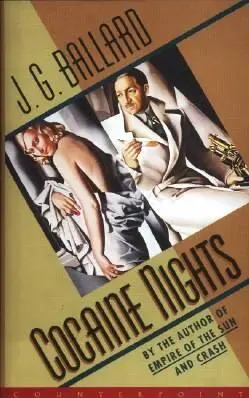
- Название:Cocaine Nights
- Автор:
- Жанр:
- Год:неизвестен
- ISBN:нет данных
- Рейтинг книги:5 / 5. Голосов: 1
-
Избранное:Добавить в избранное
- Отзывы:
-
Ваша оценка:
Cocaine Nights: краткое содержание, описание и аннотация
Предлагаем к чтению аннотацию, описание, краткое содержание или предисловие (зависит от того, что написал сам автор книги «Cocaine Nights»). Если вы не нашли необходимую информацию о книге — напишите в комментариях, мы постараемся отыскать её.
Outward appearances suggest the wholesale adoption of a new ethos of high-spirited, well-controlled collective exuberance. But there’s the matter of the fire: The house and household of an aged, wealthy industrialist has gone up in flames, claiming five lives, while virtually the entire town stood and watched. There’s the matter of the petty crime, the burglaries, muggings, and auto thefts which have begun to nibble away at the edges of Estrella Del Mar’s security despite the guardhouses and surveillance cameras. There’s the matter of the new, flourishing trade in drugs and pornography. And there’s the matter of Frank Prentice, who sits in Marbella jail awaiting trial for arson and five counts of murder, and who, despite being clearly innocent, has happily confessed.
It is up to Charles Prentice, Frank’s brother, to peel away the onionlike layers of denial and deceit which hide the rather ugly truth about this seaside idyll, its residents, and the horrific crime which brought him here. But as is usually the case in a J.G. Ballard book, the truth comes with a price tag attached, and likely without any easing of discomfort for his principal characters.
Cocaine Nights marks a partial return on Ballard’s part to the provocative, highly-successful mid-career methodology employed in novels such as Crash and High Rise: after establishing himself as a science fiction guru in the 1960s, Ballard stylistically shifted gears towards an unnerving, futuristic variant on social realism in the 1970s. Both Crash and High Rise were what-if novels, posing questions as to what the likely results would be if our collective fascination with such things as speed, violence, status, power, and sex were carried just a little bit further: How insane, how brutal could our world become if we really cut loose?
Cocaine Nights asks a question better suited to the ’90s, the age of gated communities and infrared home security systems: Does absolute security guarantee isolation and cultural death? Conversely, is a measure of crime an essential ingredient in a vibrant, living, properly functioning social system? Is it true, as a character asserts, that “Crime and creativity go together, always have done,” and that “total security is a disease of deprivation”? Suffice to say that the answers presented in Nights will be anathema to moral absolutists; the world of Ballard’s fiction, like life in the hyperkinetic, relativistic 1990s, abounds with uncomfortable grey areas.
On the surface, Cocaine Nights is a whodunit and a race against time, but as it proceeds – and as preconceived conceptions of good and evil begin to dissolve – it evolves into a thoughtful, faintly frightening look at under-examined aspects of 1990s western society. As is his wont, Ballard confronts his readers with some faintly outlandish hypotheses unlikely to be embraced by many, but which nonetheless serve to provoke both thought and a bit of paranoia; it’s a method that Ballard has developed and refined on his own, and as usual, it propels his novel along marvellously.
Cocaine Nights doesn’t have either the broad sweep or brute impact of the landmark Crash, but it retains enough social relevance and low-key creepiness to more than satisfy Ballardphiles. As is often the case in Ballard’s alternate reality, it’s a given that his most appealing, human characters turn out to be the most twisted, and that even the most normal of events turn out to be governed by a perverse, malformed logic; that this logic turns out to be grounded in sound sociological and psychological principles is its most horrific feature.
David B. Livingstone
Cocaine Nights — читать онлайн ознакомительный отрывок
Ниже представлен текст книги, разбитый по страницам. Система сохранения места последней прочитанной страницы, позволяет с удобством читать онлайн бесплатно книгу «Cocaine Nights», без необходимости каждый раз заново искать на чём Вы остановились. Поставьте закладку, и сможете в любой момент перейти на страницу, на которой закончили чтение.
Интервал:
Закладка:
We drove along the lower corniche towards Marbella, past the beach bars, boutiques and creperies. At the western limits of Estrella de Mar a mole of concrete blocks jutted into the sea. A truck loaded with fairground booths sped towards us, and Crawford seized the wheel, turning the Porsche into its path. His foot crushed mine against the accelerator, throwing the car forward as the truck's klaxon blared past us.
'Missed…' Crawford waved to the driver and steered the car on to the sandy verge beside the mole. 'A small errand, Charles. It won't take a moment.'
He stepped from the car, inhaling the bright spray as the waves broke among the blocks. Still dazed by our close escape, I looked down at my bruised foot. The yellow paint on the toe-cap of my shoe echoed the cleat-marks of Crawford's trainer, the same print that I had seen stamped into the scattered soil on Frank's balcony.
Shielding his eyes with the diary, Crawford gazed across the peninsula at the gutted shell of the Hollinger house.
'A year from now some hotel or casino complex will stand there. On this coast the past isn't allowed to exist…'
I locked the car and stood beside him. 'Why not keep the house as it is?'
'As a tribal totem? A warning to all those time-share salesmen and nightclub touts? That's not a bad idea Buffeted by the wind, we walked to the rail at the end of the mole. Crawford glanced for a last time at the diary, smiling as he turned the pages of childish scrawl. He closed it, held it behind his head and tossed it far out into the waves, a long deep serve.
'So… that's done. I wanted to find the date where she mentioned the baby – now I know how old it was.' He stared at the waves rolling in from North Africa, ice-cold crests sweeping towards the shore. 'Cocaine coming in, Charles… thousands of lines. Out of Africa always something white and strange.'
I leaned against the rail and let the spray cool my face. The loose pages of the diary were churning in the foam beneath us, pink petals dashed among the concrete blocks.
'Wouldn't Sanger have liked the diary? He was fond of her.'
'Of course. He loved Bibi – everyone did. The whole Hollinger thing is a terrible shame. Bibi's is the one death I really regret.'
'But you kept supplying her with hard drugs – according to Paula Hamilton she was a walking Palermo lab.'
'Charles…' Crawford put a brotherly arm around my shoulders, but I half-expected him to hip-throw me over the rail into the seething waves. 'You have to understand Estrella de Mar. Yes, we gave her drugs – we wanted to free her from those sinister clinics up in the hills, from those men in white coats who know best. Bibi needed to soar over our heads, dreaming her amphetamine dreams, coming off the beach in the evening and leading everyone into the cocaine night.' Crawford lowered his eyes and gestured at the sea, asking the waves to witness what he was saying. 'Sanger and Alice Hollinger turned her into a lady's maid.'
'The police found her in Hollinger's Jacuzzi. I don't suppose that was a film test?'
'Charles, forget Hollinger's Jacuzzi.'
'I'll try – it's an image that doesn't go away. Do you know who started the fire?'
Crawford waited until the last of the diary pages had vanished in the foam. 'The fire? Well… I suppose I do.'
'Who, though? I need to get Frank out of Zarzuella jail and back to London.'
'He may not want to leave.' Crawford watched me, as if waiting for me to serve at a crucial tie-break. 'I could tell you who started the fire, but you're not ready yet. It's not just a matter of someone's name, but of coming to terms with Estrella de Mar.'
'I've been here long enough. I understand what's going on.'
'No – or you wouldn't be so obsessed with that Jacuzzi.
Think of Estrella de Mar as an experiment. Something important may be taking place here, and I want you to be part of it.' Crawford held my arm, and led the way back to the Porsche. 'First, we'll go out for our ride. This time I'll drive, so you can take your eyes off the road. There's a lot to see… remember, white is the colour of silence.'
Before he started the engine I said: 'Bibi Jansen-if you made her pregnant, where did it happen? In the Hollinger house?'
'Good God, no!' Crawford seemed almost shocked. 'Even I wouldn't go that far. She visited Paula at the Clinic every Tuesday – I met her there once and we went for a drive.'
'Where exactly?'
'Into the past, Charles. Where she was happy again – just for an hour, but the longest and sweetest hour…'
19 The Costasol Complex
White silence. As we drove along the coast road, a mile to the west of Estrella de Mar, the outer-lying villas of the Residencia Costasol began to appear through the Aleppo pines that ran down to the deserted beach. The houses and apartments were set at various levels, forming a cascade of patios, terraces and swimming pools. I had visited the retirement pueblos at Calahonda and Torrenueva, but the Costasol complex was far larger than any others along the coast. Yet not a single resident was visible. No windows turned to catch the sun, and the entire development might have been empty, waiting for its first tenants to arrive and collect their keys.
Crawford pointed to the crenellated wall. 'Look at it, Charles… it's a fortified medieval city. This is Goldfinger's defensible space raised to an almost planetary intensity – security guards, tele-surveillance, no entrance except through the main gates, the whole complex closed to outsiders. It's a grim thought, but you're looking at the future.'
'Do the people here ever leave? They must go down to the beach.'
'No, that's the eerie thing about it all. The sea's only two hundred yards away but none of the villas looks out on to the beach. Space is totally internalized…'
Crawford turned off the coast road and freewheeled towards the entrance. Landscaped gardens the size of a small municipal park lay outside the Moorish gates and guardhouse. Flower- beds filled with cannas surrounded an ornamental fountain, reached by gravelled walks untouched by human feet since the day they were laid. Under an illuminated sign announcing 'The Residencia Costasol: Investment, Freedom, Security' was a road-map of the entire complex, a maze of winding avenues and culs-de-sac that emerged from their fastnesses to join the almost imperial boulevards radiating from the centre of the development.
'The map isn't really for visitors.' Crawford stopped outside the guardhouse and saluted the security man watching us from his window. 'It's there to help the residents find their way home. Sometimes they make the mistake of leaving the place for an hour or two.'
'They must go shopping. It's only a mile from Estrella de Mar.'
'But few of them ever visit the town. They might as well be on an atoll in the Maldives or in the San Fernando Valley.' Crawford drove up to the security barrier. From his breast pocket he took out a smart card embossed with the Costasol logo and fed it into the security scanner. To the guard he said: 'We'll be here for an hour-we work for Mrs Shand. Mr Prentice is your new entertainments officer.'
'Elizabeth Shand?' I repeated as the barrier fell behind us and we entered the complex. 'Don't tell me the place is one of hers. By the way, who am I supposed to be entertaining, and how?'
'Relax, Charles. I wanted to impress the security guard-the thought of being entertained always strikes terror into people. Betty buys and sells property everywhere. In fact, she's thinking of moving into here. A few of the villas are still unsold, along with empty retail units in the shopping mall. If someone could bring the place to life there's a fortune to be made – the people here are well-off.'
'I can see.' I pointed to the cars parked in the driveways.
Читать дальшеИнтервал:
Закладка:
Похожие книги на «Cocaine Nights»
Представляем Вашему вниманию похожие книги на «Cocaine Nights» списком для выбора. Мы отобрали схожую по названию и смыслу литературу в надежде предоставить читателям больше вариантов отыскать новые, интересные, ещё непрочитанные произведения.










Обсуждение, отзывы о книге «Cocaine Nights» и просто собственные мнения читателей. Оставьте ваши комментарии, напишите, что Вы думаете о произведении, его смысле или главных героях. Укажите что конкретно понравилось, а что нет, и почему Вы так считаете.