Kenzaburo Oe - Somersault
Здесь есть возможность читать онлайн «Kenzaburo Oe - Somersault» весь текст электронной книги совершенно бесплатно (целиком полную версию без сокращений). В некоторых случаях можно слушать аудио, скачать через торрент в формате fb2 и присутствует краткое содержание. Жанр: Современная проза, на английском языке. Описание произведения, (предисловие) а так же отзывы посетителей доступны на портале библиотеки ЛибКат.
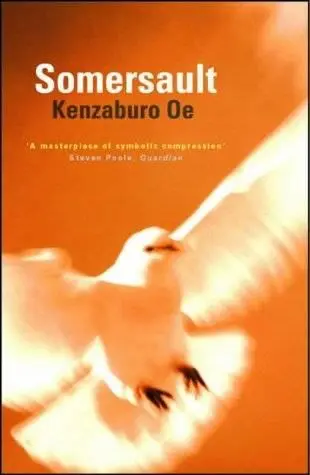
- Название:Somersault
- Автор:
- Жанр:
- Год:неизвестен
- ISBN:нет данных
- Рейтинг книги:4 / 5. Голосов: 1
-
Избранное:Добавить в избранное
- Отзывы:
-
Ваша оценка:
Somersault: краткое содержание, описание и аннотация
Предлагаем к чтению аннотацию, описание, краткое содержание или предисловие (зависит от того, что написал сам автор книги «Somersault»). Если вы не нашли необходимую информацию о книге — напишите в комментариях, мы постараемся отыскать её.
From Publishers Weekly
Nobelist Oe's giant new novel is inspired by the Aum Shinrikyo cult, which released sarin gas in Tokyo 's subway system in 1995. Ten years before the novel begins, Patron and Guide, the elderly leaders of Oe's fictional cult, discover, to their horror, that a militant faction of the organization is planning to seize a nuclear power plant. They dissolve the cult very publicly, on TV, in an act known as the Somersault. Ten years later, Patron decides to restart the fragmented movement, after the militant wing kidnaps and murders Guide, moving the headquarters of the church from Tokyo to the country town of Shikoku. Patron's idea is that he is really a fool Christ; in the end, however, he can't escape his followers' more violent expectations. Oe divides the story between Patron and his inner circle, which consists of his public relations man, Ogi, who is not a believer; his secretary, Dancer, an assertive, desirable young woman; his chauffeur, Ikuo; and Ikuo's lover, Kizu, who replaces Guide as co-leader of the cult. Kizu is a middle-aged artist, troubled by the reoccurrence of colon cancer. Like a Thomas Mann character, he discovers homoerotic passion in the throes of illness. Oe's Dostoyevskian themes should fill his story with thunder, but the pace is slow, and Patron doesn't have the depth of a Myshkin or a Karamazov-he seems anything but charismatic. It is Kizu and Ikuo's story that rises above room temperature, Kizu's sharp, painterly intelligence contrasting with Ikuo's rather sinister ardor. Oe has attempted to create a sprawling masterpiece, but American readers might decide there's more sprawl than masterpiece here.
Somersault — читать онлайн бесплатно полную книгу (весь текст) целиком
Ниже представлен текст книги, разбитый по страницам. Система сохранения места последней прочитанной страницы, позволяет с удобством читать онлайн бесплатно книгу «Somersault», без необходимости каждый раз заново искать на чём Вы остановились. Поставьте закладку, и сможете в любой момент перейти на страницу, на которой закончили чтение.
Интервал:
Закладка:
"If we get drunk on the ecstasy of the trance and are swallowed up by this deep drunkenness, we won't be able to return from that huge flow back to this side. But one of the conditions of being a living human being is that you do not stay forever over there. In other words, if you are mechanically returned to this side, you'll never again be able to discover the particles of light or resonance within your body and spirit.
"No matter the level of the trance you're in, you have to wake up within it. You have to gaze at that huge flow with your eyes wide open. You have to let your body and spirit be transparent and gaze at those particles of light or resonance reflected in the mirror of that massive flow. This has nothing to do with what we might look like from the outside while in a trance.
"You recall Guide said that when I'm in a trance I confront a huge glow- ing structure? That's how he understood what I described, what I see when I'm gazing at this huge flow with open eyes. What I see and what he describes are one and the same. From the start, what you experience in a deep trance is something that can't be categorized in words. Which means that if you do attempt to transform it into words, there'll be many different ways of express- ing it-all of them accurate.
"To get back to your painting, you can't let feelings of ecstasy draw you into that massive flow. So what do you do to prevent it? Mystics in Europe used lections, sacred phrases-the words of a prayer-as a kind of handrail to keep from falling into the abyss of ecstasy. They'd tie sacred phrases around their waists as a kind of lifeline.
"In this painting, Professor, you're walking off into the depths of the sky holding on to Ikuo's hand. Ikuo's hand linked with yours is your hand- rail, your lifeline. Led by me, you've made the decision to go into the world on the other side. But from the first you refuse to be inundated by it. You won't allow yourself to be swallowed up in that massive flow. You've decided to protect the particles of light or resonance inside your body and spirit.
"Ikuo is your handrail, or lifeline, but by the same token if I were to lead him into a deep trance you want to keep him from sinking into that flow. And you did this painting of you and Ikuo holding hands in order to make this clear to yourself. Looking at this painting, I think Ikuo, too, can mentally prepare himself."
Patron turned from Kizu to look at Ikuo-Kizu found he couldn't help but do the same with a forceful shift of weight-and Ikuo nodded so deci- sively that Kizu was overjoyed.
4
Kizu still wasn't sure exactly what a guide was supposed to be or do, though it was clear Patron viewed him as both a personal adviser and an ad- viser to his new movement. Like Ikuo, Kizu was determined to absorb all Patron had to tell him. When he'd given Patron talks on the Welsh poet, Patron had been far from just a student. A new dynamic was at work here, with Patron now endeavoring to educate Kizu. Patron was attempting to revive the doctrine that he and the sick Guide had created-despite having denied it all by doing their Somersault.
"When Guide and I were young," he told Kizu, "there was a time when our youthful unease and energy drove us to devour books in order to find out more about mysticism. There was a great inherent difference, though, between our reading abilities. Guide would read books I'd never pick up on my own and then underline or circle in red those parts he thought I'd be interested in.
I'd read more than just those parts, of course, but never the entire book. I'd read the chapters that caught his attention enough for him to mark up. And if I didn't understand that chapter, I'd read the ones that bracketed it.
"Guide would use different-colored pencils to indicate the chapters that were for reference. Once he began to drink (which didn't happen all that often) he couldn't stop. He'd adopt this overbearing attitude that he was the one in charge of educating the leader of the church. He's a detail person, so he made a distinction between what he was teaching me and what was originally within me, something on a different plane from what we usually think of as educat- ing or being educated. Rather, he said he was led by what was inside me to find those kinds of books and read them.
"Does this make me sound pretty full of myself? Guide didn't treat me as someone with special privileges. He just happened to choose me as the Sav- ior-at that point we weren't using the names Patron or Guide-but he could easily have chosen someone else. What's most important exists in every per- son, the particles of light or resonance that flow out from the Almighty, the one Being that was there at the beginning, the Always-already who includes the entire universe. The only difference is that in some people those particles of light are clearer and give off a much more intense resonance. Yours are extraordinarily clear and intense, Guide told me when we met; that's where he found his surety that I was the one.
"At that time, Guide was still teaching mathematics and science in night school. All the various students in his gloomy classroom, he said, each had these particles of light or resonance. He told me he actually got the whole concept of these particles from one of the more progressive textbooks he used for his students.
"Most of us are convinced we're each active subjects who happen to contain DNA, but most scholars now agree that since the dawn of mankind humans have been little more than containers, vehicles to transport the DNA that determines our individuality.
"Guide taught me his basic doctrine: that the world was created by light radiating from the Almighty, that each of us contains within our bodies and spirits these particles of light or resonance, and eventually these will return to their Creator.
"People tend to believe that each of us as individuals are the center of things, but we really are nothing more than vehicles for these particles of light or resonance: just portable containers, until the time when each and every particle of light returns to the Almighty and becomes the Almighty. This flow- ing out and return takes place in a different way from the events that we're used to thinking about as happening in historical time. Both happen in an in- stant yet are also occurring eternally.
"I can't say I really understood what Guide meant at the time. When those particles of light or resonance return to the Almighty, they'll cast off the body they've occupied. They'll also separate themselves from the spirit, but this doesn't mean that our individuality is discarded like a used container.
Each of our individual souls will become particles of light or resonance and return to the Almighty. I didn't entirely understand it, but I was drawn to the idea.
"I've never prayed in a Christian church-let alone in an Islamic mosque or even a Buddhist temple, for that matter-and what I know about this may be the kind of random knowledge one picks up from movies, TV, and nov- els, but the faithful do say, don't they, Thy will be done? There's a scene in the Koran where Abraham and Isaac pray together as one, and you can find the same sort of thing in Buddhist tales. Thy will be done, I believe, is a universal element of prayer.
"Even in our own church, Thy will be done was the basis of everything we did. I didn't interpret God in an anthropomorphic way but as the light that penetrates the world, the universe, the whole, and all the details, each and every one. I said these particles of light or resonance are in me, and I'm just one speck in an infinite number, but these particles of light, like salmon swimming upstream, become part of countless other particles to create one enormous entity as they return to the Almighty. The faithful imagine this One-and-only in an anthropomorphic way, as the originating ultimate Al- mighty. Call it God, if you wish.
Читать дальшеИнтервал:
Закладка:
Похожие книги на «Somersault»
Представляем Вашему вниманию похожие книги на «Somersault» списком для выбора. Мы отобрали схожую по названию и смыслу литературу в надежде предоставить читателям больше вариантов отыскать новые, интересные, ещё непрочитанные произведения.




Обсуждение, отзывы о книге «Somersault» и просто собственные мнения читателей. Оставьте ваши комментарии, напишите, что Вы думаете о произведении, его смысле или главных героях. Укажите что конкретно понравилось, а что нет, и почему Вы так считаете.