Kenzaburo Oe - Somersault
Здесь есть возможность читать онлайн «Kenzaburo Oe - Somersault» весь текст электронной книги совершенно бесплатно (целиком полную версию без сокращений). В некоторых случаях можно слушать аудио, скачать через торрент в формате fb2 и присутствует краткое содержание. Жанр: Современная проза, на английском языке. Описание произведения, (предисловие) а так же отзывы посетителей доступны на портале библиотеки ЛибКат.
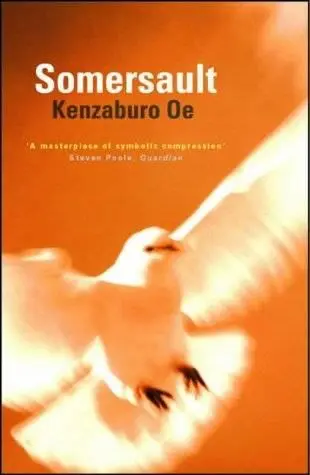
- Название:Somersault
- Автор:
- Жанр:
- Год:неизвестен
- ISBN:нет данных
- Рейтинг книги:4 / 5. Голосов: 1
-
Избранное:Добавить в избранное
- Отзывы:
-
Ваша оценка:
Somersault: краткое содержание, описание и аннотация
Предлагаем к чтению аннотацию, описание, краткое содержание или предисловие (зависит от того, что написал сам автор книги «Somersault»). Если вы не нашли необходимую информацию о книге — напишите в комментариях, мы постараемся отыскать её.
From Publishers Weekly
Nobelist Oe's giant new novel is inspired by the Aum Shinrikyo cult, which released sarin gas in Tokyo 's subway system in 1995. Ten years before the novel begins, Patron and Guide, the elderly leaders of Oe's fictional cult, discover, to their horror, that a militant faction of the organization is planning to seize a nuclear power plant. They dissolve the cult very publicly, on TV, in an act known as the Somersault. Ten years later, Patron decides to restart the fragmented movement, after the militant wing kidnaps and murders Guide, moving the headquarters of the church from Tokyo to the country town of Shikoku. Patron's idea is that he is really a fool Christ; in the end, however, he can't escape his followers' more violent expectations. Oe divides the story between Patron and his inner circle, which consists of his public relations man, Ogi, who is not a believer; his secretary, Dancer, an assertive, desirable young woman; his chauffeur, Ikuo; and Ikuo's lover, Kizu, who replaces Guide as co-leader of the cult. Kizu is a middle-aged artist, troubled by the reoccurrence of colon cancer. Like a Thomas Mann character, he discovers homoerotic passion in the throes of illness. Oe's Dostoyevskian themes should fill his story with thunder, but the pace is slow, and Patron doesn't have the depth of a Myshkin or a Karamazov-he seems anything but charismatic. It is Kizu and Ikuo's story that rises above room temperature, Kizu's sharp, painterly intelligence contrasting with Ikuo's rather sinister ardor. Oe has attempted to create a sprawling masterpiece, but American readers might decide there's more sprawl than masterpiece here.
Somersault — читать онлайн бесплатно полную книгу (весь текст) целиком
Ниже представлен текст книги, разбитый по страницам. Система сохранения места последней прочитанной страницы, позволяет с удобством читать онлайн бесплатно книгу «Somersault», без необходимости каждый раз заново искать на чём Вы остановились. Поставьте закладку, и сможете в любой момент перейти на страницу, на которой закончили чтение.
Интервал:
Закладка:
"This being called out once to you, Ikuo, and now you say you want to face that voice again and have me act as intermediary. There was a time, ap- parently, when you viewed God as something like God in the Old Testament, and I think it's all right that you want me to be a mediator for you. What the Almighty makes clear through me is directed at me, but all you need to do, Ikuo, is press the SHIFT key to change it to the voice of God you heard in your late teens. My God and the God you heard calling to you are one and the same, since the Almighty penetrates every detail in this world and in the entire universe. There can be no other God.
"You can't forget the voice of God you heard as a teenager. You staked your entire youth on waiting to hear the voice again. Even so, when Guide urged you to ask me to serve as intermediary between you and the Almighty, you hesitated-wondering whether it was right for you, as just one little in- dividual, to do something that might affect Thy will be done in the world, in the universe. Guide told me how impressed he was by this young man, so poor in spirit.
"I think Guide knew exactly what he urged you to do. Recently he ran across some words in a sixteenth-century book by a Sufi mystic that supported this belief. 'The process of all creation, which is from God, being restored to its true state,' the book said, 'requires more than simply a propulsive force from God; it also requires a propulsive force found in the religious activities of the created.'
The book goes on to say that 'this is why the prayerful hold a tremendous power in the inner world, and at the same time a tremendous responsibility to realize their messianic mission.'
"I believe Guide wanted to make this idea the basis for our new move- ment. And he started by encouraging you, Ikuo. I can imagine how dejected you must have been when he collapsed, but now-with Professor Kizu tak- ing over-you must feel as though you've been revived. And when I looked at this painting, I felt exactly the same way!"
9: THE BOOK ALREADY WRITTEN
1
When Patron was a child he learned of a book he knew he had to spend his entire life searching for. "How old were you at the time?" Kizu asked, but Patron neatly dodged the question.
It all began when Patron was attending a piano concert in place of his father, who was busy elsewhere; he was seated in special box enclosed in marble next to the main aisle that ran parallel to the stage. Right after the house lights dimmed, a tall skinny man approached him like the shadow of a bird flitting by and said, "You are a unique person, and there's something written about you in…"
The man leaned over the enclosure as he spoke and then left swiftly, bent over from the waist like someone late to the concert trying to not bother those already seated, walked quickly to a seat in the rear of the hall, and disappeared.
"It bothered me that I didn't catch the title of the book," Patron said.
'The concert was an all-Bach program and I was soon carried away by the music, but I found myself wondering whether the music was conveying to me the contents of that book. In other words, the man's words had an imme- diate effect, though what sort of content was being communicated, I couldn't have said. It was as if a surgical laser beam were shining on each word of that book inside me, and it was impossible to read it consciously-at least now that's how I look at it."
"I'm sure as you were growing up you read a lot of books," Kizu said, 'but did you ever run across a book and think This is it?"
Patron let the question pass by like a breath of wind grazing him, not letting it interrupt the rhythm of his narrative. "I never thought I'd run across an actual book. Still, sometimes I felt like I was reading it and knew all the words in it. If someone made a concordance based on that book, you'd find listed in it all the words I'd ever spoken. Still, my fate as described in that book was something that I created myself over a long period of time.
"I was always searching through large bookstores and libraries for that book, even thinking maybe I should write it myself. Indeed, it was by con- structing that book that I ended up living the life I've led. Before I could write such a book, I had to live in a way befitting its author. So there was no need to put things down on paper, and I didn't become an actual writer."
Patron said no more. While he mulled over his words a thought struck Kizu, a thought so overpowering that if he didn't suppress it he might burst out with it: Wasn't the title of that book Somersault? he wanted to shout.
He realized right away how flippant this would have been and breathed a sigh of relief that he hadn't actually voiced the question.
Later on he discovered another reason why he was happy he hadn't said this at the time; he was no longer convinced that the word Somersault could sum up Patron's whole life. After Patron and Guide admitted the way in which the term had been used to ridicule their actions, Kizu couldn't quite understand its new connotations. Another thought struck him: that if there was a book called Somersault he wanted to read it because it would contain something written about him.
With all this as background, Kizu was able to draw out from Patron a more focused response about his special book. On this particular day they were all discussing the mystical experiences Patron had had that Guide had de- scribed to Kizu and Ikuo. Deepening his understanding of this was, for Kizu, of the utmost importance. As the person chosen by Patron to be his new ad- viser, Kizu wanted to take over Guide's responsibilities as much as he could.
But ever since he'd agreed to assume the role, Patron had been somewhat casual about it, never pressing him. Still, he felt increasingly anxious.
"Guide told us once," Kizu began, "that when you are in a trance you're standing in front of a whitely glowing object, like a net that shows the entire past, present, and future of the world. I always assumed that mystical experi- ences meant you were communicating directly with God, which is why I thought this netlike structure must be God. The structure also struck me as a fantastic model of the world's whole past, present, and future. But the other day the idea came to me that perhaps this whitely glowing model itself is that one-of-a-kind book you told us about. So when you're in your trance you're focused entirely on reading that book."
"I agree," Patron said, his response so matter-of-fact that Kizu had doubts about what he'd just said. "But if I'd told Guide, when I related my visions to him, that it was the same as reading that book he wouldn't have accepted it. Books are limited in all kinds of ways, aren't they? A book has words printed in it. While you read it you can't change it. Reading can't be the same as living in the real world. Guide insisted on this rather simplistic line of reasoning.
"If you look carefully at that whitely glowing structure, you'll see that inside the net there are rapidly moving minute particles. Since it's structured this way, you can read your own present, Guide said, and you can live it and change your future. What I meant by a special book was exactly this type of new-style book."
"So," Kizu began, summoning up his courage, "was the Somersault, then, a kind of misreading the two of you had, as leaders of the church and, more specifically, of the activities of the radical faction? And didn't you and Guide notice this?"
"A misreading?" Patron gave it some thought.
Just as Kizu was about to withdraw his careless comment, Patron an- swered him with unexpectedly honest words.
"In this large book there's one thing that can't be misread, and that is the fact that, if mankind fails to repent, an irreversible time is fast approach- ing. Truthfully, though, if I were to describe for you the scene of the end of the world that I spoke about in the afterglow of my trance, and that Guide heard in the context of words on this side and then related to me, you'd be discouraged by how very ordinary it is. It's a picture of a medium-sized provincial city here in Japan. The afternoon is shining down on the scene, but it's entirely desolate. No dogs wandering around, no napping cats. The streets are filthy with garbage, but the amount remains the same; no gar- bage has been freshly discarded. All manufacturing facilities have stopped.
Читать дальшеИнтервал:
Закладка:
Похожие книги на «Somersault»
Представляем Вашему вниманию похожие книги на «Somersault» списком для выбора. Мы отобрали схожую по названию и смыслу литературу в надежде предоставить читателям больше вариантов отыскать новые, интересные, ещё непрочитанные произведения.





Обсуждение, отзывы о книге «Somersault» и просто собственные мнения читателей. Оставьте ваши комментарии, напишите, что Вы думаете о произведении, его смысле или главных героях. Укажите что конкретно понравилось, а что нет, и почему Вы так считаете.