Kenzaburo Oe - Somersault
Здесь есть возможность читать онлайн «Kenzaburo Oe - Somersault» весь текст электронной книги совершенно бесплатно (целиком полную версию без сокращений). В некоторых случаях можно слушать аудио, скачать через торрент в формате fb2 и присутствует краткое содержание. Жанр: Современная проза, на английском языке. Описание произведения, (предисловие) а так же отзывы посетителей доступны на портале библиотеки ЛибКат.
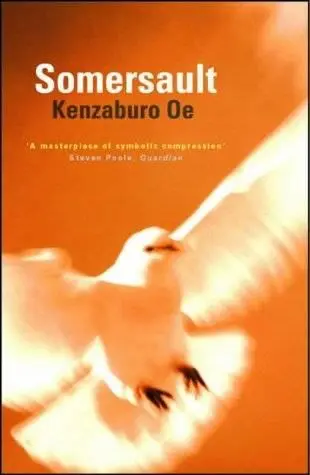
- Название:Somersault
- Автор:
- Жанр:
- Год:неизвестен
- ISBN:нет данных
- Рейтинг книги:4 / 5. Голосов: 1
-
Избранное:Добавить в избранное
- Отзывы:
-
Ваша оценка:
Somersault: краткое содержание, описание и аннотация
Предлагаем к чтению аннотацию, описание, краткое содержание или предисловие (зависит от того, что написал сам автор книги «Somersault»). Если вы не нашли необходимую информацию о книге — напишите в комментариях, мы постараемся отыскать её.
From Publishers Weekly
Nobelist Oe's giant new novel is inspired by the Aum Shinrikyo cult, which released sarin gas in Tokyo 's subway system in 1995. Ten years before the novel begins, Patron and Guide, the elderly leaders of Oe's fictional cult, discover, to their horror, that a militant faction of the organization is planning to seize a nuclear power plant. They dissolve the cult very publicly, on TV, in an act known as the Somersault. Ten years later, Patron decides to restart the fragmented movement, after the militant wing kidnaps and murders Guide, moving the headquarters of the church from Tokyo to the country town of Shikoku. Patron's idea is that he is really a fool Christ; in the end, however, he can't escape his followers' more violent expectations. Oe divides the story between Patron and his inner circle, which consists of his public relations man, Ogi, who is not a believer; his secretary, Dancer, an assertive, desirable young woman; his chauffeur, Ikuo; and Ikuo's lover, Kizu, who replaces Guide as co-leader of the cult. Kizu is a middle-aged artist, troubled by the reoccurrence of colon cancer. Like a Thomas Mann character, he discovers homoerotic passion in the throes of illness. Oe's Dostoyevskian themes should fill his story with thunder, but the pace is slow, and Patron doesn't have the depth of a Myshkin or a Karamazov-he seems anything but charismatic. It is Kizu and Ikuo's story that rises above room temperature, Kizu's sharp, painterly intelligence contrasting with Ikuo's rather sinister ardor. Oe has attempted to create a sprawling masterpiece, but American readers might decide there's more sprawl than masterpiece here.
Somersault — читать онлайн бесплатно полную книгу (весь текст) целиком
Ниже представлен текст книги, разбитый по страницам. Система сохранения места последней прочитанной страницы, позволяет с удобством читать онлайн бесплатно книгу «Somersault», без необходимости каждый раз заново искать на чём Вы остановились. Поставьте закладку, и сможете в любой момент перейти на страницу, на которой закончили чтение.
Интервал:
Закладка:
In a much more natural way than the fanciful images conjured up by run-of-the-mill surrealists, the figures of Ikuo and Kizu in the painting were walking off into the bright sky. Kizu realized he'd been taking Patron's trance world quite optimistically, hoping that he and Ikuo could stroll off into it in the near future. Even if you viewed this vision as his unconscious rising up to support his decision to become the new Guide, it was such a simplistic view he knew he himself, not Ogi, was the innocent one.
Construction work outside the apartment building that afternoon prevented people from parking in front, so Ikuo called him from down the road where he had parked. Kizu walked one block, to where Ikuo was waiting outside the car, and rested his hand on the young man's shoulder in lieu of a greet- ing, only to feel an inorganic coldness rising up at his touch, as if denying any affinity between them. Even if the young man's body was only transmitting the outside temperature, Ikuo was more taciturn than the day before. Inter- mittently in the course of their relationship Kizu had felt that they were going backward, to the time when they first met-and today was one of those days.
Ordinarily he would have taken the watercolor he'd painted that day out of its cardboard tube and shown it to Ikuo while they were waiting for a light to change. But today the timing was off.
"When you called a while ago, you said you'd just driven Dancer to the hospital for Guide's rehabilitation. Is he strong enough to undergo rehabili- tation? Is there a chance he'll recover his strength?"
Ikuo didn't respond right away to Kizu's question but just stared straight ahead. Finally, reluctantly, he answered.
"Dancer's doing her best, going to the hospital every day, but she doesn't believe he'll recover enough to take on his role as Guide again. The only thing she talked about in the car was what we can expect from you."
Kizu was escorted into the bedroom study by Ogi and sat down in a chair facing Patron, who was sunk deep in his armchair; Ikuo brought in a backless chair from the office for himself and sat down too. As they had gotten out of the car, Kizu had passed him the cardboard tube with the watercolor paint- ing in it; now Ikuo laid it in his lap and rested a hand on one end.
"We haven't done this before, but I'd like Ikuo to join us this time in hearing what you have to say, and Ogi tells me you've agreed," Kizu said.
"It's more proper now for me to say I'll listen to you," Patron said, his words brisk but his expression pensive. "Actually, I'd been hoping that we could both talk with Ikuo. There's also another reason for this meeting today. Often just after I wake up I'm in a kind of half-awake, half-asleep state, and when that happened again this morning I envisioned a scene before me.
I interpreted this as a sign that you would take on the role of being the new Guide with Ikuo beside you. I wanted to talk with you about this, and that's why I called you here without much warning.
"What I saw was you and Ikuo, hand in hand as I watched over you, stepping into space, each of you a sturdy support to the other in case one of you was about to fall. That was the scene I saw."
Kizu thought he was being taken in by some elaborate trick; at the same time he felt drawn in by those gentle, trusting eyes. He tried to resist.
"In this scene that you saw, was the place where you said Ikuo and I were walking-a space, you called it-was it the sky? If so, what was the weather like?"
"It was sunny," Patron replied. "I saw newly formed clouds gleaming whitely between the two of you and me, who was waiting to receive you. The clouds were shaped like a baby whale without a tail. The whale's head was three-dimensional; you could sense its weight, and the force of this weight made it move diagonally downward."
Kizu turned to look at Ikuo, who, before a word could pass between them, handed Kizu the cardboard tube on his lap. Kizu stuck two fingers inside the open end of the tube and extracted the watercolor painting, along with the cotton paper that was wrapped around it.
Patron took the painting and held it up to the light on the bedside table.
Kizu knew he often listened to classical CDs in this room, everything from ancient to modern music. The feeling rose up in Kizu that he was in the pres- ence of a considerable connoisseur of art.
After a while Patron lifted his eyes from the painting and laughed aloud, a simple, innocent burst of laughter. He nodded at Kizu, then passed the painting, its edges curling up on its own, over to Ikuo, who had been leaning over hesitantly to catch a glimpse. Patron didn't say a word about the con- gruence between the dream or vision he'd had and the scene depicted in the painting; his hearty laughter expressed it all. He evidently saw no need for any verbose explanation for himself, or for Kizu, or for Ikuo, who was por- ing over the painting.
It was Kizu, rather, taken in by Patron's laughter and unable to sup- press a smile, who felt that the painting cried out for interpretation. Kizu gazed at the painting in Ikuo's hands, as did Patron, Ikuo angling the paint- ing so it was easier for them to see, and once more he found himself unable to suppress a smile.
"This light-blue sky is what I saw from my apartment window this morning, and I painted it as it was," Kizu said. "The same with the grove of trees. The clouds, though, are something else. I'm amazed how accurate your description of them is-like a baby whale without a tail. These were clouds I saw outside the window of my university office in the States. Especially after I just took the job and was a little anxious about it, the clouds comforted me, so I added them nostalgically to the painting."
"That cloud-filled sky is the world on the other side toward which your soul is heading," Patron said. "It makes sense to see it as a nostalgic place."
"I wonder if I was thinking those kinds of things while I was painting it. It's a little vague to put it this way, I suppose, but I think I was envisioning Ikuo and me walking off into the bright sky as the two of us entered the world on the other side, the one you see in your trances. Rather than it being us entering my own trance."
"In a sense, though, they're one and the same," Patron said. "When you're so absorbed in your work, you break through to the other world of my trances. That's the ideal working relationship between patron and guide.
Guide once said that's what he was aiming at.
"Another important thing is that you and Ikuo are holding hands.
Through trances, we experience the world on the other side. But as Guide al- ways told me, because this great flow itself is God, you can't let yourself get caught up in the flow of ecstasy on the other side. Getting carried away by that flow means becoming one with God, and the ecstasy is a premonition of this.
"Of course, you could argue that getting caught up in it is actually the most natural thing to do. However, inside us all we have particles of light or resonance that are bestowed upon us by the One-and-only, the Almighty, or, in more prosaic terms, by God. For an individual, coming to faith means we take these particles of light or resonance so they're not some vague concept but are resituated in a more favorable environment in our own body and spirit.
Those particles of light or resonance are inside us, but they don't belong to us.
Even less are they created by us. They're put in our care by the Almighty.
Finally-and by this I don't mean just the inevitable result of the passage of time but also through training-we have to return these particles of light or resonance to the Almighty, where they originated. This is why we must keep them alive, unsullied. Not for a single moment must we forget these particles of light or resonance, which we take care of in our own bodies and spirit, are the source oí life, which we must in the end return to the Almighty.
Читать дальшеИнтервал:
Закладка:
Похожие книги на «Somersault»
Представляем Вашему вниманию похожие книги на «Somersault» списком для выбора. Мы отобрали схожую по названию и смыслу литературу в надежде предоставить читателям больше вариантов отыскать новые, интересные, ещё непрочитанные произведения.





Обсуждение, отзывы о книге «Somersault» и просто собственные мнения читателей. Оставьте ваши комментарии, напишите, что Вы думаете о произведении, его смысле или главных героях. Укажите что конкретно понравилось, а что нет, и почему Вы так считаете.