Kenzaburo Oe - Somersault
Здесь есть возможность читать онлайн «Kenzaburo Oe - Somersault» весь текст электронной книги совершенно бесплатно (целиком полную версию без сокращений). В некоторых случаях можно слушать аудио, скачать через торрент в формате fb2 и присутствует краткое содержание. Жанр: Современная проза, на английском языке. Описание произведения, (предисловие) а так же отзывы посетителей доступны на портале библиотеки ЛибКат.
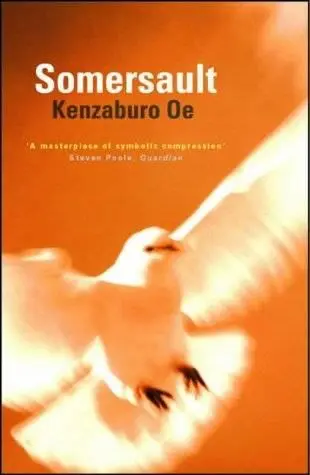
- Название:Somersault
- Автор:
- Жанр:
- Год:неизвестен
- ISBN:нет данных
- Рейтинг книги:4 / 5. Голосов: 1
-
Избранное:Добавить в избранное
- Отзывы:
-
Ваша оценка:
Somersault: краткое содержание, описание и аннотация
Предлагаем к чтению аннотацию, описание, краткое содержание или предисловие (зависит от того, что написал сам автор книги «Somersault»). Если вы не нашли необходимую информацию о книге — напишите в комментариях, мы постараемся отыскать её.
From Publishers Weekly
Nobelist Oe's giant new novel is inspired by the Aum Shinrikyo cult, which released sarin gas in Tokyo 's subway system in 1995. Ten years before the novel begins, Patron and Guide, the elderly leaders of Oe's fictional cult, discover, to their horror, that a militant faction of the organization is planning to seize a nuclear power plant. They dissolve the cult very publicly, on TV, in an act known as the Somersault. Ten years later, Patron decides to restart the fragmented movement, after the militant wing kidnaps and murders Guide, moving the headquarters of the church from Tokyo to the country town of Shikoku. Patron's idea is that he is really a fool Christ; in the end, however, he can't escape his followers' more violent expectations. Oe divides the story between Patron and his inner circle, which consists of his public relations man, Ogi, who is not a believer; his secretary, Dancer, an assertive, desirable young woman; his chauffeur, Ikuo; and Ikuo's lover, Kizu, who replaces Guide as co-leader of the cult. Kizu is a middle-aged artist, troubled by the reoccurrence of colon cancer. Like a Thomas Mann character, he discovers homoerotic passion in the throes of illness. Oe's Dostoyevskian themes should fill his story with thunder, but the pace is slow, and Patron doesn't have the depth of a Myshkin or a Karamazov-he seems anything but charismatic. It is Kizu and Ikuo's story that rises above room temperature, Kizu's sharp, painterly intelligence contrasting with Ikuo's rather sinister ardor. Oe has attempted to create a sprawling masterpiece, but American readers might decide there's more sprawl than masterpiece here.
Somersault — читать онлайн бесплатно полную книгу (весь текст) целиком
Ниже представлен текст книги, разбитый по страницам. Система сохранения места последней прочитанной страницы, позволяет с удобством читать онлайн бесплатно книгу «Somersault», без необходимости каждый раз заново искать на чём Вы остановились. Поставьте закладку, и сможете в любой момент перейти на страницу, на которой закончили чтение.
Интервал:
Закладка:
If you left Japan, Patron would lose his new Guide, but we'd be completely lost as well."
"But I don't have any of the qualities to make Patron want to rely on me," Kizu said. "I don't know anything about his earlier teachings, even if he has renounced them. And when I think of Guide, still such a unique spirit despite his condition, I don't think I understand him, either."
"You've only known Patron a short time, but the two of you have had some pretty deep conversations," Ikuo said. "Knowing you, Professor, I imag- ine that if you take on the role of the new Guide you'll use the opportunity to study Patron more. I've been thinking about this for a while now, but I really want you to ask Patron why he began calling himself the savior of mankind- whether fake or otherwise. I wanted to ask him myself, but our trip to Nasu Plateau was cut short."
"If it's so important to you, I'll do it. I need to ask Patron about Guide, too, why he called himself the prophet of mankind-fake or otherwise."
In the faint light of the snowy sky, an unexpected smile rose, like a cheer- ful mask, to Ikuo's angular, deeply chiseled features. Kizu had no idea how he was interpreting his response but didn't pursue it further. Staring out at the thickening snow lashing the windshield, he began to feel a decided softness coming from Ikuo. Not that Ikuo's soldierly frame or muscles soft- ened, it was rather that something inside was seeping out. When he turned to Ikuo, the young man's faint smile was gone, replaced by a relaxed, youth- ful expression.
Ever since he had first met Ikuo at the athletic club and invited him to pose for him at his apartment, and even more so after they began a sexual relationship, Kizu sensed the tension draining from the young man from time to time. But still Ikuo's attitude toward him, and probably toward everyone, contained, deep down, something hard and unrelenting; when Kizu had been about to write the letter to Patron for him, he had thought about how the incident he'd talked about, about God calling him as a child, had affected his life ever since.
Not that Kizu believed everything that Ikuo revealed to him. Kizu didn't believe that in this day and age there was a God who would let a young boy have such a mystical experience-not that, for God, such a concept as this day and age was relevant. Nevertheless, it was true that after Ikuo quit college, the conviction that he'd had this experience was the cornerstone of his life. When Kizu first saw Ikuo at the athletic club he had the look of a lone jungle fighter. In his rugged features and hard body, Ikuo's expression was far removed from the soft, gentle look Kizu had often seen in people of the same age after he returned to Japan. This didn't mean that Ikuo had anything in common with the dry and prosaic Vietnam vets that Kizu sometimes taught in the United States; this young man's heart was full of a yearning that wouldn't allow him to settle for being dull and ordinary.
At first Kizu had sensed something of the wild animal in Ikuo. A true loner, he drew no one else to him, but his exterior, which rejected everyone and everything, hid something quite extraordinary. Even though they were lovers the hard armor that was very much a part of Ikuo was still in place.
But now, with Kizu's acceptance of the role of new Guide, came that faint smile, that unexpected softness. He remembered that Dancer had looked dis- pleased at Patron's proposal, but later, after Kizu had emerged from the bed- room study, both she and Ogi accepted the idea.
Kizu considered again what it would mean to be the new Guide. And when he recalled something Patron had said, it was almost enough to revive the faint smile Ikuo said he'd never seen before: You don't need to say a thing.
You can be a Guide who just paints! But hadn't Patron said Guide was a man of language, who fulfilled his role by speaking? How could Kizu possibly convey Patron's visions to others through painting?
Kizu tried to imagine serving as the new Guide, but he couldn't imag- ine himself taking a proactive stance. He'd follow Patron's lead and do what he could as a painter. But painting what? Surely Patron didn't think he would do kamishibai illustrations for a storytelling session, did he?
Eventually, the agitation he'd felt talking to Patron died down, though there was no doubt in his mind that he was beginning a new stage of his life, a stage that, thankfully, included Ikuo.
3
The next morning when Kizu awoke, it had stopped snowing. It was not yet seven, but he was too excited to stay in bed. With Ikuo busy every day in the office, housecleaning duties were once more his, and he spent time straightening up the living room. He didn't use the powerful American-made vacuum cleaner that came with the apartment, though, for fear that it would disturb the neighboring residents. Sensing a flutter outside, he turned to look and saw that the powdery snow had begun to fall again. Kizu's sensitivity to peripheral movement seemed to him a good indicator of his present state of mind, though he had no idea why he felt this way.
After cleaning up his studio for a while, he looked out past the veranda to where, down the grassy slope, the surface of the pond had turned white. A thin layer of ice had covered the pond, with snow now piled on top. Snow lay, too, on the thick branches of the leafless, darkly exposed wych elm. A flock of wild birds that normally would have been chased off by even a sprinkle of rain were oblivious to the powdery snow, occasionally shaking their bodies as each protected its spot on the branch. Kizu realized that the snow had had something to do with the stirring he felt deep inside himself.
The sun came out in the afternoon and the snow that had been clinging to one side of the wych elm's trunk and the nearly horizontal parts of the thick branches melted away. All the snow on the pond's surface had disappeared, but no ripples disturbed the pond, so it was still frozen. The snow was gone from the lawn, too, just some white spots here and there on the withered grass between the trees. During the morning the awareness he felt inside him was mixed with darkness, and he recalled, for the first time in a long while, the phrase tingle with excitement, but in the afternoon the clarity of the sky and the clouds seeped into his heart.
He couldn't help but consider the new and difficult task that confronted him, but he felt he had sufficient energy saved to face up to it, so his feelings were, to use the term his students in New Jersey used, entirely positive. The clouds spreading outside his window were not the beginnings of a storm but rather a watercolor painted across the bright sky.
In the upper third of a Wattman F6 sketch pad he held vertically, Kizu sketched glittering white clouds and a light blue sky infused with light; in the lower fourth of the paper a totally leafless woods and a range of twiglike branches. He left the middle of the page blank. He wasn't clear about this space at all, but his years of experience as an artist told him it was significant; this sketch, still five-twelfths empty, would only become a work of art when this blank area was filled in. He wasn't going to use what he saw outside his win- dow, though. The space was just the right size for his imagination to fill in with something suited to the sky above and the woods below.
After a while Kizu began filling in the remaining areas with a soft pen- cil sketch of two standing figures facing away from the viewer. He switched to watercolors for the figures and added many vertical banks of clouds to the light-blue sky.
What Kizu had drawn was himself and Ikuo standing there and, in a way somehow not unnatural for two grown men, holding each other's hand.
In the painting Kizu was dressed as he was now, in faded black cotton trou- sers, a wool shirt, and a wine-colored sweater. Ikuo wore jeans and an over- sized blue shirt with sleeves that were too long. On their feet were something you'd never need in this city, the kind of ankle-high lace-up winter boots you might find a U. S. artist in the Northeast wearing.
Читать дальшеИнтервал:
Закладка:
Похожие книги на «Somersault»
Представляем Вашему вниманию похожие книги на «Somersault» списком для выбора. Мы отобрали схожую по названию и смыслу литературу в надежде предоставить читателям больше вариантов отыскать новые, интересные, ещё непрочитанные произведения.





Обсуждение, отзывы о книге «Somersault» и просто собственные мнения читателей. Оставьте ваши комментарии, напишите, что Вы думаете о произведении, его смысле или главных героях. Укажите что конкретно понравилось, а что нет, и почему Вы так считаете.