Kenzaburo Oe - Somersault
Здесь есть возможность читать онлайн «Kenzaburo Oe - Somersault» весь текст электронной книги совершенно бесплатно (целиком полную версию без сокращений). В некоторых случаях можно слушать аудио, скачать через торрент в формате fb2 и присутствует краткое содержание. Жанр: Современная проза, на английском языке. Описание произведения, (предисловие) а так же отзывы посетителей доступны на портале библиотеки ЛибКат.
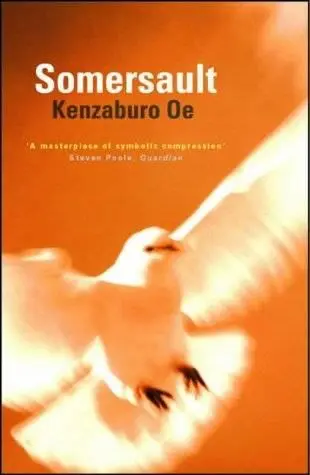
- Название:Somersault
- Автор:
- Жанр:
- Год:неизвестен
- ISBN:нет данных
- Рейтинг книги:4 / 5. Голосов: 1
-
Избранное:Добавить в избранное
- Отзывы:
-
Ваша оценка:
Somersault: краткое содержание, описание и аннотация
Предлагаем к чтению аннотацию, описание, краткое содержание или предисловие (зависит от того, что написал сам автор книги «Somersault»). Если вы не нашли необходимую информацию о книге — напишите в комментариях, мы постараемся отыскать её.
From Publishers Weekly
Nobelist Oe's giant new novel is inspired by the Aum Shinrikyo cult, which released sarin gas in Tokyo 's subway system in 1995. Ten years before the novel begins, Patron and Guide, the elderly leaders of Oe's fictional cult, discover, to their horror, that a militant faction of the organization is planning to seize a nuclear power plant. They dissolve the cult very publicly, on TV, in an act known as the Somersault. Ten years later, Patron decides to restart the fragmented movement, after the militant wing kidnaps and murders Guide, moving the headquarters of the church from Tokyo to the country town of Shikoku. Patron's idea is that he is really a fool Christ; in the end, however, he can't escape his followers' more violent expectations. Oe divides the story between Patron and his inner circle, which consists of his public relations man, Ogi, who is not a believer; his secretary, Dancer, an assertive, desirable young woman; his chauffeur, Ikuo; and Ikuo's lover, Kizu, who replaces Guide as co-leader of the cult. Kizu is a middle-aged artist, troubled by the reoccurrence of colon cancer. Like a Thomas Mann character, he discovers homoerotic passion in the throes of illness. Oe's Dostoyevskian themes should fill his story with thunder, but the pace is slow, and Patron doesn't have the depth of a Myshkin or a Karamazov-he seems anything but charismatic. It is Kizu and Ikuo's story that rises above room temperature, Kizu's sharp, painterly intelligence contrasting with Ikuo's rather sinister ardor. Oe has attempted to create a sprawling masterpiece, but American readers might decide there's more sprawl than masterpiece here.
Somersault — читать онлайн бесплатно полную книгу (весь текст) целиком
Ниже представлен текст книги, разбитый по страницам. Система сохранения места последней прочитанной страницы, позволяет с удобством читать онлайн бесплатно книгу «Somersault», без необходимости каждый раз заново искать на чём Вы остановились. Поставьте закладку, и сможете в любой момент перейти на страницу, на которой закончили чтение.
Интервал:
Закладка:
"Our church grew overnight. We started out with fifteen people, and in less than two years over five hundred people had renounced the world to join us. Having people renounce everything to join wasn't Guide's idea. One old lady did it and others followed suit. Since becoming a renuncíate meant selling your house and land and donating all your assets to the church, our financial situation improved by leaps and bounds. Guide took care of the bookkeeping, as well as of the steps needed to make our church nonprofit.
As I mentioned before, at that point we had over two thousand members.
"At this stage my own personal prayers and teachings were simple. I remember being questioned once by a Belgian reporter who was writing a piece on our church. I have trances, I told him, in order to gain a deeper under- standing of the approaching end of the world. This helps me be more open to it, intellectually and emotionally. My goal is complete repentance. As the power of the repentant grows, our connection with God will exceed the level of each individual and may even influence society.
"Suspicious of why the interpreter was silent, the Belgian reporter asked, 'Is that all?' just to make sure. 'Are your teachings really that simple?' The way he said it implied he was trying to unearth some secret teachings that had to exist in a church like ours, with over two thousand renunciates and funds exceeding two billion yen. To tell the truth, though, that was all there was to it.
"It was after our church became a religious foundation that Guide cre- ated his group of the best and the brightest of our young people. He expanded this group at a feverish pace. He bought some resort facilities in Izu that had belonged to a printing company and showed them how to fix it up; when it was finished it was quite a nice research facility. He created research teams to carry out inquiries in many fields-chemistry, biology, and physics-spar- ing no expense. At first the team members were selected from among our followers and were allowed to carry out the kind of research they had been doing in their former graduate schools and research labs. Over time, though, these members began to ask that former colleagues be allowed to join them.
As they did their research together, the new people would usually become believers, a development that took off quickly.
"Guide was always so excited when he reported to me on the activities of the Izu center. Those researchers who joined the church had all had some spiritual unease, and some people had dropped out of the competitive world of graduate school and research labs. Others couldn't get along with their academic advisers. Once these young people found our state-of-the-art re- search facility, they cooperated with their fellow researchers and immersed themselves in their research.
"The results they came up with at the research facility were good enough to present at international academic conferences, but in Japan once you leave your research lab it's difficult to get another job. These young researchers were oblivious to that, though, and went at their research with all the enthusiasm of young people training for a soccer match. Their attitude toward their work might very well be a model for how young people today should repent. All fired up, Guide told me he dreamed about organizing the education of this kind of young people.
"However, among this elite group, whom I'd left up to him for the most part and whom he mostly trained, a special sort of movement arose concern- ing our religious activities. In other words, what the press later dubbed the radical faction. This radical faction grew so quickly that it forced Guide and me to do our Somersault, but at first I had no misgivings about them whatso- ever. Rather, I felt a childish sense of relief. With this elite corps going at their research with such zeal, Guide wasn't likely to leave the church anytime soon.
That's what I hoped."
3
"Before long, Guide began running religious seminars at the Izu center and invited me to lecture. As I'm sure you know, Professor, from your years of teaching, seminars are an interesting forum for teaching because of the interaction between people involved. I was used to speaking about my reli- gious experiences as the visions I'd emotionally and physically experienced, with Guide helping to interpret them, but at the seminar the young people challenged me, and I discovered a new light shining on the page I'd seen in my vision. I found myself rereading this in front of them. That was how I discovered the way to proceed.
"I remember the first seminar well. Guide picked me up at headquar- ters and accompanied me to the Izu research center; our headquarters had begun as just a single rented room in Asukayama, where we used to meet, but soon we purchased the land and the whole apartment building and made a headquarters appropriate for this period of growth in the church.
"I had little academic background, and I thought it was a bother to have to go to Izu to appear in front of these former students from science depart- ments and medical schools. But something beyond this bothered me. The research facility, once a company resort, looked like an old deserted house from the outside, but once inside you could see how the members' devotion had made it into a pleasant place. To my surprise when I actually saw them all together, I found Guide had assembled over forty of these men and women.
The seminar began in a conference room right after we arrived, as we ate lunch. I was scared to death, but soon I was completely absorbed and found myself saying things I never would have normally said aloud. Guide, seated beside me, sometimes tilted his head to one side in disbelief, but still he viewed the proceedings happily.
"This elite group at the Izu research center was much more alert and active than the young followers at our usual gatherings. They sat at these old- fashioned long tables, no doubt left over from the days when the center was a recreational facility, and leaned forward toward me in rapt attention. I wasn't used to such attentive expressions and shining eyes. It gave me the kind of happy feeling you get when you see something completely new and unex- pected. Finally Guide spoke.
"'This isn't the first time you all have met Savior, is it? Most of you have heard him talk before, at various branch gatherings. I assume you're all pleased to have this opportunity to ask him questions directly?'
"They responded with youthful laughter, and one young woman spoke up and said it was the first time she'd actually seen me. She was part of a little five-person group that was seated in the front row, on the right. As soon as I entered the conference room I'd felt something was different about that group.
The young woman's hair was pulled back so tightly her forehead looked stretched, and though the color of her eyes was not pure Japanese, she was a type of person you might run across on the streets of Tokyo. Gesticulating in an offhand way that was different from people raised in Japan, she made the following statement: '"This is the first time I've met Savior,' she said. 'My mother became a follower first. My parents were divorced when I was little and I grew up with my father, who's of Irish extraction, in California. But my mother in Japan got very sick and wanted to see her ex-husband and daughter. She was hav- ing a terrible time trying to track us down when Savior gave her a hint that allowed her to locate us. After she got in touch with my father, he went to see her, quit his job, and decided to live in Japan. That's how our family was reunited.
'"I looked for a university I could transfer to from the one I was going to in the States. After I started school here I ran across an old friend from when I was a student in the American School in Yokohama, who was a follower of the Savior. When we graduated he was asked to come to the center here, and I came with him.
Читать дальшеИнтервал:
Закладка:
Похожие книги на «Somersault»
Представляем Вашему вниманию похожие книги на «Somersault» списком для выбора. Мы отобрали схожую по названию и смыслу литературу в надежде предоставить читателям больше вариантов отыскать новые, интересные, ещё непрочитанные произведения.





Обсуждение, отзывы о книге «Somersault» и просто собственные мнения читателей. Оставьте ваши комментарии, напишите, что Вы думаете о произведении, его смысле или главных героях. Укажите что конкретно понравилось, а что нет, и почему Вы так считаете.