Orhan Pamuk - My Name is Red
Здесь есть возможность читать онлайн «Orhan Pamuk - My Name is Red» весь текст электронной книги совершенно бесплатно (целиком полную версию без сокращений). В некоторых случаях можно слушать аудио, скачать через торрент в формате fb2 и присутствует краткое содержание. Жанр: Современная проза, на английском языке. Описание произведения, (предисловие) а так же отзывы посетителей доступны на портале библиотеки ЛибКат.
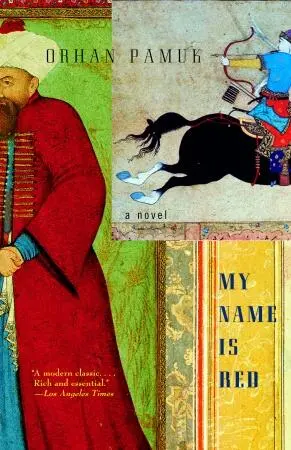
- Название:My Name is Red
- Автор:
- Жанр:
- Год:неизвестен
- ISBN:нет данных
- Рейтинг книги:5 / 5. Голосов: 1
-
Избранное:Добавить в избранное
- Отзывы:
-
Ваша оценка:
My Name is Red: краткое содержание, описание и аннотация
Предлагаем к чтению аннотацию, описание, краткое содержание или предисловие (зависит от того, что написал сам автор книги «My Name is Red»). Если вы не нашли необходимую информацию о книге — напишите в комментариях, мы постараемся отыскать её.
When the Sultan commissions a great book to celebrate his royal self and his extensive dominion, he directs Enishte Effendi to assemble a cadre of the most acclaimed artists in the land. Their task: to illuminate the work in the European style. But because figurative art can be deemed an affront to Islam, this commission is a dangerous proposition indeed, and no one in the elite circle can know the full scope or nature of the project.
Panic erupts when one of the chosen miniaturists disappears, and the Sultan demands answers within three days. The only clue to the mystery-or crime?-lies in the half-finished illuminations themselves. Has an avenging angel discovered the blasphemous work? Or is a jealous contender for the hand of Enishte’s ravishing daughter, the incomparable Shekure, somehow to blame?
Orhan Pamuk’s My Name Is Red is at once a fantasy and a philosophical puzzle, a kaleidoscopic journey to the intersection of art, religion, love, sex, and power.
"Pamuk is a novelist and a great one…My Name is Red is by far the grandest and most astonishing contest in his internal East-West war…It is chock-full of sublimity and sin…The story is told by each of a dozen characters, and now and then by a dog, a tree, a gold coin, several querulous corpses and the color crimson ('My Name is Red')…[Readers will] be lofted by the paradoxical lightness and gaiety of the writing, by the wonderfully winding talk perpetually about to turn a corner, and by the stubborn humanity in the characters' maneuvers to survive. It is a humanity whose lies and silences emerge as endearing and oddly bracing individual truths."- Richard Eder, New York Times Book Review
"A murder mystery set in sixteenth-century Istanbul [that] uses the art of miniature illumination, much as Mann's 'Doctor Faustus' did music, to explore a nation's soul… Erdag Goknar deserves praise for the cool, smooth English in which he has rendered Pamuk's finespun sentences, passionate art appreciations, sly pedantic debates, [and] eerie urban scenes."- John Updike, The New Yorker
"The interweaving of human and philosophical intrigue is very much as I remember it in The Name of the Rose, as is the slow, dense beginning and the relentless gathering of pace… But, in my view, his book is by far the better of the two. I would go so far as to say that Pamuk achieves the very thing his book implies is impossible… More than any other book I can think of, it captures not just Istanbul's past and present contradictions, but also its terrible, timeless beauty. It's almost perfect, in other words. All it needs is the Nobel Prize."-Maureen Freely, New Statesman (UK)
"A perfect example of Pamuk's method as a novelist, which is to combine literary trickery with page-turning readability… As a meditation on art, in particular, My Name is Red is exquisitely subtle, demanding and repaying the closest attention.. We in the West can only feel grateful that such a novelist as Pamuk exists, to act as a bridge between our culture and that of a heritage quite as rich as our own."-Tom Holland, Daily Telegraph (UK)
"Readers… will find themselves lured into a richly described and remarkable world… Reading the novel is like being in a magically exotic dream…Splendidly enjoyable and rewarding… A book in which you can thoroughly immerse yourself." -Allan Massie, The Scotsman (UK)
"A wonderful novel, dreamy, passionate and august, exotic in the most original and exciting way. Orhan Pamuk is indisputably a major novelist."-Philip Hensher, The Spectator (UK)
"[In this] magnificent new novel… Pamuk takes the reader into the strange and beautiful world of Islamic art,in which Western notions no longer make sense… In this world of forgeries, where some might be in danger of losing their faith in literature, Pamuk is the real thing, and this book might well be one of the few recent works of fiction that will be remembered at the end of this century."-Avkar Altinel, The Observer (UK)
My Name is Red — читать онлайн бесплатно полную книгу (весь текст) целиком
Ниже представлен текст книги, разбитый по страницам. Система сохранения места последней прочитанной страницы, позволяет с удобством читать онлайн бесплатно книгу «My Name is Red», без необходимости каждый раз заново искать на чём Вы остановились. Поставьте закладку, и сможете в любой момент перейти на страницу, на которой закончили чтение.
Интервал:
Закладка:
“How does one depict shadow?” asked Black.
From time to time, as my nephew listened, I perceived impatience in him. He’d begin to fiddle with the Mongol inkpot he’d given me as a present. At times, he’d take up the iron poker and stoke the fire in the stove. Now and then I imagined that he wanted to lower that poker onto my head and kill me because I dared to move the art of illustrating away from Allah’s perspective; because I would betray the dreams of the masters of Herat and their entire tradition of painting; because I’d duped Our Sultan into already doing so. Occasionally, Black would sit dead still for long stretches and fix his eyes deeply into mine. I could imagine what he was thinking: “I’ll be your slave until I can have your daughter.” Once, as I would do when he was a child, I took him out into the yard and tried to explain to him, as a father might, about the trees, about the light falling onto the leaves, about the melting snow and why the houses seemed to shrink as we moved away from them. But this was a mistake: It proved only that our former filial relationship had long since collapsed. Now patient sufferance of the rantings of a demented old man had taken the place of Black’s childhood curiosity and passion for knowledge. I was just an old man whose daughter was the object of Black’s love. The influence and experience of the countries and cities that my nephew had traveled through for a dozen years had been fully absorbed by his soul. He was tired of me, and I pitied him. And he was angry, I assumed, not only because I hadn’t allowed him to marry Shekure twelve years ago-after all, there was no other choice then-but because I dreamed of paintings whose style transgressed the precepts of the masters of Herat. Furthermore, because I raved about this nonsense with such conviction, I imagined my death at his hands.
I was not, however, afraid of him; on the contrary, I tried to frighten him. For I believed that fear was appropriate to the writing I’d requested of him. “As in those pictures,” I said, “one ought to be able to situate oneself at the center of the world. One of my illustrators brilliantly depicted Death for me. Behold.”
Thus I began to show him the paintings I’d secretly commissioned from the master miniaturists over the last year. At first, he was a tad shy, even frightened. When he understood that the depiction of Death was inspired by familiar scenes that could be found in many Book of Kings volumes-from the scene of Afrasiyab’s decapitation of Siyavush, for example, or Rüstem’s murder of Suhrab without realizing this was his son-he quickly became interested in the subject. Among the pictures that depicted the funeral of the late Sultan Süleyman was one I’d made with bold but sad colors, combining a compositional sensibility inspired by the Franks with my own attempt at shading-which I’d added later. I pointed out the diabolic depth evoked by the interplay of cloud and horizon. I reminded him that Death was unique, just like the portraits of infidels I had seen hanging in Venetian palazzos; all of them desperately yearned to be rendered distinctly. “They want to be so distinct and different, and they want this with such passion that,” I said, “look, look into the eyes of Death. See how men do not fear Death, but rather the violence implicit in the desire to be one-of-a-kind, unique and exceptional. Look at this illustration and write an account of it. Give voice to Death. Here’s paper and pen. I shall give what you write to the calligrapher straightaway.”
He stared at the picture in silence. “Who painted this?” he asked later.
“Butterfly. He’s the most talented of the lot. Master Osman had been in love with and awed by him for years.”
“I’ve seen rougher versions of this depiction of a dog at the coffeehouse where the storyteller performs,” Black said.
“My illustrators, most of whom are spiritually bound to Master Osman and the workshop, take a dim view of the labors performed for my book. When they leave here at night I imagine they have their vulgar fun over these illustrations which they draw for money and ridicule me at the coffeehouse. And who among them will ever forget the time Our Sultan had the young Venetian artist, whom He’d invited from the embassy at my behest, paint His portrait. Thereafter, He had Master Osman make a copy of that oil painting. Forced to imitate the Venetian painter, Master Osman held me responsible for this unseemly coercion and the shameful portrait that came of it. He was justified.”
All day long, I showed him every picture-except the final illustration that I cannot, for whatever reason, finish. I prodded him to write. I discussed the temperaments of the miniaturists, and I enumerated the sums of money I meted out to them. We discussed “perspective” and whether the diminutive objects in the background of Venetian pictures were sacrilegious, and equally, we talked about the possibility that unfortunate Elegant Effendi had been murdered for excessive ambition and out of jealousy over his wealth.
As Black returned home that night, I was confident he’d come again the next morning as promised and that he’d once again listen to me recount the stories that would constitute my book. I listened to his footsteps fading beyond the open gate; there was something to the cold night that seemed to make my sleepless and troubled murderer stronger and more devilish than me and my book.
I closed the courtyard gate tightly behind him. I placed the old ceramic water basin that I used as a basil planter behind the gate as I did each night. Before I reduced the stove to smoldering ashes and went to bed, I glanced up to see Shekure in a white gown looking like a ghost in the blackness.
“Are you absolutely certain that you want to marry him?” I asked.
“No, dear Father. I’ve long since forgotten about marriage. Besides, I am married.”
“If you still want to marry him, I’m willing to give you my blessing now.”
“I wish not to be wed to him.”
“Why?”
“Because it’s against your will. In all sincerity, I desire nobody that you do not want.”
I noticed, momentarily, the coals in the stove reflected in her eyes. Her eyes had aged, not out of unhappiness, but anger; yet there was no trace of offense in her voice.
“Black is in love with you,” I said as if divulging a secret.
“I know.”
“He listened to all I had to say today not out of his love of painting, but out of his love for you.”
“He will complete your book, this is what matters.”
“Your husband might return one day,” I said.
“I’m not certain why, perhaps it’s the silence, but tonight I’ve realized once and for all that my husband will never return. What I’ve dreamt seems to be the truth: They must’ve killed him. He’s long since turned to dust.” She whispered the last statement lest the sleeping children hear. And she said it with a peculiar tinge of anger.
“If they happen to kill me,” I said, “I want you to finish this book to which I’ve dedicated everything. Swear that you will.”
“I give my word. Who will be the one to complete your book?”
“Black! You can ensure that he does so.”
“You are already ensuring that he does so, dear Father,” she said. “You have no need for me.”
“Agreed, but he’s giving in to me because of you. If they kill me, he might be afraid to continue on.”
“In that case, he won’t be able to marry me,” said my clever daughter, smiling.
Where did I come up with the detail about her smiling? During the entire conversation, I noticed nothing except an occasional glimmer in her eyes. We were standing tensely facing one another in the middle of the room.
“Do you communicate with each other, exchange signals?” I asked, unable to contain myself.
Читать дальшеИнтервал:
Закладка:
Похожие книги на «My Name is Red»
Представляем Вашему вниманию похожие книги на «My Name is Red» списком для выбора. Мы отобрали схожую по названию и смыслу литературу в надежде предоставить читателям больше вариантов отыскать новые, интересные, ещё непрочитанные произведения.






Обсуждение, отзывы о книге «My Name is Red» и просто собственные мнения читателей. Оставьте ваши комментарии, напишите, что Вы думаете о произведении, его смысле или главных героях. Укажите что конкретно понравилось, а что нет, и почему Вы так считаете.