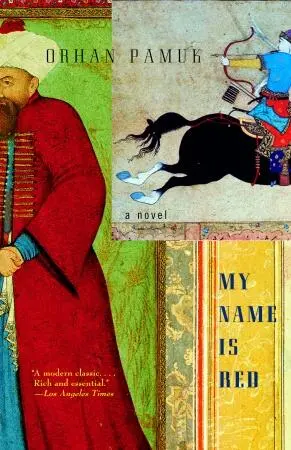
Orhan Pamuk - My Name is Red
Здесь есть возможность читать онлайн «Orhan Pamuk - My Name is Red» весь текст электронной книги совершенно бесплатно (целиком полную версию без сокращений). В некоторых случаях можно слушать аудио, скачать через торрент в формате fb2 и присутствует краткое содержание. Жанр: Современная проза, на английском языке. Описание произведения, (предисловие) а так же отзывы посетителей доступны на портале библиотеки ЛибКат.
- Название:My Name is Red
- Автор:
- Жанр:
- Год:неизвестен
- ISBN:нет данных
- Рейтинг книги:5 / 5. Голосов: 1
-
Избранное:Добавить в избранное
- Отзывы:
-
Ваша оценка:
My Name is Red: краткое содержание, описание и аннотация
Предлагаем к чтению аннотацию, описание, краткое содержание или предисловие (зависит от того, что написал сам автор книги «My Name is Red»). Если вы не нашли необходимую информацию о книге — напишите в комментариях, мы постараемся отыскать её.
When the Sultan commissions a great book to celebrate his royal self and his extensive dominion, he directs Enishte Effendi to assemble a cadre of the most acclaimed artists in the land. Their task: to illuminate the work in the European style. But because figurative art can be deemed an affront to Islam, this commission is a dangerous proposition indeed, and no one in the elite circle can know the full scope or nature of the project.
Panic erupts when one of the chosen miniaturists disappears, and the Sultan demands answers within three days. The only clue to the mystery-or crime?-lies in the half-finished illuminations themselves. Has an avenging angel discovered the blasphemous work? Or is a jealous contender for the hand of Enishte’s ravishing daughter, the incomparable Shekure, somehow to blame?
Orhan Pamuk’s My Name Is Red is at once a fantasy and a philosophical puzzle, a kaleidoscopic journey to the intersection of art, religion, love, sex, and power.
"Pamuk is a novelist and a great one…My Name is Red is by far the grandest and most astonishing contest in his internal East-West war…It is chock-full of sublimity and sin…The story is told by each of a dozen characters, and now and then by a dog, a tree, a gold coin, several querulous corpses and the color crimson ('My Name is Red')…[Readers will] be lofted by the paradoxical lightness and gaiety of the writing, by the wonderfully winding talk perpetually about to turn a corner, and by the stubborn humanity in the characters' maneuvers to survive. It is a humanity whose lies and silences emerge as endearing and oddly bracing individual truths."- Richard Eder, New York Times Book Review
"A murder mystery set in sixteenth-century Istanbul [that] uses the art of miniature illumination, much as Mann's 'Doctor Faustus' did music, to explore a nation's soul… Erdag Goknar deserves praise for the cool, smooth English in which he has rendered Pamuk's finespun sentences, passionate art appreciations, sly pedantic debates, [and] eerie urban scenes."- John Updike, The New Yorker
"The interweaving of human and philosophical intrigue is very much as I remember it in The Name of the Rose, as is the slow, dense beginning and the relentless gathering of pace… But, in my view, his book is by far the better of the two. I would go so far as to say that Pamuk achieves the very thing his book implies is impossible… More than any other book I can think of, it captures not just Istanbul's past and present contradictions, but also its terrible, timeless beauty. It's almost perfect, in other words. All it needs is the Nobel Prize."-Maureen Freely, New Statesman (UK)
"A perfect example of Pamuk's method as a novelist, which is to combine literary trickery with page-turning readability… As a meditation on art, in particular, My Name is Red is exquisitely subtle, demanding and repaying the closest attention.. We in the West can only feel grateful that such a novelist as Pamuk exists, to act as a bridge between our culture and that of a heritage quite as rich as our own."-Tom Holland, Daily Telegraph (UK)
"Readers… will find themselves lured into a richly described and remarkable world… Reading the novel is like being in a magically exotic dream…Splendidly enjoyable and rewarding… A book in which you can thoroughly immerse yourself." -Allan Massie, The Scotsman (UK)
"A wonderful novel, dreamy, passionate and august, exotic in the most original and exciting way. Orhan Pamuk is indisputably a major novelist."-Philip Hensher, The Spectator (UK)
"[In this] magnificent new novel… Pamuk takes the reader into the strange and beautiful world of Islamic art,in which Western notions no longer make sense… In this world of forgeries, where some might be in danger of losing their faith in literature, Pamuk is the real thing, and this book might well be one of the few recent works of fiction that will be remembered at the end of this century."-Avkar Altinel, The Observer (UK)
My Name is Red — читать онлайн бесплатно полную книгу (весь текст) целиком
Ниже представлен текст книги, разбитый по страницам. Система сохранения места последней прочитанной страницы, позволяет с удобством читать онлайн бесплатно книгу «My Name is Red», без необходимости каждый раз заново искать на чём Вы остановились. Поставьте закладку, и сможете в любой момент перейти на страницу, на которой закончили чтение.
Интервал:
Закладка:
I meandered behind the mulberry bushes and the bay-leaf trees, which had a pleasant aroma even in the coldest weather, and with my usual fastidiousness, I straightened up the wall boards between the collapsed chimney and the window with its dilapidated shutters. I entered and drew the lingering scent of one-hundred-year-old incense and mold deep into my lungs. It made me so blissful to be here, I thought tears would fall from my eyes.
If I haven’t already said so, I’d like to say that I fear nothing but Allah and the punishment meted out in this world has no import whatsoever in my opinion. What I fear are the various torments that murderers like myself will have to endure on Judgment Day, as is clearly described in the Glorious Koran, in the “Criterion” chapter, for example. In the ancient books, that I quite rarely lay hold of, whenever I see this punishment in all its colors and violence, recalling the simple, childish, yet terrifying scenes of Hell illustrated on calfskin by the old Arab miniaturists, or, for whatever reason, the torments of demons depicted by Chinese and Mongol master artists, I can’t keep myself from drawing this analogy and heeding its logic: What does “The Night Journey” chapter state in its thirty-third verse? Is it not written that one should not, without justification, take the life of another whose murder God forbids? All right then: The miscreant I’ve sent to Hell was not a believer, whose murder God had forbidden; and besides, I had excellent justification for shattering his skull.
This man had slandered those of us who’d worked on that book Our Sultan had secretly commissioned. If I hadn’t silenced him, he would’ve denounced as unbelievers Enishte Effendi, all the miniaturists and even Master Osman, letting the rabid followers of the Hoja of Erzurum have their way with them. If someone succeeded in announcing that the miniaturists were committing blasphemy, these followers of Ezurumi-who are looking for any excuse to exercise their strength-wouldn’t just be satisfied with doing away with the master miniaturists, they’d destroy the entire workshop and Our Sultan would be helpless to do anything but watch without a peep.
As I did every time I came here, I cleaned up with the broom and some rags I kept hidden in a corner. As I cleaned, I was heartened and felt like a dutiful servant of Allah again. So that He wouldn’t deprive me of this blessed feeling, I prayed for a long time. The cold, which was enough to make a fox shit copper, drove into my bones. I began to feel that sinister ache at the back of my throat. I stepped outside.
Soon afterward, again in the same strange state of mind, I found myself in a completely different neighborhood. I don’t know what had happened, what I’d thought between the deserted neighborhood of the dervish house and here. I didn’t know how I’d arrived on these roads lined with cypress trees.
However much I walked, a pestering thought wouldn’t leave me be, and it ate at me like a worm. Maybe if I tell you it’ll ease the burden: Call him a “vile slanderer” or “poor Elegant Effendi”-either way it’s the same thing-a short time before the dearly departed gilder had left this world, he was making vehement accusations against our Enishte, but when he saw that I wasn’t that affected by his declaration that Enishte Effendi made use of the perspectival techniques of the infidels, that beast divulged the following: “There’s one final picture. In that picture Enishte desecrates everything we believe in. What he’s doing is no longer an insult to religion, it’s pure blasphemy.” Furthermore, three weeks after this accusation by that scoundrel, Enishte Effendi had actually asked me to illustrate a number of unrelated things, such as a horse, a coin and Death, in various random spots on a page and in shockingly inconsistent scales; indeed, it was what one would expect of a Frankish painting. Enishte always took the trouble to cover large portions of the ruled section of the page he wanted me to illustrate as well as the places ill-fated Elegant Effendi had guilded, as though he wanted to conceal something from me and the other miniaturists.
I want to ask Enishte what he’s illustrating in this large, final painting, but there’s much holding me back. If I ask him, he’ll of course suspect that I murdered Elegant Effendi and make his suspicions known to all. But there’s something else that unsettles me as well. If I ask him, Enishte might declare that Elegant Effendi was in fact justified in his beliefs. Occasionally, I tell myself I should ask him, pretending as if this suspicion hadn’t passed to me from Elegant Effendi, but had simply occurred to me. In the end, it’s no comfort either way.
My legs, which have always been quicker than my head, had taken me of their own accord to Enishte Effendi’s street. I crouched in a secluded spot, and for a long time observed the house as best I could in the blackness. I watched for a long time: Nestled among trees was the large and odd-looking two-story house of a rich man! I couldn’t tell on which side Shekure’s room was located. As is the case in some of the pictures made in Tabriz during the reign of Shah Tahmasp, I imagined the house in cross-section-as if it were cut in half with a knife-and I tried to illustrate in my mind’s eye where I would find my Shekure, behind which shutter.
The door opened. I saw Black leaving the house in the darkness. Enishte gazed at him with affection from behind the courtyard gate for a moment before closing it.
Even my mind, which had given itself over to idiotic fantasies, quickly, and painfully, drew three conclusions based on what I had seen:
One: Since Black was cheaper and less dangerous, Enishte Effendi would have him complete our book.
Two: The beautiful Shekure would marry Black.
Three: What the unfortunate Elegant Effendi had said was true, and so, I’d killed him for naught.
In situations such as this, as soon as our merciless intellects draw the bitter conclusion that our hearts refuse, the entire body rebels against the mind. At first, half my mind violently opposed the third conclusion, which indicated that I was nothing but the vilest of murderers. My legs, once again, acting quicker and more rationally than my head, had already put me in pursuit of Black Effendi.
We’d passed down a few side streets when I thought how very easy it would be to murder him, so contentedly and self-assuredly walking before me, and how such a crime would save me from having to confront the first two vexing conclusions established by my mind. Furthermore, I wouldn’t have cracked Elegant Effendi’s skull for no reason at all. Now, if I run ahead eight or ten paces, catch up to Black and land a blow onto his head with all my might, everything will go on as usual. Enishte Effendi will invite me to finish our book. But meanwhile my more honest (what was honesty if not fear?) and prudent side continued to tell me that the monster I’d murdered and tossed into a well was truly a slanderer. And if this were the case, I hadn’t killed him for naught, and Enishte, who no longer had anything to hide with respect to the book he was making, would most certainly invite me back to his home.
As I watched Black walking before me, however, I knew with utmost certainty that none of this would happen. It was all illusion. Black Effendi was more real than I. It happens to us all: In reaction to being overly logical we’ll feed fantasies for weeks and years on end, and one day we’ll see something, a face, an outfit, a happy person, and suddenly realize that our dreams will never come true; thus, we come to understand that a particular maiden won’t be permitted to marry us or that we’ll never reach such-and-such a station in life.
I was watching the rise and fall of Black’s shoulders, his head and his neck-the incredibly annoying way that he walked, as though his every step were a gift to the world-with a profound hatred that coiled cozily around my heart. Men like Black, free from pangs of conscience and with promising futures before them, assume that the entire world is their home; they open every door like a sultan entering his personal stable and immediately belittle those of us crouched inside. The urge to grab a stone and run up behind him was almost too great to resist.
Читать дальшеИнтервал:
Закладка:
Похожие книги на «My Name is Red»
Представляем Вашему вниманию похожие книги на «My Name is Red» списком для выбора. Мы отобрали схожую по названию и смыслу литературу в надежде предоставить читателям больше вариантов отыскать новые, интересные, ещё непрочитанные произведения.









Обсуждение, отзывы о книге «My Name is Red» и просто собственные мнения читателей. Оставьте ваши комментарии, напишите, что Вы думаете о произведении, его смысле или главных героях. Укажите что конкретно понравилось, а что нет, и почему Вы так считаете.