Orhan Pamuk - My Name is Red
Здесь есть возможность читать онлайн «Orhan Pamuk - My Name is Red» весь текст электронной книги совершенно бесплатно (целиком полную версию без сокращений). В некоторых случаях можно слушать аудио, скачать через торрент в формате fb2 и присутствует краткое содержание. Жанр: Современная проза, на английском языке. Описание произведения, (предисловие) а так же отзывы посетителей доступны на портале библиотеки ЛибКат.
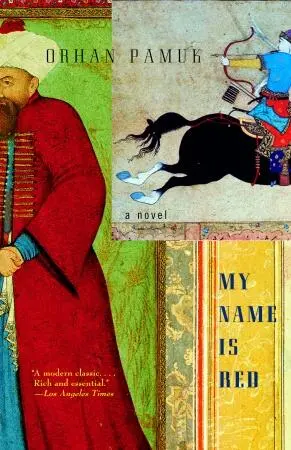
- Название:My Name is Red
- Автор:
- Жанр:
- Год:неизвестен
- ISBN:нет данных
- Рейтинг книги:5 / 5. Голосов: 1
-
Избранное:Добавить в избранное
- Отзывы:
-
Ваша оценка:
My Name is Red: краткое содержание, описание и аннотация
Предлагаем к чтению аннотацию, описание, краткое содержание или предисловие (зависит от того, что написал сам автор книги «My Name is Red»). Если вы не нашли необходимую информацию о книге — напишите в комментариях, мы постараемся отыскать её.
When the Sultan commissions a great book to celebrate his royal self and his extensive dominion, he directs Enishte Effendi to assemble a cadre of the most acclaimed artists in the land. Their task: to illuminate the work in the European style. But because figurative art can be deemed an affront to Islam, this commission is a dangerous proposition indeed, and no one in the elite circle can know the full scope or nature of the project.
Panic erupts when one of the chosen miniaturists disappears, and the Sultan demands answers within three days. The only clue to the mystery-or crime?-lies in the half-finished illuminations themselves. Has an avenging angel discovered the blasphemous work? Or is a jealous contender for the hand of Enishte’s ravishing daughter, the incomparable Shekure, somehow to blame?
Orhan Pamuk’s My Name Is Red is at once a fantasy and a philosophical puzzle, a kaleidoscopic journey to the intersection of art, religion, love, sex, and power.
"Pamuk is a novelist and a great one…My Name is Red is by far the grandest and most astonishing contest in his internal East-West war…It is chock-full of sublimity and sin…The story is told by each of a dozen characters, and now and then by a dog, a tree, a gold coin, several querulous corpses and the color crimson ('My Name is Red')…[Readers will] be lofted by the paradoxical lightness and gaiety of the writing, by the wonderfully winding talk perpetually about to turn a corner, and by the stubborn humanity in the characters' maneuvers to survive. It is a humanity whose lies and silences emerge as endearing and oddly bracing individual truths."- Richard Eder, New York Times Book Review
"A murder mystery set in sixteenth-century Istanbul [that] uses the art of miniature illumination, much as Mann's 'Doctor Faustus' did music, to explore a nation's soul… Erdag Goknar deserves praise for the cool, smooth English in which he has rendered Pamuk's finespun sentences, passionate art appreciations, sly pedantic debates, [and] eerie urban scenes."- John Updike, The New Yorker
"The interweaving of human and philosophical intrigue is very much as I remember it in The Name of the Rose, as is the slow, dense beginning and the relentless gathering of pace… But, in my view, his book is by far the better of the two. I would go so far as to say that Pamuk achieves the very thing his book implies is impossible… More than any other book I can think of, it captures not just Istanbul's past and present contradictions, but also its terrible, timeless beauty. It's almost perfect, in other words. All it needs is the Nobel Prize."-Maureen Freely, New Statesman (UK)
"A perfect example of Pamuk's method as a novelist, which is to combine literary trickery with page-turning readability… As a meditation on art, in particular, My Name is Red is exquisitely subtle, demanding and repaying the closest attention.. We in the West can only feel grateful that such a novelist as Pamuk exists, to act as a bridge between our culture and that of a heritage quite as rich as our own."-Tom Holland, Daily Telegraph (UK)
"Readers… will find themselves lured into a richly described and remarkable world… Reading the novel is like being in a magically exotic dream…Splendidly enjoyable and rewarding… A book in which you can thoroughly immerse yourself." -Allan Massie, The Scotsman (UK)
"A wonderful novel, dreamy, passionate and august, exotic in the most original and exciting way. Orhan Pamuk is indisputably a major novelist."-Philip Hensher, The Spectator (UK)
"[In this] magnificent new novel… Pamuk takes the reader into the strange and beautiful world of Islamic art,in which Western notions no longer make sense… In this world of forgeries, where some might be in danger of losing their faith in literature, Pamuk is the real thing, and this book might well be one of the few recent works of fiction that will be remembered at the end of this century."-Avkar Altinel, The Observer (UK)
My Name is Red — читать онлайн бесплатно полную книгу (весь текст) целиком
Ниже представлен текст книги, разбитый по страницам. Система сохранения места последней прочитанной страницы, позволяет с удобством читать онлайн бесплатно книгу «My Name is Red», без необходимости каждый раз заново искать на чём Вы остановились. Поставьте закладку, и сможете в любой момент перейти на страницу, на которой закончили чтение.
Интервал:
Закладка:
At Kemeraralık, I saw a woman on horseback with her slaves, sitting bolt upright like a man. She was proud as proud could be, maybe the wife of a pasha or his rich daughter. I sighed. If Shekure’s father hadn’t been so absentmindedly devoted to books, if her husband had returned from the Safavid war with his plunder, Shekure might’ve lived like this haughty woman. More than anyone, she deserved it.
When I turned onto Black’s street, my heart quickened. Did I want Shekure to marry this man? I’ve succeeded both in keeping Shekure involved with Hasan and, at the same time, in keeping them apart. But what about this Black? He seems to have both feet on the ground in all respects except with regard to his love for Shekure.
“Clothierrrrr!”
There’s nothing I’d trade for the pleasure of delivering letters to lovers addled by loneliness or the lack of wife or husband. Even if they’re certain of receiving the worst news, when they’re about to read the letter, a shudder of hope overcomes them.
By not mentioning anything about her husband’s return, by tying her warning “Don’t get your hopes up” to one condition alone, Shekure had, of course, given Black more than just cause to be hopeful. With great pleasure, I watched him read the letter. He was so happy he was distraught, afraid even. When he withdrew to write his response, I, being a sensible clothes peddler, spread open my decoy “delivery” satchel and withdrew from it a dark money purse, which I attempted to sell to Black’s nosy landlady.
“This is made of the best Persian velvet,” I said.
“My son died at war in Persia,” she said. “Whose letters do you deliver to Black?”
I could read from her face that she was making plans to set up her own wiry daughter, or who knows whose daughter, with lionhearted Black. “No one’s,” I said. “A poor relative of his who’s on his deathbed in the Bayrampasha sickhouse and needs money.”
“Oh my,” she said, unconvinced, “who is the unfortunate man?”
“How did your son die in the war?” I asked stubbornly.
We began to glare at each other with hostility. She was a widow and all alone. Her life must’ve been quite difficult. If you ever happen to become a clothier-cum-messenger like Esther, you’ll soon learn that only wealth, might and legendary romances stir people’s curiosity. Everything else is but worry, separation, jealousy, loneliness, enmity, tears, gossip and never-ending poverty. Such things never change, just like the objects that furnish a home: a faded old kilim, a ladle and small copper pan resting on an empty baking sheet, tongs and an ash box resting beside the stove, two worn chests-one small, one large-a turban stand maintained to conceal the widow’s solitary life and an old sword to scare thieves off.
Black hastily returned with his money purse. “Clothier woman,” he said, making himself heard to the meddling landlady rather than myself. “Take this and bring it to our suffering patient. If he has any response for me, I’ll be waiting. You can find me at Master Enishte’s house, where I’ll spend the rest of the day.”
There’s no need for all of these games. No cause for a young brave-heart like Black to hide his amatory maneuvers, the signals he receives, the handkerchiefs and letters he sends in pursuit of a maiden. Or does he truly have his eye on his landlady’s daughter? At times, I didn’t trust Black at all and was afraid that he was deceiving Shekure terribly. How is it that, despite spending his entire day with Shekure in the same house, he’s incapable of giving her a sign?
Once I was outside, I opened the purse. It contained twelve silver coins and a letter. I was so curious about the letter that I nearly ran to Hasan. Vegetable-sellers had spread out cabbage, carrots and the rest in front of their shops. But I didn’t even have it in me to touch the plump leeks that were crying out to me to fondle them.
I turned onto the side street, and saw that the blind Tatar was there waiting to heckle me again. “Tuh,” I spat in his direction; that was all. Why doesn’t this biting cold freeze these vagrants to death?
As Hasan silently read the letter, I could barely maintain my patience. Finally, unable to restrain myself, I suddenly said “Yes?” and he began reading aloud:
My Dearest Shekure, you’ve requested that I complete your father’s book. You can be certain that I have no other goal. I visit your house for this reason; not to pester you, as you’d earlier indicated. I’m quite aware that my love for you is my own concern. Yet, due to this love, I’m unable properly to take up my pen and write what your father-my dear Uncle-has requested for his book. Whenever I sense your presence in the house, I seize up and am of no service to your father. I’ve mulled this over extensively and there can be but one cause: After twelve years, I’ve seen your face only once, when you showed yourself at the window. Now, I quite fear losing that vision. If I could once more see you close-up, I’d have no fear of losing you, and I could easily finish your father’s book. Yesterday, Shevket brought me to the abandoned house of the Hanged Jew. No one will see us there. Today, at whatever time you see fit, I’ll go there and wait for you. Yesterday, Shevket mentioned that you dreamt your husband had died.
Hasan read the letter mockingly, in places raising his already high-pitched voice even higher like a woman’s, and in places, emulating the trembling supplication of a lover who’d lost all reason. He made light of Black’s having written his wish “to see you just once” in Persian. He added, “As soon as Black saw that Shekure had given him some hope, he quickly began to negotiate. Such haggling isn’t something a genuine lover would resort to.”
“He’s genuinely in love with Shekure,” I said naively.
“This comment proves that you’ve taken Black’s side,” he said. “If Shekure has written that she dreamt my older brother was dead, it means she accepts her husband’s death.”
“That was just a dream,” I said like an idiot.
“I know how smart and cunning Shevket is. We lived together for many years! Without his mother’s permission and prodding, he’d never have taken Black to the house of the Hanged Jew. If Shekure thinks she’s through with my older brother-with us-she’s terribly mistaken! My older brother is still alive and he’ll return from the war.”
Before he had a chance to conclude, he went into the next room where he intended to light a candle, but succeeded only in burning his hand. He let out a howl. All the while licking the burn, he finally lit the candle and placed it beside a folding worktable. He produced a reed pen from its case, dipped it into an inkwell and began furiously writing on a small piece of paper. I sensed his pleasure at my watching him, and to show that I wasn’t afraid, I smiled exaggeratedly.
“Who is this Hanged Jew, you must know?” he asked.
“Just beyond these houses there’s a yellow one. They say that Moshe Hamon, the beloved doctor of the previous Sultan and the wealthiest of men, had for years hidden his Jewish mistress from Amasya and her brother there. Years ago in Amasya, on the eve of Passover, when a Greek youth supposedly ”disappeared“ in the Jewish quarter, people claimed that he’d been strangled so unleavened bread could be made from his blood. When false witnesses were brought forward, an execution of Jews began; however, the Sultan’s beloved doctor helped this beautiful woman and her brother escape, and hid them with the permission of the Sultan. After the Sultan died, His enemies couldn’t find the beautiful woman, but they hanged her brother, who’d been living alone.”
“If Shekure doesn’t wait for my brother to come back from the front, they’ll punish her,” said Hasan, handing me the letters.
Читать дальшеИнтервал:
Закладка:
Похожие книги на «My Name is Red»
Представляем Вашему вниманию похожие книги на «My Name is Red» списком для выбора. Мы отобрали схожую по названию и смыслу литературу в надежде предоставить читателям больше вариантов отыскать новые, интересные, ещё непрочитанные произведения.










Обсуждение, отзывы о книге «My Name is Red» и просто собственные мнения читателей. Оставьте ваши комментарии, напишите, что Вы думаете о произведении, его смысле или главных героях. Укажите что конкретно понравилось, а что нет, и почему Вы так считаете.