Orhan Pamuk - My Name is Red
Здесь есть возможность читать онлайн «Orhan Pamuk - My Name is Red» весь текст электронной книги совершенно бесплатно (целиком полную версию без сокращений). В некоторых случаях можно слушать аудио, скачать через торрент в формате fb2 и присутствует краткое содержание. Жанр: Современная проза, на английском языке. Описание произведения, (предисловие) а так же отзывы посетителей доступны на портале библиотеки ЛибКат.
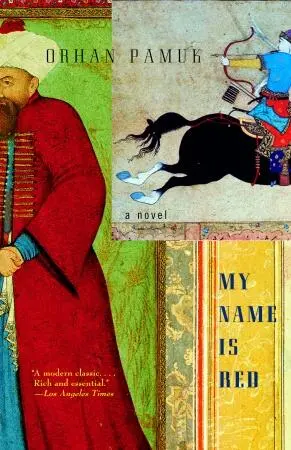
- Название:My Name is Red
- Автор:
- Жанр:
- Год:неизвестен
- ISBN:нет данных
- Рейтинг книги:5 / 5. Голосов: 1
-
Избранное:Добавить в избранное
- Отзывы:
-
Ваша оценка:
My Name is Red: краткое содержание, описание и аннотация
Предлагаем к чтению аннотацию, описание, краткое содержание или предисловие (зависит от того, что написал сам автор книги «My Name is Red»). Если вы не нашли необходимую информацию о книге — напишите в комментариях, мы постараемся отыскать её.
When the Sultan commissions a great book to celebrate his royal self and his extensive dominion, he directs Enishte Effendi to assemble a cadre of the most acclaimed artists in the land. Their task: to illuminate the work in the European style. But because figurative art can be deemed an affront to Islam, this commission is a dangerous proposition indeed, and no one in the elite circle can know the full scope or nature of the project.
Panic erupts when one of the chosen miniaturists disappears, and the Sultan demands answers within three days. The only clue to the mystery-or crime?-lies in the half-finished illuminations themselves. Has an avenging angel discovered the blasphemous work? Or is a jealous contender for the hand of Enishte’s ravishing daughter, the incomparable Shekure, somehow to blame?
Orhan Pamuk’s My Name Is Red is at once a fantasy and a philosophical puzzle, a kaleidoscopic journey to the intersection of art, religion, love, sex, and power.
"Pamuk is a novelist and a great one…My Name is Red is by far the grandest and most astonishing contest in his internal East-West war…It is chock-full of sublimity and sin…The story is told by each of a dozen characters, and now and then by a dog, a tree, a gold coin, several querulous corpses and the color crimson ('My Name is Red')…[Readers will] be lofted by the paradoxical lightness and gaiety of the writing, by the wonderfully winding talk perpetually about to turn a corner, and by the stubborn humanity in the characters' maneuvers to survive. It is a humanity whose lies and silences emerge as endearing and oddly bracing individual truths."- Richard Eder, New York Times Book Review
"A murder mystery set in sixteenth-century Istanbul [that] uses the art of miniature illumination, much as Mann's 'Doctor Faustus' did music, to explore a nation's soul… Erdag Goknar deserves praise for the cool, smooth English in which he has rendered Pamuk's finespun sentences, passionate art appreciations, sly pedantic debates, [and] eerie urban scenes."- John Updike, The New Yorker
"The interweaving of human and philosophical intrigue is very much as I remember it in The Name of the Rose, as is the slow, dense beginning and the relentless gathering of pace… But, in my view, his book is by far the better of the two. I would go so far as to say that Pamuk achieves the very thing his book implies is impossible… More than any other book I can think of, it captures not just Istanbul's past and present contradictions, but also its terrible, timeless beauty. It's almost perfect, in other words. All it needs is the Nobel Prize."-Maureen Freely, New Statesman (UK)
"A perfect example of Pamuk's method as a novelist, which is to combine literary trickery with page-turning readability… As a meditation on art, in particular, My Name is Red is exquisitely subtle, demanding and repaying the closest attention.. We in the West can only feel grateful that such a novelist as Pamuk exists, to act as a bridge between our culture and that of a heritage quite as rich as our own."-Tom Holland, Daily Telegraph (UK)
"Readers… will find themselves lured into a richly described and remarkable world… Reading the novel is like being in a magically exotic dream…Splendidly enjoyable and rewarding… A book in which you can thoroughly immerse yourself." -Allan Massie, The Scotsman (UK)
"A wonderful novel, dreamy, passionate and august, exotic in the most original and exciting way. Orhan Pamuk is indisputably a major novelist."-Philip Hensher, The Spectator (UK)
"[In this] magnificent new novel… Pamuk takes the reader into the strange and beautiful world of Islamic art,in which Western notions no longer make sense… In this world of forgeries, where some might be in danger of losing their faith in literature, Pamuk is the real thing, and this book might well be one of the few recent works of fiction that will be remembered at the end of this century."-Avkar Altinel, The Observer (UK)
My Name is Red — читать онлайн бесплатно полную книгу (весь текст) целиком
Ниже представлен текст книги, разбитый по страницам. Система сохранения места последней прочитанной страницы, позволяет с удобством читать онлайн бесплатно книгу «My Name is Red», без необходимости каждый раз заново искать на чём Вы остановились. Поставьте закладку, и сможете в любой момент перейти на страницу, на которой закончили чтение.
Интервал:
Закладка:
“Have you ever seen a dead cat?” he asked. His nose was exactly like his mother’s. Was she watching us? I looked around. The shutters were closed on the enchanted second-floor window in which I’d first seen Shekure after so many years.
“Nay.”
“Shall I show you the dead cat in the house of the Hanged Jew?”
He went out to the street without waiting for my response. I followed him. We walked forty or fifty paces along the muddy and icy path before entering an unkempt garden. Here, it smelled of wet and rotting leaves, and faintly of mold. With the confidence of a child who knew the place well, taking firm, rhythmic steps, he entered through the door of a yellow house, which stood before us almost hidden behind somber fig and almond trees.
The house was completely empty, but it was dry and warm, as if somebody were living there.
“Whose house is this?” I asked.
“The Jews”. When the man died, his wife and kids went to the Jewish quarter over by the fruit-sellers’ quay. They’re having Esther the clothier sell the house.“ He went into a corner of the room and returned. ”The cat’s gone, it’s disappeared,“ he said.
“Where would a dead cat go?”
“My grandfather says the dead wander.”
“Not the dead themselves,” I said. “Their spirits wander.”
“How do you know?” he said. He was holding the chamber pot tightly against his lap in all seriousness.
“I just know. Do you always come here?”
“My mother comes here with Esther. The living dead, risen from the grave, come here at night, but I’m not afraid of this place. Have you ever killed a man?”
“Yes.”
“How many?”
“Not many. Two.”
“With a sword?”
“With a sword.”
“Do their souls wander?”
“I don’t know. According to what’s written in books, they must wander.”
“Uncle Hasan has a red sword. It’s so sharp it’ll cut you if you just touch it. And he has a dagger with a ruby-studded handle. Are you the one who killed my father?”
I nodded indicating neither “yes” nor “no.” “How do you know that your father is dead?”
“My mother said so yesterday. He won’t be returning. She saw him in her dream.”
If presented with the opportunity, we would choose to do in the name of a greater goal whatever awful thing we’ve already prepared to do for the sake of our own miserable gains, for the lust that burns within us or for the love that breaks our hearts; and so, I resolved once more to become the father of these forsaken children, and, when I returned to the house, I listened more intently to Shevket’s grandfather as he described the book whose text and illustrations I had to complete.
Let me begin with the illustrations that my Enishte had shown me, the horse for example. On this page there were no human figures and the area around the horse was empty; even so, I couldn’t say it was simply and exclusively the painting of a horse. Yes, the horse was there, yet it was apparent that the rider had stepped off to the side, or who knows, perhaps he was on the verge of emerging from behind the bush drawn in the Kazvin style. This was immediately apparent from the saddle upon the horse, which bore the marks and embellishments of nobility: Maybe, a man with his sword at the ready was about to appear beside the steed.
It was obvious that Enishte commissioned this horse from a master illustrator whom he’d secretly summoned from the workshop. Because the illustrator, arriving at night, could draw a horse-ingrained in his mind like a stencil-only if it were the extension of a story, that’s exactly how he’d begin: by rote. As he was drawing the horse, which he’d seen thousands of times in scenes of love and war, my Enishte, inspired by the methods of the Venetian masters, had probably instructed the illustrator; for example, he might have said, “Forget about the rider, draw a tree there. But draw it in the background, on a smaller scale.”
The illustrator, who came at night, would sit before his work desk together with my Enishte, eagerly drawing by candlelight an odd, unconventional picture that didn’t resemble any of the usual scenes to which he was accustomed and had memorized. Of course, my Enishte paid him handsomely for each drawing, but frankly, this peculiar method of drawing also had its charms. However, as with my Enishte, after a while, the illustrator could no longer determine which story the illustration was intended to enhance and complete. What my Enishte expected of me was that I examine these illustrations made in half-Venetian, half-Persian mode and write a story suitable to accompany them on the opposite page. If I hoped to get Shekure, I absolutely had to write these stories, but all that came to mind were the stories the storyteller told at the coffeehouse.
I WILL BE CALLED A MURDERER
Ticking away, my windup clock told me it was evening. The prayers had yet to be called, but long before, I’d lit the candle resting beside my folding worktable. I quickly completed drawing an opium addict from memory, having dipped my reed pen into black Hasan Pasha ink and skated it over well-burnished and beautifully sized paper, when I heard that voice calling me out to the street as it did every night. I resisted. I was so determined not to go, but to stay at home and work, I even tried nailing my door shut for a time.
This book I was hastily completing was commissioned by an Armenian who’d come all the way from Galata, knocking on my door this morning before anyone had risen. The man, an interpreter and guide, though he stuttered, hunted me down whenever a Frank or Venetian traveler wanted a “book of costumes” and engaged me in a bout of vicious bargaining. Having agreed that morning upon a lesser-quality book of costumes for a price of twenty silver pieces, I proceeded to illustrate a dozen Istanbulites in a single sitting around the time of the evening prayer, paying particular attention to the detail of their outfits. I drew a Sheikhulislam, a palace porter, a preacher, a Janissary, a dervish, a cavalryman, a judge, a liver seller, an executioner-executioners in the act of torture sold quite well-a beggar, a woman bound for the hamam, and an opium addict. I’d done so many of these books just to earn a few extra silver pieces that I began to invent games for myself to fight off boredom while I drew; for example, I forced myself to draw the judge without lifting my pen off the page or to draw the beggar with my eyes closed.
All brigands, poets and men of constant sorrow know that when the evening prayer is called the jinns and demons within them will grow agitated and rebellious, urging in unision: “Out! Outside!” This restless inner voice demands, “Seek the company of others, seek blackness, misery and disgrace.” I’ve spent my time appeasing these jinns and demons. I’ve painted pictures, which many regard as miracles that have issued from my hands, with the help of these evil spirits. But for seven days now after dusk, since I murdered that disgrace, I’m no longer able to control the jinns and demons within me. They rage with such violence that I tell myself they might calm down if I go out for a while.
After saying so, as always without knowing how, I found myself roaming through the night. I walked briskly, advancing through snowy streets, muddy passages, icy slopes and deserted sidewalks as if I would never stop. As I walked, descending into the dark of night, into the most remote and abandoned parts of the city, I’d ever so gradually leave my soul behind, and walking along the narrow streets, my footsteps echoing off the walls of stone inns, schools and mosques, my fears would subside.
Of their own accord, my feet brought me to the abandoned streets of this neighborhood on the outskirts of the city, where I came each night and where even specters and jinns would shudder to roam. I heard tell that half the men in this neighborhood had perished in the wars with Persia and that the rest had fled, declaring it ill-omened, but I don’t believe such superstition. The only tragedy that has befallen this good quarter on account of the Safavid wars was the closing of the Kalenderi dervish house forty years ago because it was suspected of harboring the enemy.
Читать дальшеИнтервал:
Закладка:
Похожие книги на «My Name is Red»
Представляем Вашему вниманию похожие книги на «My Name is Red» списком для выбора. Мы отобрали схожую по названию и смыслу литературу в надежде предоставить читателям больше вариантов отыскать новые, интересные, ещё непрочитанные произведения.







Обсуждение, отзывы о книге «My Name is Red» и просто собственные мнения читателей. Оставьте ваши комментарии, напишите, что Вы думаете о произведении, его смысле или главных героях. Укажите что конкретно понравилось, а что нет, и почему Вы так считаете.