Orhan Pamuk - My Name is Red
Здесь есть возможность читать онлайн «Orhan Pamuk - My Name is Red» весь текст электронной книги совершенно бесплатно (целиком полную версию без сокращений). В некоторых случаях можно слушать аудио, скачать через торрент в формате fb2 и присутствует краткое содержание. Жанр: Современная проза, на английском языке. Описание произведения, (предисловие) а так же отзывы посетителей доступны на портале библиотеки ЛибКат.
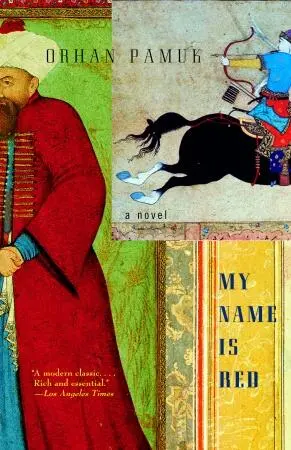
- Название:My Name is Red
- Автор:
- Жанр:
- Год:неизвестен
- ISBN:нет данных
- Рейтинг книги:5 / 5. Голосов: 1
-
Избранное:Добавить в избранное
- Отзывы:
-
Ваша оценка:
My Name is Red: краткое содержание, описание и аннотация
Предлагаем к чтению аннотацию, описание, краткое содержание или предисловие (зависит от того, что написал сам автор книги «My Name is Red»). Если вы не нашли необходимую информацию о книге — напишите в комментариях, мы постараемся отыскать её.
When the Sultan commissions a great book to celebrate his royal self and his extensive dominion, he directs Enishte Effendi to assemble a cadre of the most acclaimed artists in the land. Their task: to illuminate the work in the European style. But because figurative art can be deemed an affront to Islam, this commission is a dangerous proposition indeed, and no one in the elite circle can know the full scope or nature of the project.
Panic erupts when one of the chosen miniaturists disappears, and the Sultan demands answers within three days. The only clue to the mystery-or crime?-lies in the half-finished illuminations themselves. Has an avenging angel discovered the blasphemous work? Or is a jealous contender for the hand of Enishte’s ravishing daughter, the incomparable Shekure, somehow to blame?
Orhan Pamuk’s My Name Is Red is at once a fantasy and a philosophical puzzle, a kaleidoscopic journey to the intersection of art, religion, love, sex, and power.
"Pamuk is a novelist and a great one…My Name is Red is by far the grandest and most astonishing contest in his internal East-West war…It is chock-full of sublimity and sin…The story is told by each of a dozen characters, and now and then by a dog, a tree, a gold coin, several querulous corpses and the color crimson ('My Name is Red')…[Readers will] be lofted by the paradoxical lightness and gaiety of the writing, by the wonderfully winding talk perpetually about to turn a corner, and by the stubborn humanity in the characters' maneuvers to survive. It is a humanity whose lies and silences emerge as endearing and oddly bracing individual truths."- Richard Eder, New York Times Book Review
"A murder mystery set in sixteenth-century Istanbul [that] uses the art of miniature illumination, much as Mann's 'Doctor Faustus' did music, to explore a nation's soul… Erdag Goknar deserves praise for the cool, smooth English in which he has rendered Pamuk's finespun sentences, passionate art appreciations, sly pedantic debates, [and] eerie urban scenes."- John Updike, The New Yorker
"The interweaving of human and philosophical intrigue is very much as I remember it in The Name of the Rose, as is the slow, dense beginning and the relentless gathering of pace… But, in my view, his book is by far the better of the two. I would go so far as to say that Pamuk achieves the very thing his book implies is impossible… More than any other book I can think of, it captures not just Istanbul's past and present contradictions, but also its terrible, timeless beauty. It's almost perfect, in other words. All it needs is the Nobel Prize."-Maureen Freely, New Statesman (UK)
"A perfect example of Pamuk's method as a novelist, which is to combine literary trickery with page-turning readability… As a meditation on art, in particular, My Name is Red is exquisitely subtle, demanding and repaying the closest attention.. We in the West can only feel grateful that such a novelist as Pamuk exists, to act as a bridge between our culture and that of a heritage quite as rich as our own."-Tom Holland, Daily Telegraph (UK)
"Readers… will find themselves lured into a richly described and remarkable world… Reading the novel is like being in a magically exotic dream…Splendidly enjoyable and rewarding… A book in which you can thoroughly immerse yourself." -Allan Massie, The Scotsman (UK)
"A wonderful novel, dreamy, passionate and august, exotic in the most original and exciting way. Orhan Pamuk is indisputably a major novelist."-Philip Hensher, The Spectator (UK)
"[In this] magnificent new novel… Pamuk takes the reader into the strange and beautiful world of Islamic art,in which Western notions no longer make sense… In this world of forgeries, where some might be in danger of losing their faith in literature, Pamuk is the real thing, and this book might well be one of the few recent works of fiction that will be remembered at the end of this century."-Avkar Altinel, The Observer (UK)
My Name is Red — читать онлайн бесплатно полную книгу (весь текст) целиком
Ниже представлен текст книги, разбитый по страницам. Система сохранения места последней прочитанной страницы, позволяет с удобством читать онлайн бесплатно книгу «My Name is Red», без необходимости каждый раз заново искать на чём Вы остановились. Поставьте закладку, и сможете в любой момент перейти на страницу, на которой закончили чтение.
Интервал:
Закладка:
Pretending not to understand, I said, “Exactly the way we see Shah Ismail ascending the throne in those illustrated books that recount ancient Persian legends. Or when we come across a depiction of Tamerlane, who actually ruled long afterward, in the story of Hüsrev and Shirin .”
Was there a noise somewhere in the house?
“It’s as if the Venetian paintings were made to frighten us,” said my Enishte later. “And it isn’t enough that we be in awe of the authority and money of these men who commission the works, they also want us to know that simply existing in this world is a very special, very mysterious event. They’re attempting to terrify us with their unique faces, eyes, bearing and with their clothing whose every fold is defined by shadow. They’re attempting to terrify us by being creatures of mystery.”
He explained how once he’d gotten lost in the exquisite portrait gallery of a lunatic collector whose opulent estate was perched on the shores of Lake Como; the proprietor had collected the portraits of all the great personages in Frankish history from kings to cardinals, and from soldiers to poets: “When my hospitable host left me alone to roam as I wished throughout his palazzo, which he’d proudly given me a tour of, I saw that these supposedly important infidels-most of whom appeared to be real and some of whom looked me straight in the eye-had attained their importance in this world solely on account of having their portraits made. Their likenesses had imbued them with such magic, had so distinguished them, that for a moment among the paintings I felt flawed and impotent. Had I been depicted in this fashion, it seemed, I’d better understand why I existed in this world.”
He was frightened because he suddenly understood-and perhaps desired-that Islamic artistry, perfected and securely established by the old masters of Herat, would meet its end on account of the appeal of portraiture. “However, it was as if I too wanted to feel extraordinary, different and unique,” he said. As if prodded by the Devil, he felt himself strongly drawn to what he feared. “How should I say it? It’s as if this were a sin of desire, like growing arrogant before God, like considering oneself of utmost importance, like situating oneself at the center of the world.”
Thereafter, this idea dawned on him: These methods which the Frankish artists made use of as if playing a prideful child’s game, could be more than simply magic associated with Our Exalted Sultan-but could in fact become a force meant to serve our religion, bringing under its sway all who beheld it.
I learned that the idea of preparing an illuminated manuscript had arisen then: my Enishte, who’d returned to Istanbul from Venice, suggested it would be excellent indeed for Our Sultan to be the subject of a portrait in the Frankish style. But after His Excellency took exception, a book containing pictures of Our Sultan and the objects that represented Him was agreed upon.
“It is the story that’s essential,” our wisest and most Glorious Sultan had said. “A beautiful illustration elegantly completes the story. An illustration that does not complement a story, in the end, will become but a false idol. Since we cannot possibly believe in an absent story, we will naturally begin believing in the picture itself. This would be no different than the worship of idols in the Kaaba that went on before Our Prophet, peace and blessings be upon him, had destroyed them. If not as part of a story, how would you propose to depict this red carnation, for example, or that insolent dwarf over there?”
“By exposing the carnation’s beauty and uniqueness.”
“In the arrangement of your scene, then, would you situate the flower at the precise center of the page?”
“I was afraid,” my Enishte said. “I panicked momentarily when I realized where Our Sultan’s thoughts were taking me.”
What filled my Enishte with fear was the notion of situating at the center of the page-and thereby, the world-something other than what God had intended.
“Thereafter,” Our Sultan had said, “you’ll want to exhibit a picture in whose center you’ve situated a dwarf.” It was as I had assumed. “But this picture could never be displayed: after a while, we’d begin to worship a picture we’ve hung on a wall, regardless of the original intentions. If I believed, heaven forbid, the way these infidels do, that the Prophet Jesus was also the Lord God himself, then I’d also hold that God could be observed in this world, and even, that He could manifest in human form; only then might I accept the depiction of mankind in full detail and exhibit such images. You do understand that, eventually, we would unthinkingly begin worshiping any picture that is hung on a wall, don’t you?”
My Enishte said: “I understood it quite well, and because I did, I was afraid of what we both were thinking.”
“For this reason,” Our Sultan remarked, “I could never allow my portrait to be displayed.”
“Though this is exactly what he wanted,” whispered my Enishte, with a devilish titter.
It was my turn to be frightened now.
“Nonetheless, it is my desire that my portrait be made in the style of the Frankish masters,” Our Sultan went on. “Such a portrait will, of course, have to be concealed within the pages of a book. Whatever that book might be, you shall be the one to tell me.”
“In an instant of surprise and awe, I considered his statement,” said my Enishte, then grinning more devilishly than before, he seemed, suddenly, to become someone else.
“His Excellency Our Sultan ordered me to start working on His book posthaste. My head spun with joy. He added that it ought to be prepared as a present for the Venetian Doge, whom I was to visit once again. Once the book was completed, it would become a symbol of the vanquishing power of the Islamic Caliph Our Exalted Sultan, in the thousandth year of the Hegira. He requested that I prepare the illuminated manuscript in utmost secrecy, primarily to conceal its purpose as an olive branch extended to the Venetians, but also to avoid aggravating workshop jealousies. And in a state of great elation and sworn to secrecy, I embarked upon this venture.”
I AM YOUR BELOVED UNCLE
And so it was on that Friday morning, I began to describe the book that would contain Our Sultan’s portrait painted in the Venetian style. I broached the topic to Black by recounting how I’d brought it up with Our Sultan and how I’d persuaded him to fund the book. My hidden purpose was to have Black write the stories-which I hadn’t even begun-that were meant to accompany the illustrations.
I told him I’d completed most of the book’s illustrations and that the last picture was nearly finished. “There’s a depiction of Death,” I said, “and I had the most clever of miniaturists, Stork, illustrate the tree representing the peacefulness of Our Sultan’s worldly realm. There’s a picture of Satan and a horse meant to spirit us far far away. There’s a dog, always cunning and wily, and also a gold coin…I had the master miniaturists depict these things with such beauty,” I told Black, “that if you saw them but once, you’d know straightaway what the corresponding text ought to be. Poetry and painting, words and color, these things are brothers to each other, as you well know.”
For a while, I pondered whether I should tell him I might marry off my daughter to him. Would he live together with us in this house? I told myself not to be taken in by his rapt attention and his childlike expression. I knew he was scheming to elope with my Shekure. Still, I could rely on nobody else to finish my book.
Returning together from the Friday prayers, we discussed “shadow,” the greatest of innovations manifest in the paintings of the Venetian masters. “If,” I said, “we intend to make our paintings from the perspective of pedestrians exchanging pleasantries and regarding their world; that is, if we intend to illustrate from the street, we ought to learn how to account for-as the Franks do-what is, in fact, most prevalent there: shadows.”
Читать дальшеИнтервал:
Закладка:
Похожие книги на «My Name is Red»
Представляем Вашему вниманию похожие книги на «My Name is Red» списком для выбора. Мы отобрали схожую по названию и смыслу литературу в надежде предоставить читателям больше вариантов отыскать новые, интересные, ещё непрочитанные произведения.








Обсуждение, отзывы о книге «My Name is Red» и просто собственные мнения читателей. Оставьте ваши комментарии, напишите, что Вы думаете о произведении, его смысле или главных героях. Укажите что конкретно понравилось, а что нет, и почему Вы так считаете.