Orhan Pamuk - My Name is Red
Здесь есть возможность читать онлайн «Orhan Pamuk - My Name is Red» весь текст электронной книги совершенно бесплатно (целиком полную версию без сокращений). В некоторых случаях можно слушать аудио, скачать через торрент в формате fb2 и присутствует краткое содержание. Жанр: Современная проза, на английском языке. Описание произведения, (предисловие) а так же отзывы посетителей доступны на портале библиотеки ЛибКат.
- Название:My Name is Red
- Автор:
- Жанр:
- Год:неизвестен
- ISBN:нет данных
- Рейтинг книги:5 / 5. Голосов: 1
-
Избранное:Добавить в избранное
- Отзывы:
-
Ваша оценка:
My Name is Red: краткое содержание, описание и аннотация
Предлагаем к чтению аннотацию, описание, краткое содержание или предисловие (зависит от того, что написал сам автор книги «My Name is Red»). Если вы не нашли необходимую информацию о книге — напишите в комментариях, мы постараемся отыскать её.
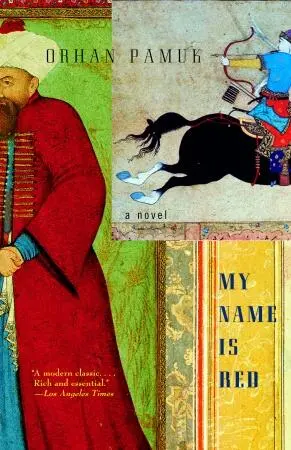
When the Sultan commissions a great book to celebrate his royal self and his extensive dominion, he directs Enishte Effendi to assemble a cadre of the most acclaimed artists in the land. Their task: to illuminate the work in the European style. But because figurative art can be deemed an affront to Islam, this commission is a dangerous proposition indeed, and no one in the elite circle can know the full scope or nature of the project.
Panic erupts when one of the chosen miniaturists disappears, and the Sultan demands answers within three days. The only clue to the mystery-or crime?-lies in the half-finished illuminations themselves. Has an avenging angel discovered the blasphemous work? Or is a jealous contender for the hand of Enishte’s ravishing daughter, the incomparable Shekure, somehow to blame?
Orhan Pamuk’s My Name Is Red is at once a fantasy and a philosophical puzzle, a kaleidoscopic journey to the intersection of art, religion, love, sex, and power.
"Pamuk is a novelist and a great one…My Name is Red is by far the grandest and most astonishing contest in his internal East-West war…It is chock-full of sublimity and sin…The story is told by each of a dozen characters, and now and then by a dog, a tree, a gold coin, several querulous corpses and the color crimson ('My Name is Red')…[Readers will] be lofted by the paradoxical lightness and gaiety of the writing, by the wonderfully winding talk perpetually about to turn a corner, and by the stubborn humanity in the characters' maneuvers to survive. It is a humanity whose lies and silences emerge as endearing and oddly bracing individual truths."- Richard Eder, New York Times Book Review
"A murder mystery set in sixteenth-century Istanbul [that] uses the art of miniature illumination, much as Mann's 'Doctor Faustus' did music, to explore a nation's soul… Erdag Goknar deserves praise for the cool, smooth English in which he has rendered Pamuk's finespun sentences, passionate art appreciations, sly pedantic debates, [and] eerie urban scenes."- John Updike, The New Yorker
"The interweaving of human and philosophical intrigue is very much as I remember it in The Name of the Rose, as is the slow, dense beginning and the relentless gathering of pace… But, in my view, his book is by far the better of the two. I would go so far as to say that Pamuk achieves the very thing his book implies is impossible… More than any other book I can think of, it captures not just Istanbul's past and present contradictions, but also its terrible, timeless beauty. It's almost perfect, in other words. All it needs is the Nobel Prize."-Maureen Freely, New Statesman (UK)
"A perfect example of Pamuk's method as a novelist, which is to combine literary trickery with page-turning readability… As a meditation on art, in particular, My Name is Red is exquisitely subtle, demanding and repaying the closest attention.. We in the West can only feel grateful that such a novelist as Pamuk exists, to act as a bridge between our culture and that of a heritage quite as rich as our own."-Tom Holland, Daily Telegraph (UK)
"Readers… will find themselves lured into a richly described and remarkable world… Reading the novel is like being in a magically exotic dream…Splendidly enjoyable and rewarding… A book in which you can thoroughly immerse yourself." -Allan Massie, The Scotsman (UK)
"A wonderful novel, dreamy, passionate and august, exotic in the most original and exciting way. Orhan Pamuk is indisputably a major novelist."-Philip Hensher, The Spectator (UK)
"[In this] magnificent new novel… Pamuk takes the reader into the strange and beautiful world of Islamic art,in which Western notions no longer make sense… In this world of forgeries, where some might be in danger of losing their faith in literature, Pamuk is the real thing, and this book might well be one of the few recent works of fiction that will be remembered at the end of this century."-Avkar Altinel, The Observer (UK)
My Name is Red — читать онлайн бесплатно полную книгу (весь текст) целиком
Ниже представлен текст книги, разбитый по страницам. Система сохранения места последней прочитанной страницы, позволяет с удобством читать онлайн бесплатно книгу «My Name is Red», без необходимости каждый раз заново искать на чём Вы остановились. Поставьте закладку, и сможете в любой момент перейти на страницу, на которой закончили чтение.
Интервал:
Закладка:
Over the last seven years in Istanbul, I’ve changed hands 560 times, and there’s not a house, shop, market, bazaar, mosque, church or synagogue I haven’t entered. As I’ve roamed about, I’ve learned that much more gossip has been spread, many more legends told and lies spun in my name than I’d ever suspected. I’ve constantly had my nose rubbed in it: Nothing’s considered valuable anymore besides me, I’m merciless, I’m blind, I myself am even enamored of money, the unfortunate world revolves around, not God, but me, and there’s nothing I can’t buy-all this is to say nothing of my dirty, vulgar and base nature. And those who know that I’m fake are given to even harsher judgments. As my actual value drops, however, my metaphorical value increases-proof that poetry is consolation to life’s miseries. But despite all such heartless comparison and thoughtless slander, I’ve realized that a large majority do sincerely love me. In this age of hatred, such heartfelt-even impassioned-affection ought to gladden us all.
I’ve seen every square inch of Istanbul, street by street and district by district; I’ve known all hands from Jews to Abkhazians and from Arabs to Mingerians. I once left Istanbul in the purse of a preacher from Edirne who was going to Manisa. On the way, we happened to be attacked by thieves. One of them shouted, “Your money or your life!” Panicking, the miserable preacher hid us in his asshole. This spot, which he assumed was the safest, smelled worse than the mouth of the garlic lover and was much less comfortable. But the situation quickly grew worse when instead of “Your money or your life!” the thieves began to shout “Your honor or your life!” Lining up, they took him by turns. I don’t dare describe the agony we suffered in that cramped hole. It’s for this reason that I dislike leaving Istanbul.
I’ve been well received in Istanbul. Young girls kiss me as if I were the husband of their dreams; they hide me beneath their pillows, between their huge breasts, and in their underwear; they even fondle me in their sleep to make certain I’m still there. I’ve been stored next to the furnace in a public bath, in a boot, at the bottom of a small bottle in a wonderful-smelling musk seller’s shop and in the secret pocket sewn into a chef’s lentil sack. I’ve wandered through Istanbul in belts made of camel leather, jacket linings made from checkered Egyptian cloth, in the thick fabric of shoe lining and in the hidden corners of multicolored shalwars. The master watchmaker Petro hid me in a secret compartment of a grandfather clock, and a Greek grocer stuck me directly into a wheel of kashari cheese. I hid together with jewelry, seals and keys wrapped in pieces of thick cloth stowed away in chimneys, in stoves, beneath windowsills, inside cushions stuffed with rough straw, in underground chambers and in the hidden compartments of chests. I’ve known fathers who frequently stood up from the dinner table to check whether I was still where I was supposed to be, women who sucked on me like candy for no reason, children who sniffed at me as they stuck me up their noses and old people with one foot in the grave who couldn’t relax unless they removed me from their sheepskin purses at least seven times a day. There was a meticulous Circassian woman who, after spending the whole day cleaning the house, took us coins out of her purse and scrubbed us with a coarse brush. I remember the one-eyed money changer who constantly stacked us up into towers; the porter who smelled of morning glories and who, along with his family, watched us as if looking out over a stunning landscape; and the gilder, no longer among us-no need to name names-who spent his evenings arranging us into various designs. I’ve traveled in mahogany skiffs; I’ve visited the Sultan’s palace; I’ve hidden within Herat-made bindings, in the heels of rose-scented shoes and in the covers of packsaddles. I’ve known hundreds of hands: dirty, hairy, plump, oily, trembling and old. I’ve been redolent of opium dens, candle-makers’ shops, dried mackerel and the sweat of all of Istanbul. After experiencing such excitement and commotion, a base thief who had slit his victim’s throat in the blackness of night and tossed me into his purse, once back in his accursed house, spat in my face and grunted, “Damn you, it’s all because of you.” I was so offended, so hurt, that I wanted nothing more than to disappear.
If I didn’t exist, however, no one would be able to distinguish a good artist from a bad one, and this would lead to chaos among the miniaturists; they’d all be at each other’s throats. So I haven’t vanished. I’ve entered the purse of the most talented and intelligent of miniaturists and made my way here.
If you think you’re better than Stork, then by all means, get hold of me.
I AM CALLED BLACK
I wondered whether Shekure’s father was aware of the letters we exchanged. If I were to consider her tone, which bespoke a timid maiden quite afraid of her father, I’d have to conclude that not a single word about me had passed between them. Yet, I sensed that this was not the case. The slyness in Esther’s looks, Shekure’s enchanting appearance at the window, the decisiveness with which my Enishte sent me to his illustrators and his despair when he ordered me to come this morning-all of it made me quite uneasy.
In the morning, as soon as my Enishte asked me to sit before him, he began to describe the portraits he saw in Venice. As the ambassador of Our Sultan, Refuge of the World, he’d visited quite a number of palazzos, churches and the houses of prosperous men. Over a period of days, he stood before thousands of portraits. He saw thousands of framed faces depicted on stretched canvas or wood or painted directly onto walls. “Each one was different from the next. They were distinctive, unique human faces!” he said. He was intoxicated by their variety, their colors, the pleasantness-even severity-of the soft light that seemed to fall on them and the meaning emanating from their eyes.
“As if a virulent plague had struck, everyone was having his portrait made,” he said. “In all of Venice, rich and influential men wanted their portraits painted as a symbol, a memento of their lives and a sign of their riches, power and influence-so they might always be there, standing before us, announcing their existence, nay, their individuality and distinction.”
His words were belittling, as if he were speaking out of jealousy, ambition or greed. Though, at times, as he talked about the portraits he’d seen in Venice, his face would abruptly light up like a child’s, invigorated.
Portraiture had become such a contagion among affluent men, princes and great families who were patrons of art that even when they commissioned frescoes of biblical scenes and religious legends for church walls, these infidels would insist that their own images appear somewhere in the work. For instance, in a painting of the burial of St. Stephan, you’d suddenly see, ah yes, present among the tearful graveside mourners, the very prince who was giving you the tour-in a state of pure enthusiasm, exhilaration and conceit-of the paintings hanging on his palazzo walls. Next, in the corner of a fresco depicting St. Peter curing the sick with his shadow, you’d realize with an odd sense of disillusionment that the unfortunate one writhing there in pain was, in fact, the strong-as-an-ox brother of your polite host. The following day, this time in a piece depicting the Resurrection of the Dead, you’d discover the guest who’d stuffed himself beside you at lunch.
“Some have gone so far, just to be included in a painting,” said my Enishte, fearfully as though he were talking about the temptations of Satan, “that they’re willing to be portrayed as a servant filling goblets in the crowd, or a merciless man stoning an adulteress, or a murderer, his hands drenched in blood.”
Читать дальшеИнтервал:
Закладка:
Похожие книги на «My Name is Red»
Представляем Вашему вниманию похожие книги на «My Name is Red» списком для выбора. Мы отобрали схожую по названию и смыслу литературу в надежде предоставить читателям больше вариантов отыскать новые, интересные, ещё непрочитанные произведения.









Обсуждение, отзывы о книге «My Name is Red» и просто собственные мнения читателей. Оставьте ваши комментарии, напишите, что Вы думаете о произведении, его смысле или главных героях. Укажите что конкретно понравилось, а что нет, и почему Вы так считаете.