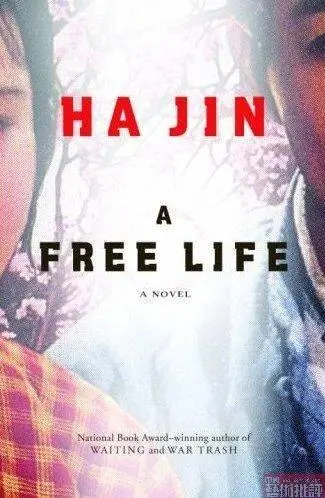
Ha Jin - A Free Life
Здесь есть возможность читать онлайн «Ha Jin - A Free Life» весь текст электронной книги совершенно бесплатно (целиком полную версию без сокращений). В некоторых случаях можно слушать аудио, скачать через торрент в формате fb2 и присутствует краткое содержание. Жанр: Современная проза, на английском языке. Описание произведения, (предисловие) а так же отзывы посетителей доступны на портале библиотеки ЛибКат.
- Название:A Free Life
- Автор:
- Жанр:
- Год:неизвестен
- ISBN:нет данных
- Рейтинг книги:3 / 5. Голосов: 1
-
Избранное:Добавить в избранное
- Отзывы:
-
Ваша оценка:
A Free Life: краткое содержание, описание и аннотация
Предлагаем к чтению аннотацию, описание, краткое содержание или предисловие (зависит от того, что написал сам автор книги «A Free Life»). Если вы не нашли необходимую информацию о книге — напишите в комментариях, мы постараемся отыскать её.
Ha Jin, who emigrated from China in the aftermath of Tiananmen Square, had only been writing in English for 12 years when he won the National Book Award for Waiting in 1999. His latest novel sheds light on an émigré writer's woodshedding period. It follows the fortunes of Nan Wu, who drops out of a U.S. grad school after the repression of the democracy movement in China, hoping to find his voice as a poet while supporting his wife, Pingping, and son, Taotao. After several years of spartan living, Nan and Pingping save enough to buy a Chinese restaurant in suburban Atlanta, setting up double tensions: between Nan's literary hopes and his career, and between Nan and Pingping, who, at the novel's opening, are staying together for the sake of their young boy. While Pingping grows more independent, Nan -amid the dulling minutiae of running a restaurant and worries about mortgage payments, insurance and schooling-slowly snuffs the torch he carries for his first love. That Nan at one point reads Dr. Zhivago isn't coincidental: while Ha Jin's novel lacks Zhivago's epic grandeur, his biggest feat may be making the reader wonder whether the trivialities of American life are not, in some ways, as strange and barbaric as the upheavals of revolution.
***
From the award-winning author of Waiting, a new novel about a family's struggle for the American Dream.
Meet the Wu family-father Nan, mother Pingping, and son Taotao. They are arranging to fully sever ties with China in the aftermath of the 1989 massacre at Tiananmen Square, and to begin a new, free life in the United States. At first, their future seems well-assured. But after the fallout from Tiananmen, Nan 's disillusionment turns him toward his first love, poetry. Leaving his studies, he takes on a variety of menial jobs as Pingping works for a wealthy widow as a cook and housekeeper. As Pingping and Taotao slowly adjust to American life, Nan still feels a strange attachment to his homeland, though he violently disagrees with Communist policy. But severing all ties-including his love for a woman who rejected him in his youth-proves to be more difficult than he could have ever imagined.
A Free Life — читать онлайн бесплатно полную книгу (весь текст) целиком
Ниже представлен текст книги, разбитый по страницам. Система сохранения места последней прочитанной страницы, позволяет с удобством читать онлайн бесплатно книгу «A Free Life», без необходимости каждый раз заново искать на чём Вы остановились. Поставьте закладку, и сможете в любой момент перейти на страницу, на которой закончили чтение.
Интервал:
Закладка:
The service started, and the younger clergyman on the chancel went to the microphone and called for the people to rise. Together they started singing a hymn, "A Mighty Fortress Is Our God," accompanied by a huge piano played by a mousy woman in a corner. Next, they bowed and meditated for a moment. The hall turned quiet while Nan glanced right and left and noticed an old woman in front of him thumbing through a Bible rested atop the back of the pew before her. A baby let out a cry but was stopped immediately by its parent. Then a choir, eight women and six men in scarlet-collared gowns, went onto the chancel steps and sang "Sweet Hours of Prayer." Their singing was passionate but serene, swelling and ebbing as if they were leading the piano. After that, the pastor wearing tinted glasses, surnamed Bian, took the lectern and began preaching the sermon, entitled " New Hope." His voice was soft most of the time, but now and then it grew strong, fervent and exultant. He spoke about Paul, the apostle, as a model follower of the Lord and an ideal man. He quoted from the New Testament to illustrate that Paul was originally a sinner and a persecutor of Christians, but then changed into a man with a big heart. Paul never lost hope and always remained modest, not taking pride in his own accomplishments and praising only the Lord. He loved his siblings despite their tricks against him, despite their transgressions and sins, because he could forget the past and look ahead only. "Think about the sprinters at the Olympic Games," the preacher announced in Mandarin softened by his Fujian accent. "How can they run that fast? Do they look back when they're dashing toward the finish line? Of course not. Brothers and sisters, we have to lay aside our old disputes and animosity and look forward and think about the future, where our hopes are. Otherwise, how could we see any light?… "
Nan 's eyes were glued to the pastor's long, heavy-chinned face. He believed he had seen him before. But where? He couldn't remember. He was positive this man had come from mainland China.
Pastor Bian now was speaking about how to get rid of one's sins. He said, "If you have a glass of water mixed with soy sauce, how can you get the water clean again? Very simple. You keep pouring pure water into the glass until the soy sauce is washed away. Brothers and sisters, our Lord is the most abundant fountain of pure water. Tap into that divine source and you will be cleansed, clean like a newborn baby and bountiful with love."
Then he went on to talk about the necessity of accumulating one's rewards in heaven by doing good deeds on earth. He even claimed that he couldn't wait to meet God and collect the rewards he had deposited in God's bank up there.
Nan was fascinated by the analogies the pastor hurled, though he wasn't fully convinced by his eloquence. He remembered that his friend Danning Meng had told him that he couldn't stop weeping once at a Sunday service. In Massachusetts, Danning had gone to a Catholic church in Watertown at least once a month. In contrast, Nan now felt calm and detached. When the sermon was over, the choir again went to the front and belted out "Take My Life and Let It Be." After the singing, the pastor announced the birth of a baby to a couple in the congregation; it weighed seven pounds and five ounces, and mother and child were both safe and well. He also spoke about the amount of donations the church had received lately and urged people to give more so that they could reach the annual goal of collecting $50,000. After the announcements, the younger clergyman called everybody to rise again, and together they sang the final hymn, "I Praise My Lord Only," following the lines projected on the wall beside the chancel.
The moment they finished singing, the young clergyman said, "Please receive Brother Shiming Bian's benediction." People sat down and bowed their heads while the pastor raised both hands to deliver his final words: "Precious God, we thank you for making this church flourish and prosper. We ask for your blessing on every member of our community. Please make us strong and humble, brave and meek, righteous and compassionate. Please grant us the eyes that can see far and deep. Please grant us the ears that can hear your voice and the unpronounced truth. May your light and love guide our everyday existence so that we can forever remain yours-"
"Amen!" the hall cried.
Nan hadn't lowered his head during the benediction, because at the mention of the pastor's name, he had realized that the man was an exiled dissident who had once been a preeminent journalist in China, famous for his reportage that exposed official corruption and power abuse. Each year photographs of this man would appear a few times in Chinese-language newspapers and magazines, and there was a famous saying attributed to him: "We have gained the freedom of the sky but lost the gravity of the earth," which described the existential condition of the Chinese exiles living in North America. No wonder his face looked so familiar. After the benediction, instead of filing out with others, Nan went up to the pastor and introduced himself as a local businessman. He told Mr. Bian that he admired his articles and was happy to meet him in person. He handed him his card and said, "Please stop by at my restaurant whenever you like. Your friends are welcome too."
Mr. Bian glanced at the card. " Nan Wu, I know of you," he said in surprise. "I liked the poems you published in New Lines, especially the one called 'This Is Just Another Day.' Are you still editing the magazine?"
"No, I'm a chef now."
"That's good. I too have put my feet on the ground finally, working to earn my keep. By the way, you know Mr. Manping Liu, don't you?"
"Of course, I visited him in New York."
"He's going to speak here next Tuesday evening."
"Really? On what?"
"On the relationship between Taiwan and mainland China. I hope you can join us. He'll be delighted to see you."
Then Mr. Bian went on to tell Nan that the talk would be given at the public library in Alpharetta, an affluent town full of brick mansions, about ten miles northwest of Lilburn. Nan promised to attend the meeting.
22
NAN was excited, not having seen Mr. Liu for almost three years. At work that day he even called him in New York and invited him to stay at his home. The old man was pleased, but said his friends in Atlanta had already made arrangements for his lodging and board. He sounded glad to hear from Nan, saying he looked forward to seeing him on Tuesday evening. Nan promised to attend his talk, though he hadn't mentioned it to Pingping yet.
When he brought it up, Pingping was reluctant to let him go, but later Nan persuaded her. On Tuesday evening, after eight-thirty, when the busiest time had passed at the Gold Wok, he arrived at the library, where the talk was already under way. He took a seat in the back corner. Mr. Liu had aged considerably, his mouth more sunken, but his voice was still metallic and ardent. He was speaking about the necessity for Taiwan to be reunified with mainland China, because if it went independent, China would lose its gateway to the Pacific Ocean, and Japan, in addition to the United States, would control the China Sea entirely. Nan was amazed that Mr. Liu's view dovetailed with the Chinese government's. It was as if all the years' exile hadn't changed the old man's mind-set one bit.
After the talk, the audience raised questions for the speaker, and some of them also stood up to add their opinions to Mr. Liu's answers. A young man who must have come from Taiwan asked, "Mr. Liu, you're one of the foremost figures in the Chinese democracy movement and may hold an important office in the Chinese government someday. If you become China 's president, what will you do if Taiwan declares independence?"
Mr. Liu remained silent for a moment, then replied, "First of all, I can never become a national leader. But if I were the president, I might have to order the People's Liberation Army to attack Taiwan. There isn't another way out of this. China must protect its territorial integrity. Whoever loses Taiwan will be recorded by history as a criminal of the Chinese nation."
Читать дальшеИнтервал:
Закладка:
Похожие книги на «A Free Life»
Представляем Вашему вниманию похожие книги на «A Free Life» списком для выбора. Мы отобрали схожую по названию и смыслу литературу в надежде предоставить читателям больше вариантов отыскать новые, интересные, ещё непрочитанные произведения.











Обсуждение, отзывы о книге «A Free Life» и просто собственные мнения читателей. Оставьте ваши комментарии, напишите, что Вы думаете о произведении, его смысле или главных героях. Укажите что конкретно понравилось, а что нет, и почему Вы так считаете.