William Gibson - Spook Country
Здесь есть возможность читать онлайн «William Gibson - Spook Country» весь текст электронной книги совершенно бесплатно (целиком полную версию без сокращений). В некоторых случаях можно слушать аудио, скачать через торрент в формате fb2 и присутствует краткое содержание. Город: NEW YORK, Год выпуска: 2007, Издательство: G. P. PUTNAM’S SONS, Жанр: Современная проза, на английском языке. Описание произведения, (предисловие) а так же отзывы посетителей доступны на портале библиотеки ЛибКат.
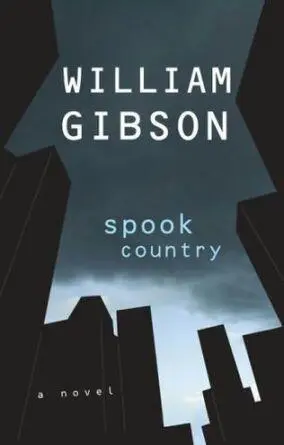
- Название:Spook Country
- Автор:
- Издательство:G. P. PUTNAM’S SONS
- Жанр:
- Год:2007
- Город:NEW YORK
- ISBN:нет данных
- Рейтинг книги:4 / 5. Голосов: 1
-
Избранное:Добавить в избранное
- Отзывы:
-
Ваша оценка:
Spook Country: краткое содержание, описание и аннотация
Предлагаем к чтению аннотацию, описание, краткое содержание или предисловие (зависит от того, что написал сам автор книги «Spook Country»). Если вы не нашли необходимую информацию о книге — напишите в комментариях, мы постараемся отыскать её.
, the challenge of writing about the present-day world drove him to create perhaps his best novel yet, and in
he remains at the top of his game. It's a stripped-down thriller that reads like the best DeLillo (or the best Gibson), with the lives of a half-dozen evocative characters connected by a tightly converging plot and by the general senses of unease and wonder in our networked, post-9/11 time.
Spook Country — читать онлайн бесплатно полную книгу (весь текст) целиком
Ниже представлен текст книги, разбитый по страницам. Система сохранения места последней прочитанной страницы, позволяет с удобством читать онлайн бесплатно книгу «Spook Country», без необходимости каждый раз заново искать на чём Вы остановились. Поставьте закладку, и сможете в любой момент перейти на страницу, на которой закончили чтение.
Интервал:
Закладка:
Odile’s eyebrows went up. “Really?”
“Yes.”
“You know, Ollis, Node pays to bring me here, pays for le Standard…”
“There you go, then. How about it?”
“Certainly,” said Odile, “but why?”
“I want you to help me find Bobby.”
“I will try, but…” Odile demonstrated her French shrugging anatomy.
“Excellent,” said Hollis.
50. WHISPERING GALLERY
M ilgrim woke in a narrow bed, beneath a single flannel sheet printed with trout flies, partial riverscapes, and the repeated image of an angler, casting. The pillowcase was made of matching material. On the wall opposite the foot of the bed was a large poster of an American eagle’s head, depicted against the billowing folds of Old Glory. He seemed to have gotten undressed for bed, although he didn’t remember doing it.
He looked at the poster, behind glass in a plain gold plastic frame. He’d never seen anything quite like it. It had a soft, worryingly pornographic quality, as though a Vaselined lens had been involved, though he supposed they no longer really did that, Vaselining lenses. Likely the whole thing had been executed on a monitor. The eagle’s eye, though, was hyperrealist bright and beady, as if rendered to fix on the viewer’s forehead. He thought a slogan would have helped, somehow, some nudge in a specific patriotic direction. Just these sinuous waves of stripes, though, a few stars up in one corner, and the raked and angular head of this really rather murderous-looking bird of prey, was too much, on its own, too purely iconic.
He thought of the peculiar, phoenix-like creature on the front door, downstairs.
But then he remembered eating pizza that Brown had ordered, in the kitchen, downstairs. Pepperoni and three cheeses. And the fridge, which had contained a six-pack of very cold Pepsi and nothing else. He remembered feeling the smooth white circles of the heating elements on the range, something he’d not seen before. Brown had taken his pizza into a sort of study, along with a glass and a bottle of whiskey. Milgrim had never seen Brown drink before. Then he’d heard Brown on the phone, through the closed door, but hadn’t been able to make anything of it. And then, he guessed, he’d treated himself to another Rize.
Sometimes, he observed now, sitting on the edge of the bed in his underwear, a little too much had a way of clearing the air, the morning after. He looked up and encountered the eagle’s gun-muzzle eye. Looking quickly away, he rose, surveyed the room, and began to search it, quietly and with an efficiency born of practice.
It had obviously been decorated to be a boy’s room, and in the style of the rest of the house, though perhaps with a bit less effort. Less Ralph Lauren than some diffusion line. He hadn’t yet seen a single actual antique, aside from the Ur-eagle outside, which might even be original to the house. The furnishings were faux-old, and that rather halfhearted, more likely made in India or China than North Carolina. For that matter, he thought, noting the room’s empty inbuilt bookcase, he hadn’t seen a single book.
He carefully, quietly opened each drawer in the small bureau. All empty, aside from the bottom one, which contained a wire coat hanger clad in tissue, printed with the name and address of a dry cleaner in Bethesda, and two pins. He knelt on the carpet and peered under the bureau. Nothing.
The small, vaguely Colonial desk, finished, like the bureau, in rather robotically distressed blue paint, offered nothing more, other than a dead fly and a black ballpoint pen marked PROPERTY OF U.S. GOVERNMENT in white. Milgrim tucked the pen into the elastic waistband of his underwear, having at that point no pockets, and carefully opened what he took, correctly, to be a closet door. The hinges squeaked with disuse. Empty coat hangers rattled on a hook. The closet proved to contain nothing but more coat hangers, on one of which hung a small navy blazer with an elaborately gold-embroidered crest. Milgrim went through its pockets, finding a wadded Kleenex and a stub of chalk.
The boy’s jacket and the piece of chalk saddened him. He didn’t like thinking of this as a child’s room. Perhaps there had been other things here once, books and toys, but somehow it didn’t seem like it. The room suggested a difficult childhood, perhaps not too different from the one Milgrim himself had had. He left the closet, closing the door, and went to the blue, ladder-backed chair on which his clothes had been draped. Forgetting the U.S. Government pen, he jabbed himself with it as he was putting on his pants.
Dressed, he approached the drawn striped drapes of the room’s single window. Positioning himself so that he could move the outer edge of one drape as minimally as possible, he discovered what he took to be N Street, on what appeared to be an overcast day. But his angle down also revealed the right front fender of a parked car, black and highly polished. A large car, to judge by what he could see of its fender.
He put on the Paul Stuart coat, discovering his book in its pocket, clipped the government pen into the inside pocket, and tried the room’s door, finding it unlocked.
A paneled, carpeted hallway, illuminated now by a skylight. He looked over a banister and down, two flights, to the softly gleaming gray marble of the hallway they’d entered yesterday evening. One of those central but minimal stairwell-shafts encountered in houses of this age, very long and narrow, running back to front. Beside his ear, a spoon rattled against china. He spun, starting violently. “I appreciate that,” an invisible Brown said, with an uncharacteristic note of gratitude.
The hallway was empty.
“I understand what you have to work with,” said a voice Milgrim had never heard before, the speaker equally close, equally invisible. “You’re using the best men available to you, and finding them lacking. We see that all too often. I’m disappointed, of course, that you weren’t able to apprehend him. In the light of your previous lack of success, I think it would have been wise to arrange to try to photograph him. Don’t you? To be prepared to photograph him in any case, in the event he escaped again.” The man had a lawyer’s cadence, Milgrim thought. He spoke slowly and clearly, and as though he took it for granted that he’d be paid attention to.
“Yes, sir,” said Brown.
“Then we might at least have a chance to learn who he is.”
“Yes.”
Eyes wide, gripping the banister rail as though it were the railing of ship in a storm, Milgrim stared down at the distant, narrow slice of marble floor, tasting his own blood. He’d bitten the inside of his cheek, when that spoon had rattled against that coffee cup. Brown’s breakfast conversation was being reflected off that marble floor, he guessed, or being sucked up this slit of Federal stairwell, or both. Had children stood here a hundred years ago, he wondered, suppressing giggles at some other conversation?
“You say the information intended for him indicates that he still has no tracking ability, hence no knowledge of whereabouts or ability to predict destination.”
“Whoever he has working on it,” Brown said, “doesn’t seem to be getting the job done.”
“And our friends,” the other said, “are they able to determine, when they go over this material, what it is, exactly, that’s being so unsuccessfully searched for?”
“The assessment’s handled by someone who has no knowledge of any of this. It’s just information, to him, and he analyzes classified data constantly.”
“Government?”
“Telco,” Brown said. “You know who handles the decryption. They never look at the product. And our analyst has every reason to pay as little attention as possible to what this might actually be about. I’ve made sure of that.”
Читать дальшеИнтервал:
Закладка:
Похожие книги на «Spook Country»
Представляем Вашему вниманию похожие книги на «Spook Country» списком для выбора. Мы отобрали схожую по названию и смыслу литературу в надежде предоставить читателям больше вариантов отыскать новые, интересные, ещё непрочитанные произведения.

Обсуждение, отзывы о книге «Spook Country» и просто собственные мнения читателей. Оставьте ваши комментарии, напишите, что Вы думаете о произведении, его смысле или главных героях. Укажите что конкретно понравилось, а что нет, и почему Вы так считаете.