William Gibson - Spook Country
Здесь есть возможность читать онлайн «William Gibson - Spook Country» весь текст электронной книги совершенно бесплатно (целиком полную версию без сокращений). В некоторых случаях можно слушать аудио, скачать через торрент в формате fb2 и присутствует краткое содержание. Город: NEW YORK, Год выпуска: 2007, Издательство: G. P. PUTNAM’S SONS, Жанр: Современная проза, на английском языке. Описание произведения, (предисловие) а так же отзывы посетителей доступны на портале библиотеки ЛибКат.
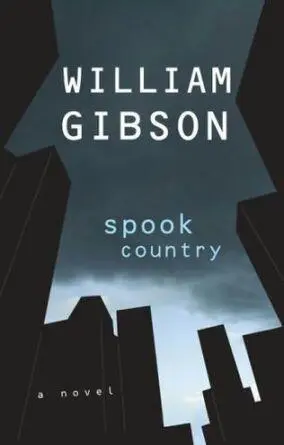
- Название:Spook Country
- Автор:
- Издательство:G. P. PUTNAM’S SONS
- Жанр:
- Год:2007
- Город:NEW YORK
- ISBN:нет данных
- Рейтинг книги:4 / 5. Голосов: 1
-
Избранное:Добавить в избранное
- Отзывы:
-
Ваша оценка:
Spook Country: краткое содержание, описание и аннотация
Предлагаем к чтению аннотацию, описание, краткое содержание или предисловие (зависит от того, что написал сам автор книги «Spook Country»). Если вы не нашли необходимую информацию о книге — напишите в комментариях, мы постараемся отыскать её.
, the challenge of writing about the present-day world drove him to create perhaps his best novel yet, and in
he remains at the top of his game. It's a stripped-down thriller that reads like the best DeLillo (or the best Gibson), with the lives of a half-dozen evocative characters connected by a tightly converging plot and by the general senses of unease and wonder in our networked, post-9/11 time.
Spook Country — читать онлайн бесплатно полную книгу (весь текст) целиком
Ниже представлен текст книги, разбитый по страницам. Система сохранения места последней прочитанной страницы, позволяет с удобством читать онлайн бесплатно книгу «Spook Country», без необходимости каждый раз заново искать на чём Вы остановились. Поставьте закладку, и сможете в любой момент перейти на страницу, на которой закончили чтение.
Интервал:
Закладка:
Tito obeyed. Prada man handed him a short green cloth jacket with something embroidered in yellow on the back. Tito pulled it on. He was handed a green cap with a yellow bill, JOHNSON BROS. TURF AND LAWN in yellow across the front. He put it on. “Sunglasses,” said Prada man, handing Tito a pair. He bundled Tito’s jacket into a small black nylon bag, zipped it shut, and handed it to him. “Glasses,” he reminded Tito. Tito put them on.
They climbed out into the sunlight, into the terrible roaring. Tito saw the sign on the chain-link, a few feet from the truck.
AIR PEGASUS VIP HELIPORT
Beyond the chain-link, the roaring helicopters.
Then Vianca was there, on her motorcycle, face hidden by her mirrored visor. He saw the Prada man pass her the Bulgarian’s gun, folded in its handkerchief. She shoved it into the front of her jacket, threw Tito a quick wave goodbye, and was gone, the whine of her engine lost beneath the thunder of helicopters.
Tito, his stomach full of cold heavy fear, followed the others into this VIP.
And when they had gone through the metal detector, and shown their identification, and had crouched, scuttling, under the whirling blades, and were belted in, and the roaring sharpened, until something seemed to pick the helicopter up as if on a cable, and bore it away, rising, out across the Hudson, Tito could only close his eyes. So that he did not see the city, as they rose, nor see it recede behind him.
Eventually, still without opening his eyes, he was able to pull his Nano from the front of his shirt, extract the earphones from the left front pocket of his jeans, and find the hymn he’d played on his Casio, to the goddess Ochun.
47. N STREET
T here were ghosts in the Civil War trees, past Philadelphia.
Earlier the track had passed near streets of tiny row houses, in neighborhoods where poverty seemed to have been as efficient as the neutron bomb was said to be. Streets as denuded of population as their windows were of glass. The houses themselves seemed to belong less to another time than to another country; Belfast perhaps, after some sectarian biological attack. The shells of Japanese cars in the streets, belly down on bare rims.
But past Philadelphia, and after taking another tablet, Milgrim began to catch glimpses of spectral others, angels perhaps. The late-afternoon sun dressed the passing woods with Maxfield Parrish foxfire, and perhaps it was that epileptic flicker generated by the train’s motion that called these beings forth. He found them neutral, if not actually benign. They belonged to this landscape, this hour and time of year, and not to his story.
Across the Metroliner’s aisle, Brown tapped steadily on his armored laptop. An anxiety stole into Brown’s face when he wrote, Milgrim knew, and he saw it again now. Perhaps Brown was uncertain of his writing abilities, or habitually prepared to have what he wrote rejected or criticized excessively, by whoever it was to whom he wrote. Or was it that he was simply uncomfortable with reporting a lack of success? As far as Milgrim knew, Brown had never been successful at what he had seemed to be trying to do, with the IF and the subject. Capturing the subject seemed to have been a win position for Brown, and Brown had tried, but hadn’t managed it. Seizing whatever it was the IF delivered to the subject had seemed to be another, though secondary, win position, and possibly Brown had succeeded in that, today, in Union Square. Capturing the IF had never seemed like a win position. Had they captured the IF, Milgrim assumed, both subject and the IF’s extended family would be alerted to Brown’s game. The planting of the signal-grabber in the IF’s room would have been negated. So, Milgrim, assumed, what Brown was doing now was drafting his report of what had happened in Union Square.
But he thought it unlikely that any such report would mention him, or Dennis’s black associates, and that was probably a very good thing. He was concerned that Brown had not yet mentioned to him the fact of his having been discovered no longer cuffed to the bench, but he felt prepared; the cuff itself had failed, and Milgrim, sensing trouble in the park, had taken it upon himself to return to Brown’s car, the better to facilitate their departure.
Tiring of the flicking of sun through the trees, he thought he might read his book. But putting his hand on the worn cover, in the side pocket of the Paul Stuart, was as far as he got. He fell asleep, then, with his cheek against the warm glass, and only woke as Brown was shaking him, as they pulled into Union Station in Washington.
He found he was horribly stiff now, no doubt from his uncharacteristic bout of exercise in the park, as well as from the burst of fear-driven adrenaline that had made it possible. His legs felt like stilts as he staggered upright, brushing at crumbs from the turkey sandwich he’d had before Philadelphia. “Move,” Brown ordered, pushing him ahead. Brown had his laptop and his bag slung at his hips, packhorse-style, straps crossing his chest. Milgrim suspected Brown had been taught this at some point in a course on optimally securing one’s hand luggage. He had the sense that Brown improvised relatively little, and never with much of a sense of ease; he was a man who believed there were ways to do things, and that those were the ways things should be done.
He was also, Milgrim thought, struggling to keep up with him along the platform, an authoritarian, but with what Milgrim assumed would be a fundamental need to obey orders.
The Beaux-Arts triumphalism of the station made Milgrim feel suddenly very small. His neck shrank into the collar of the Paul Stuart coat. He seemed to see himself, and Brown, from high up in those ornate arches, the two of them like beetles, far below, trundling across a vast expanse of marble. He forced himself to peer up, from between his shoulders, at inscribed stone, allegorical sculpture, gilt, all the pomp and gravitas of another young century’s American Renaissance.
Outside, the air laced with a tonality of pollution not New York’s, and faintly muggy, Brown got them quickly into a cab, driven by a Thai with yellow shooting-glasses, and out of there, into that street plan that Milgrim had never been able to grasp at all. Circles, radial avenues, Masonic complexities. But Brown had given the driver an address on N Street, and Milgrim did remember that, that other alphabet city, so different. He had spent three weeks here, once, in the salad days of the first Clinton administration, as part of a team translating Russian trade reports for a firm of lobbyists.
At some point they turned off a busy shopping street full of mall brands and into a suddenly quieter neighborhood, entirely residential, of smaller, older houses. In the Federal style, Milgrim remembered, and also that this must be Georgetown, recalled from a style seminar conducted in a townhouse. Not unlike these they were passing, but grander, with a walled rear garden in which Milgrim, having slipped out for a joint, had discovered an enormous tortoise and an even larger rabbit, the resident’s pets he’d supposed, but remembered now as in some magical moment of childhood. Milgrim’s actual childhood had been short on magical moments, he reflected, so perhaps he’d shifted this encounter back, along the subjective time line, to compensate for that. But definitely this was Georgetown, these narrow façades of mellow brick, black-painted wooden shutters, the sense that Martha Stewart and Ralph Lauren would have been hard at work on interiors, together at last, sheathing inherently superior surfaces under hand-rubbed coats of golden beeswax.
Their cab came to a sudden halt, the driver’s acrid yellow glasses turning to Brown. “You here?” he asked.
Probably, Milgrim replied silently, as Brown passed the man a few folded bills and ordered Milgrim out.
Читать дальшеИнтервал:
Закладка:
Похожие книги на «Spook Country»
Представляем Вашему вниманию похожие книги на «Spook Country» списком для выбора. Мы отобрали схожую по названию и смыслу литературу в надежде предоставить читателям больше вариантов отыскать новые, интересные, ещё непрочитанные произведения.

Обсуждение, отзывы о книге «Spook Country» и просто собственные мнения читателей. Оставьте ваши комментарии, напишите, что Вы думаете о произведении, его смысле или главных героях. Укажите что конкретно понравилось, а что нет, и почему Вы так считаете.