William Gibson - Spook Country
Здесь есть возможность читать онлайн «William Gibson - Spook Country» весь текст электронной книги совершенно бесплатно (целиком полную версию без сокращений). В некоторых случаях можно слушать аудио, скачать через торрент в формате fb2 и присутствует краткое содержание. Город: NEW YORK, Год выпуска: 2007, Издательство: G. P. PUTNAM’S SONS, Жанр: Современная проза, на английском языке. Описание произведения, (предисловие) а так же отзывы посетителей доступны на портале библиотеки ЛибКат.
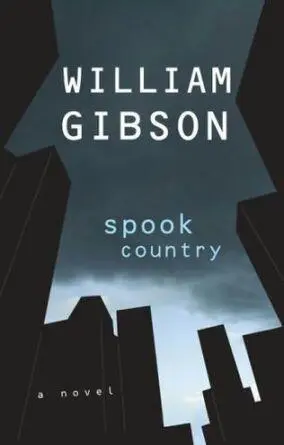
- Название:Spook Country
- Автор:
- Издательство:G. P. PUTNAM’S SONS
- Жанр:
- Год:2007
- Город:NEW YORK
- ISBN:нет данных
- Рейтинг книги:4 / 5. Голосов: 1
-
Избранное:Добавить в избранное
- Отзывы:
-
Ваша оценка:
Spook Country: краткое содержание, описание и аннотация
Предлагаем к чтению аннотацию, описание, краткое содержание или предисловие (зависит от того, что написал сам автор книги «Spook Country»). Если вы не нашли необходимую информацию о книге — напишите в комментариях, мы постараемся отыскать её.
, the challenge of writing about the present-day world drove him to create perhaps his best novel yet, and in
he remains at the top of his game. It's a stripped-down thriller that reads like the best DeLillo (or the best Gibson), with the lives of a half-dozen evocative characters connected by a tightly converging plot and by the general senses of unease and wonder in our networked, post-9/11 time.
Spook Country — читать онлайн бесплатно полную книгу (весь текст) целиком
Ниже представлен текст книги, разбитый по страницам. Система сохранения места последней прочитанной страницы, позволяет с удобством читать онлайн бесплатно книгу «Spook Country», без необходимости каждый раз заново искать на чём Вы остановились. Поставьте закладку, и сможете в любой момент перейти на страницу, на которой закончили чтение.
Интервал:
Закладка:
“Nothing can be done in either world,” she said, “without his permission.”
It had begun to snow, as he walked uphill, past chicken wire and poster-crusted plywood, where the retaining wall of the cathedral’s grounds had been brought down, long ago, by rain. He turned up his collar, settled his hat, and walked on, no stranger now to snow. Though he was grateful, finally, to reach Amsterdam. He saw the unlit neon of V&T Pizza, like something pointing to the avenue’s ordinary human past, and then he was passing the priest’s house, and the garden that surrounded the perpetually dry fountain, with its delirious sculpture, where the decapitated head of Satan dangled from the great bronze claw of the Holy Crab of God. It was this sculpture that had most interested him, when Juana first brought him here, that and the cathedral’s four peacocks, one of them albino and, Juana said, sacred to Orunmila.
There were no guards at the cathedral’s doors, but he found them within, waiting, with their suggestion of five dollars’ donation. Juana had shown him how to remove his hat, and cross himself, and, ignoring them, pretending he spoke no English, to light a candle and pretend to pray.
So large a space, within this church; Juana said the largest cathedral in the world. And this morning of snow he found it deserted, or seemingly so, and somehow colder than the street. There was a fog here, a cloud, of sound; the tiniest echoes, set moving by any movement, seemed to stir ceaselessly among the columns and across the stone floor.
Leaving his candle burning beside four others, he went in the direction of the main altar, watching his own breath, and pausing once to look back at the dim glow of the giant rose window, above the doors through which he’d come.
One of the bays of stone that lined the sides of this tremendous space was Eleggua’s, and this made clear by images in colored glass. A santero consulting a sheet of signs, among which would be found the numbers three and twenty-one, whereby the orisha recognizes himself and is recognized; a man climbing a pole to install a wiretap; another man studying the monitor of a computer. All images of ways in which the world and worlds are linked, and all these ways under the orisha.
Silently, within himself, as Juana had taught him, Tito made respectful greeting.
There was a disturbance in the fog of sound, then, louder than the rest, its source lost immediately in the turning and stirring of echo. Tito glanced back, down the length of the nave, and saw a single figure, approaching.
He looked up, to Ellegua’s window, where one man used something like a mouse, another a keyboard, though the shapes of these familiar things were archaic, unfamiliar. He asked to be protected.
The old man, when Tito looked back, was like some illustration of perspective and the inevitability of the given moment’s arrival. Snow dusted the shoulders of the man’s tweed coat, and the brim of a dark hat held against his chest. His head seemed bowed, slightly, as he walked. His gray hair shone like steel, against the dull putty tones of the cathedral’s stone.
And then he was there, unmoving, directly in front of Tito. He looked very directly into Tito’s eyes, then up, at the window. “Gutenberg,” he said, raising his hat to indicate the santero. “Samuel Morse sending the first message,” indicating the man using the mouse. “A lineman. A television set.” This last what Tito had taken for a monitor. He lowered the hat. His gaze returned to Tito. “You resemble both your father and grandfather, strongly,” he said in Russian.
“Did she tell you I would be here?” Tito asked, in Spanish.
“No,” the old man replied, his accent that of an older Cuba, “it was not to be my pleasure. A formidable woman, your aunt. I had you followed here.” He switched to English: “It has been some time, since you and I have seen one another.”
“Verdad.”
“But we will be seeing one another again, and soon,” the old man said. “You will be given another, identical item. You will bring it to me, as before. As before, you will be observed, followed.”
“Alejandro was correct, then?”
“No fault of yours. Your protocol is highly correct, your systema adroit,” injecting the Russian term into his English sentence. “It was made quite certain that you would be followed. We require it.”
Tito waited.
“They will attempt to seize us,” the man said, “as you make the delivery. They will fail, but you will have lost the item to them. That is essential, as essential as your escape, and my own. And you have a systema for exactly that, do you not?”
Tito nodded, moving his head only slightly.
“But then,” said the old man, “you will be going away, as you’ve been prepared for. The city will no longer be safe for you. Do you understand?”
Tito thought of his windowless room. His computer. His keyboard. The vase for Ochun. He remembered the protocol established for his departure, carefully maintained. He had absolutely no idea what place would have been chosen for him, beyond that protocol. He only knew that it would not be New York. “I understand,” he said, in Russian.
“There is an arch, here,” the old man said, in English, “called the Pearl Harbor Arch.” He looked up, and back along the nave. “It was pointed out to me, once, but I can no longer recall where it is. The masons laid down their tools, the day of the attack. The construction of the cathedral lapsed for decades.”
Tito turned and looked up, uncertain as to what he was supposed to be looking for. The arches were so high overhead. He and Alejandro had once played with a helium-filled Mylar blimp, in Battery Park. A small radio-controlled airship. With such a thing, here, one could explore the nave’s forest of arches, the shadows of its inverted deep-sea canyon. He wanted to ask this man about his father, ask him how and why his father had died.
When he turned back, the man was gone.
19. FISH
B rown took Milgrim back to the Korean-owned laundry on Lafayette Street, for parking. From what Milgrim had heard of Brown’s end of the morning’s cellular traffic, Brown felt that his team needed more talking to about having lost the IF.
This time, Brown didn’t bother to remind Milgrim that there were watchers outside, or that attempting to escape would be both futile and painful. Brown was starting to assume, Milgrim decided, that he, Milgrim, had internalized the watchers (whether they existed or not, and Milgrim now doubted they ever had). This was interesting, Milgrim thought.
Brown didn’t say goodbye. Just turned and headed down the west side of Lafayette.
Milgrim and the Korean owner, a man in his seventies, with an ageless and curiously nonreflective simulacrum of Kim Jong Il’s jet-black haircut, eyed each other neutrally. Milgrim supposed Brown had some arrangement here, as the Korean never asked where Milgrim’s laundry was, or why it was, otherwise, that Milgrim would sit for hours at the westernmost end of a red vinyl settee, either reading his medieval messianism book, thumbing through the Korean’s dead gossip magazines, or just staring into space.
Milgrim unbuttoned the Paul Stuart, but seated himself without removing it. He looked at the thick compost of celebrity features on the coffee table in front of him (did navels count as features?) and noted the issue of Time with the president dressed up like a pilot, on the flight deck of that aircraft carrier. That issue was nearly three years old now, he decided, after some calculation, older than the majority of these gossip mags—which Milgrim did sometimes resort to, if twelfth-century messianism proved inconveniently soporific, as it certainly could. If he nodded out here, he’d learned, the Korean would come over and prod him in the ribs with a rolled-up Us.
Читать дальшеИнтервал:
Закладка:
Похожие книги на «Spook Country»
Представляем Вашему вниманию похожие книги на «Spook Country» списком для выбора. Мы отобрали схожую по названию и смыслу литературу в надежде предоставить читателям больше вариантов отыскать новые, интересные, ещё непрочитанные произведения.


Обсуждение, отзывы о книге «Spook Country» и просто собственные мнения читателей. Оставьте ваши комментарии, напишите, что Вы думаете о произведении, его смысле или главных героях. Укажите что конкретно понравилось, а что нет, и почему Вы так считаете.