William Gibson - Spook Country
Здесь есть возможность читать онлайн «William Gibson - Spook Country» весь текст электронной книги совершенно бесплатно (целиком полную версию без сокращений). В некоторых случаях можно слушать аудио, скачать через торрент в формате fb2 и присутствует краткое содержание. Город: NEW YORK, Год выпуска: 2007, Издательство: G. P. PUTNAM’S SONS, Жанр: Современная проза, на английском языке. Описание произведения, (предисловие) а так же отзывы посетителей доступны на портале библиотеки ЛибКат.
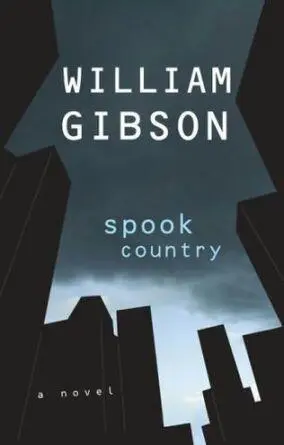
- Название:Spook Country
- Автор:
- Издательство:G. P. PUTNAM’S SONS
- Жанр:
- Год:2007
- Город:NEW YORK
- ISBN:нет данных
- Рейтинг книги:4 / 5. Голосов: 1
-
Избранное:Добавить в избранное
- Отзывы:
-
Ваша оценка:
Spook Country: краткое содержание, описание и аннотация
Предлагаем к чтению аннотацию, описание, краткое содержание или предисловие (зависит от того, что написал сам автор книги «Spook Country»). Если вы не нашли необходимую информацию о книге — напишите в комментариях, мы постараемся отыскать её.
, the challenge of writing about the present-day world drove him to create perhaps his best novel yet, and in
he remains at the top of his game. It's a stripped-down thriller that reads like the best DeLillo (or the best Gibson), with the lives of a half-dozen evocative characters connected by a tightly converging plot and by the general senses of unease and wonder in our networked, post-9/11 time.
Spook Country — читать онлайн бесплатно полную книгу (весь текст) целиком
Ниже представлен текст книги, разбитый по страницам. Система сохранения места последней прочитанной страницы, позволяет с удобством читать онлайн бесплатно книгу «Spook Country», без необходимости каждый раз заново искать на чём Вы остановились. Поставьте закладку, и сможете в любой момент перейти на страницу, на которой закончили чтение.
Интервал:
Закладка:
The door opened on the buzz and tinkle of Starck’s lobby in late-evening bar mode. A brown-haired bellman, in trademark pale suit, stood centered in the projected faux-Islamic squiggles of the carpet-of-light device, smiling mightily in her direction.
This functionary’s teeth, illuminated by the accidental fall of a single sunny squiggle, were presented with billboard clarity. As she approached him, scanning for her Belgian advertising magnate, the smile increased in both width and magnitude, till, as she was about to pass, the luxurious tones last heard on her cell emerged, startling her: “Miss Henry? Hubertus Bigend.”
Instead of screaming, she took his hand, finding it firm, dry, and of a neutral temperature. He squeezed hers lightly in return, his smile expanding still further.
“Pleased to meet you, Mr. Bigend.”
“Hubertus,” he insisted, “please. Are you finding the hotel satisfactory?”
“Yes, thanks.” What she’d taken for a Mondrian doorman’s suit was crisp beige wool. His sky-blue shirt was open at the collar.
“Shall we try Skybar?” he asked, consulting a watch the size of a small ashtray. “Unless you’d prefer something here.” He indicated the high, narrow, surrealistically long alabaster table, atop some number of tall, biomorphic Starck legs, that was the lobby bar.
There’s safety in numbers, said an inner voice that wanted to stay right here, have the required drink and the absolute polite minimum of talk.
“Skybar,” she opted, not certain why, but recalling that it might well be impossible to get in, let alone get a table. As he led her toward the pool and the shed-sized flowerpots, each with its ficus tree, she recalled fragments from the last few times she’d been here, at the end of and just after the Curfew’s official cessation. People who didn’t know the music industry, Inchmale said, believed that the movie business was the ne plus ultra of vicious, asshole-chewing, hyena-like behavior.
They passed a Brobdingnagian futon, in whose squishy depths a covey of vicious, asshole-chewing, hyena-like, and exceptionally pretty young people reclined with their drinks. But you don’t know that about them, she reminded herself; it was just that they looked like A&R people. But then almost everyone here did.
He led her past the bouncer as though the bouncer weren’t there. Indeed, the Bluetoothed bouncer was hard-pressed to get out of Bigend’s way in time, so thoroughly did it seem that Bigend was unaccustomed to anyone being in his way.
The bar was packed, as she remembered it having always been, but he had no trouble getting them a table. Looking broad, bright-eyed, and, she supposed, Belgian, he held her heavy, library-style oak chair for her. “I was quite a fan of the Curfew,” he said to her ear.
And a huge Goth altogether, I’ll bet, she resisted replying. The idea of a baby Belgian advertising magnate raising his Bic in some darkened Curfew concert was best left unexamined. These days, according to Inchmale, they raised their cell phones, and the screens gave out quite a startling amount of light. “Thank you,” she said, leaving it ambiguous as to whether she was thanking him for having told her he’d liked the Curfew, or for having held her chair.
Seated opposite her now, beige elbows on the table, manicured fingers steepled in front of him, he was managing a good approximation of the look she was given by male Hollis Henry aficionados who were actually seeing some private inner version of Anton Corbijn’s portrait of her, the one in the deconstructed tweed miniskirt.
“My mother,” he began on an unexpected note, “enjoyed the Curfew immensely. She was a sculptor. Phaedra Seynhaev. When I visited her Paris studio for the last time, she was playing you. Loudly.” He smiled.
“Thank you.” She decided not to go with the dead mother. “But I’m a journalist now. No credentials to coast on, there.”
“Rausch is very pleased with you as a journalist,” he said. “He wants you on staff.” Their waiter arrived, and went away for Hollis’s gin-tonic and Bigend’s piso mojado, a new one on Hollis.
“Tell me about Node,” she suggested. “It doesn’t seem to be generating much in the way of industry gossip.”
“No?”
“No.”
He lowered his finger-steeple. “Anti-buzz,” he said. “Definition by absence.”
She waited to see if he’d indicate that he was joking. He didn’t. “That’s ridiculous.”
The smile unshuttered, gleamed, shuttered, and then their drinks arrived, in disposable plastic that protected the hotel against barefoot poolside litigations. She afforded herself a quick scan of the rest of the clientele. Were a cruise missile just then to impact the corrugated roof of Skybar, she decided, there would be no great need for People to change its next cover. The fancy, as Inchmale had called them, seemed to have moved on. Just as well, for present purposes. “Tell me,” she said, leaning slightly forward over her gin.
“Yes?”
“Chombo. Bobby Chombo. Why did Rausch make such a point of my meeting him?”
“Rausch is the story’s editor,” he said, mildly. “Perhaps you should ask him.”
“Something else is going on,” she pressed. She felt as though she were marching out to confront the Mongolian Death Worm on its own ground; probably not that good an idea, but somehow she knew she must. “His urgency didn’t feel to me like part of the story.”
Bigend studied her. “Ah. Well. Part of another story, then. A much bigger one. Your second Node story, we hope. And you’ve just come from meeting him—Chombo?”
“Yes.”
“And what did you think?”
“He knows he knows something nobody else does. Or thinks he does.”
“And what do you think that might be, Hollis? May I call you Hollis?”
“Please do. I don’t think Bobby’s all that keen on his position in any locative avant-garde. He likes being on top of any breaking phenomenon, I’d guess, but is basically bored with the grunt work. When he was helping to invent the context of the locative thing, to whatever extent he did, he probably wasn’t bored.”
Bigend’s smile opened again. It reminded her of the lights in another train when trains pass at night, going in opposite directions. Then it closed. It was like she’d entered a tunnel. “Go on.” He sipped his piso, which looked a lot like NyQuil.
“And it’s not DJ-ing,” she said, “or making mash-ups, or whatever else he does publicly. It’s whatever makes him mark the floor of that factory according to the GPS grid. He won’t sleep in the same square twice. Whatever makes him confident he’s important is also what’s making him crazy.”
“And that might be?”
She thought of the wireframed cargo container, how Chombo had so abruptly tried to yank the helmet off her head, almost pulling her over. She hesitated.
“Pirates,” he said.
“Pirates?”
“The Straits of Malacca and the South China Sea. Small, fast boats, preying on cargo vessels. They operate from lagoons, coves, islets. The Malay Peninsula. Java, Borneo, Sumatra…”
She looked from Bigend to the crowd around them, feeling like she’d fallen into someone else’s pitch meeting. A ghostly studio log line, left to hover near the bar’s massively timbered, corrugated ceiling, had fallen on her, the first likely victim to sit at this table. A pirate movie. “Arrrr,” she said, meeting his gaze again and downing the last of her gin-tonic, “matey.”
“Real pirates,” Hubertus Bigend said, unsmiling. “Most of them, anyway.”
“Most?”
“Some of them were part of a covert CIA maritime program.” He put his empty plastic glass down as though it were something he was considering bidding on at Sotheby’s. He framed it with his fingers, a director considering a shot. “Stopping suspect cargo vessels to search for weapons of mass destruction.” He looked up at her, unsmiling.
Читать дальшеИнтервал:
Закладка:
Похожие книги на «Spook Country»
Представляем Вашему вниманию похожие книги на «Spook Country» списком для выбора. Мы отобрали схожую по названию и смыслу литературу в надежде предоставить читателям больше вариантов отыскать новые, интересные, ещё непрочитанные произведения.

Обсуждение, отзывы о книге «Spook Country» и просто собственные мнения читателей. Оставьте ваши комментарии, напишите, что Вы думаете о произведении, его смысле или главных героях. Укажите что конкретно понравилось, а что нет, и почему Вы так считаете.