William Gibson - Spook Country
Здесь есть возможность читать онлайн «William Gibson - Spook Country» весь текст электронной книги совершенно бесплатно (целиком полную версию без сокращений). В некоторых случаях можно слушать аудио, скачать через торрент в формате fb2 и присутствует краткое содержание. Город: NEW YORK, Год выпуска: 2007, Издательство: G. P. PUTNAM’S SONS, Жанр: Современная проза, на английском языке. Описание произведения, (предисловие) а так же отзывы посетителей доступны на портале библиотеки ЛибКат.
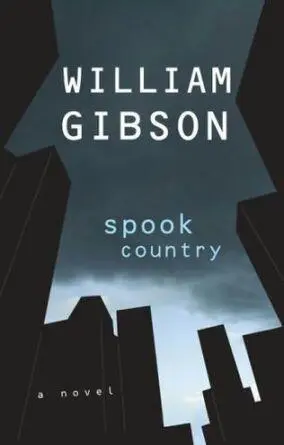
- Название:Spook Country
- Автор:
- Издательство:G. P. PUTNAM’S SONS
- Жанр:
- Год:2007
- Город:NEW YORK
- ISBN:нет данных
- Рейтинг книги:4 / 5. Голосов: 1
-
Избранное:Добавить в избранное
- Отзывы:
-
Ваша оценка:
Spook Country: краткое содержание, описание и аннотация
Предлагаем к чтению аннотацию, описание, краткое содержание или предисловие (зависит от того, что написал сам автор книги «Spook Country»). Если вы не нашли необходимую информацию о книге — напишите в комментариях, мы постараемся отыскать её.
, the challenge of writing about the present-day world drove him to create perhaps his best novel yet, and in
he remains at the top of his game. It's a stripped-down thriller that reads like the best DeLillo (or the best Gibson), with the lives of a half-dozen evocative characters connected by a tightly converging plot and by the general senses of unease and wonder in our networked, post-9/11 time.
Spook Country — читать онлайн бесплатно полную книгу (весь текст) целиком
Ниже представлен текст книги, разбитый по страницам. Система сохранения места последней прочитанной страницы, позволяет с удобством читать онлайн бесплатно книгу «Spook Country», без необходимости каждый раз заново искать на чём Вы остановились. Поставьте закладку, и сможете в любой момент перейти на страницу, на которой закончили чтение.
Интервал:
Закладка:
“Why do you say that he had fewer choices?”
“The head of a large family has duties. And we had already become a different sort of family, a firma, as we are today. He put his family before his desire for a more perfect state. If it had been him, alone, I believe he would have stayed. Perhaps he would be alive today. Your father’s death, of course, strongly affected his decision to bring us here. Sit.” She brought a yellow tray to the small table, with the tostada on a white saucer, and a large white cup of café con leche.
“This man, he enabled Grandfather to bring us here?”
“In a sense.”
“What does that mean?”
“Too many questions.”
He smiled up at her. “Is he CIA?”
She glowered at him from beneath the gray kerchief. The pale tip of her tongue appeared at the corner of her mouth, then vanished. “Was your grandfather DGI?”
Tito dunked and chewed a piece of his tostada, considering. “Yes.”
“There you are,” said Juana. “Of course he was.” She brushed her wrinkled hands together, as if wishing to be free of the traces of something. “But who did he work for? Think of our saints, Tito. Two faces. Always, two.”
15. SPIV
I nchmale had always been balding and intense, and Inchmale had always been middle-aged—even when she first met him, when they were both nineteen. People who really liked the Curfew tended to like Inchmale or to like her, but seldom both. Bobby Chombo, she thought, as Alberto drove her back to the Mondrian, was one of the former. But that had been a good thing, really, because it had meant that she’d been able to lay out her best public pieces of Inchmale without revealing herself, then shuffle them, palm them, rearrange them, withdraw them, to help keep him talking. She’d never asked Inchmale, but she took it for granted he did the same with her.
And it hadn’t hurt that Bobby was himself a musician, though not in the old plays-a-physical-instrument-and/or-sings modality. He took things apart, sampled them, mashed them up. This was fine with her, though like General Bosquet watching the charge of the Light Brigade, she was inclined to think it wasn’t war. Inchmale understood it, though, and indeed had championed it, as soon as it was digitally possible pulling guitar lines out of obscure garage chestnuts and stretching them, like a mad jeweler elongating sturdy Victorian tableware into something insectile, post-functionally fragile, and neurologically dangerous.
She’d also assumed that she had Bobby’s Marlboro binge on her side, though she’d noticed that she was starting to count his smokes, and to worry, as he neared the bottom of his pack, about having one herself. She’d tried distracting herself with sips of room-temperature Red Bull from a previously unopened can she’d excavated from the table clutter, but it had only made her bug-eyed with caffeine, or perhaps with taurine, the drink’s other famous ingredient, extracted supposedly from the testicles of bulls. Bulls generally looked more placid than she now felt, or perhaps those were cows. She didn’t know cattle.
Bobby Chombo’s sampling talk had helped her make a kind of sense of him, of his annoying shoes and his tight white pants. He was, basically, a DJ. Or DJ-like, in any case, which was what counted. His day job, troubleshooting navigational systems or whatever it was, made a sort of sense too. It was, often as not, the wonk side of being DJ-like, and often as not the side that paid the rent. Either it was his wonk-hipster thing that had so strongly evoked Inchmale for her, or that he was the sort of jerk that Inchmale had always been able to handle so efficiently. Because, she supposed, Inchmale had been more or less that sort of jerk himself.
“It went better than I expected it to,” said Alberto, interrupting her thoughts. “He’s a difficult person to get to know.”
“I went to a gig in Silverlake, a couple of years ago, what they call reggaeton. Sort of reggae-salsa fusion.”
“Yeah?”
“Chombo. The DJ was a big deal in that scene: El Chombo.”
“That’s not Bobby.”
“I’ll say. But why’s our Bobby white-guy a Chombo too?”
Alberto grinned. “He likes people to wonder about that. But his Chombo’s a kind of software.”
“Software?”
“Yes.”
She decided there wasn’t much to be thought about that, at this point. “He sleeps there?”
“He doesn’t go out, unless he has to.”
“You said he won’t sleep twice in the same square of that grid.”
“Never mention that to him, no matter what, okay?”
“And he does gigs? DJs?”
“He podcasts,” Alberto said.
Her cell rang.
“Hello?”
“Reg.”
“I was just thinking about you.”
“Why was that?”
“Another time.”
“Get my e-mail?”
“I did.”
“Angelina asked me to call, re-reiterate. Ree-ree.”
“I get the message, thanks. I don’t think there’s much I can do about it, though, except do what I’m doing and see what happens.”
“Are you taking some sort of seminar?” he asked.
“Why?”
“You sounded uncharacteristically philosophical, just then.”
“I saw Heidi, earlier.”
“Christ,” said Inchmale. “Was she walking on her hind legs?”
“She drove past me in a very nice-looking car. Headed in the direction of Beverly Hills.”
“She’s been headed in that direction since the birth canal.”
“I’m with someone, Reg. Have to go.”
“Toodles.” He was gone.
“Was that Reg Inchmale?” Alberto asked.
“Yes, it was.”
“You saw Heidi Hyde tonight?”
“Yes, while you were getting rousted in Virgin. She drove past on Sunset.”
“Wow,” said Alberto. “How likely is that?”
“Statistically, who knows? Subjectively, feels to me, not so weird. She lives in Beverly Hills, works in Century City.”
“Doing what?”
“Something in her husband’s company. He’s a tax lawyer. With his own production company.”
“Eek,” said Alberto, after a pause, “there really is a life after rock.”
“You’d better believe it,” she assured him.
ODILE’S ROBOT appeared to have died, or to be hibernating. It sat there by the drapes, inert and unfinished-looking. Hollis nudged it with the toe of her Adidas.
There were no messages on the hotel voice mail.
She got her PowerBook out of the bag, woke it, and tried holding the back of the open screen against the window. Did she want to rejoin trusted wireless network SpaDeLites47? Yes, please. SpaDeLites47 had treated her right, before. She assumed SpaDeLites47 was in the period apartment building across the street.
No mail. One-handed, supporting the laptop with her other, she Googled “bigend.”
First up was a Japanese site for “BIGEND,” but this seemed to be a brand of performance motor oil for dragsters.
She tried the link for his Wikipedia entry.
Hubertus Hendrik Bigend, born June 7, 1967, in Antwerp, is the founder of the innovative global advertising agency Blue Ant. He is the only child of Belgian industrialist Benoît Bigend and Belgian sculptor Phaedra Seynhaev. Much has been made, by Bigend’s admirers and detractors alike, of his mother’s early links with the Situationist International (Charles Saatchi was famously but falsely reported to have described him as “a jumped-up Situationist spiv”) but Bigend himself has declared that the success of Blue Ant has entirely to do with his own gifts, one of which, he claims, is the ability to find precisely the right person for a given project. He is very much a hands-on micromanager, in spite of the firm’s remarkable growth in the past five years.
Her cell began to ring, in her bag, back on the table. If she moved the PowerBook, she’d lose the wifi from across the street, though this page would still be cached. She crossed to the table, put the laptop down on it, and dug her phone out of her bag. “Hello?”
Читать дальшеИнтервал:
Закладка:
Похожие книги на «Spook Country»
Представляем Вашему вниманию похожие книги на «Spook Country» списком для выбора. Мы отобрали схожую по названию и смыслу литературу в надежде предоставить читателям больше вариантов отыскать новые, интересные, ещё непрочитанные произведения.



Обсуждение, отзывы о книге «Spook Country» и просто собственные мнения читателей. Оставьте ваши комментарии, напишите, что Вы думаете о произведении, его смысле или главных героях. Укажите что конкретно понравилось, а что нет, и почему Вы так считаете.