William Gibson - Spook Country
Здесь есть возможность читать онлайн «William Gibson - Spook Country» весь текст электронной книги совершенно бесплатно (целиком полную версию без сокращений). В некоторых случаях можно слушать аудио, скачать через торрент в формате fb2 и присутствует краткое содержание. Город: NEW YORK, Год выпуска: 2007, Издательство: G. P. PUTNAM’S SONS, Жанр: Современная проза, на английском языке. Описание произведения, (предисловие) а так же отзывы посетителей доступны на портале библиотеки ЛибКат.
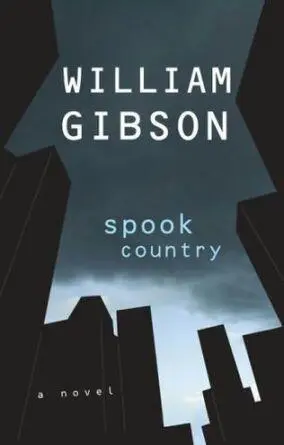
- Название:Spook Country
- Автор:
- Издательство:G. P. PUTNAM’S SONS
- Жанр:
- Год:2007
- Город:NEW YORK
- ISBN:нет данных
- Рейтинг книги:4 / 5. Голосов: 1
-
Избранное:Добавить в избранное
- Отзывы:
-
Ваша оценка:
Spook Country: краткое содержание, описание и аннотация
Предлагаем к чтению аннотацию, описание, краткое содержание или предисловие (зависит от того, что написал сам автор книги «Spook Country»). Если вы не нашли необходимую информацию о книге — напишите в комментариях, мы постараемся отыскать её.
, the challenge of writing about the present-day world drove him to create perhaps his best novel yet, and in
he remains at the top of his game. It's a stripped-down thriller that reads like the best DeLillo (or the best Gibson), with the lives of a half-dozen evocative characters connected by a tightly converging plot and by the general senses of unease and wonder in our networked, post-9/11 time.
Spook Country — читать онлайн бесплатно полную книгу (весь текст) целиком
Ниже представлен текст книги, разбитый по страницам. Система сохранения места последней прочитанной страницы, позволяет с удобством читать онлайн бесплатно книгу «Spook Country», без необходимости каждый раз заново искать на чём Вы остановились. Поставьте закладку, и сможете в любой момент перейти на страницу, на которой закончили чтение.
Интервал:
Закладка:
“Hubertus Bigend, for Hollis Henry.”
It sounded as though her phone had received some sort of corporate upgrade. She froze, out of primeval fear that he’d caught her Googling him, peering into his Wiki.
“Mr. Bigend,” she said, giving up on the idea of any attempt at the Franco-Belgian pronunciation.
“Miss Henry. Consider us introduced, shall we? You may have no idea why I’m calling. The Node start-up, you see, is a project of mine.”
“I’ve only just Googled you.” She opened her mouth wide, wider, in the silent scream that Inchmale had taught her reduces tension.
“Ahead of the game, then. What we want in a journalist. I’ve just spoken myself with Rausch, in London.”
If Rausch is in London, she wondered, then where are you? “Where are you?”
“I’m in the lobby of your hotel. I was wondering if you might like a drink.”
16. KNOWN EXITS
Milgrim was reading the New York Times, finishing his breakfast coffee in a bakery on Bleecker, while Brown conducted a series of quiet, tense, and extremely pissed-off conversations with whoever was supposed to be in charge of watching the IF’s known exits, when the IF was home sleeping—or whatever the IF did, when he was home. “Known exits” seemed to Milgrim to imply that the IF’s neighborhood might be riddled with gaslit opium tunnels and the odd subterranean divan, a possibility Milgrim found appealing, however unlikely.
Whoever was on the other end of this particular call was not having a good morning. The IF and another male had left the IF’s building, walked to the Canal Street subway, entered, and vanished. Milgrim knew, from having also overheard Brown’s half of other conversations, that the IF and his family tended to do that, and particularly around subways. Milgrim imagined that the IF and his family had the keys to some special kind of subway-based porosity, a way into the cracks and holes and spaces between things.
Milgrim himself was having a better morning than he recalled having had in some time, and this in spite of Brown’s having shaken him awake to translate Volapuk. Then he’d fallen back into some dream he could no longer remember, not a pleasant one, something about blue light coming from his skin, or beneath it. But all in all very pleasant to be here in the Village this early in the day, having coffee and a pastry and enjoying the Times someone had left.
Brown didn’t like the New York Times. Brown actually didn’t like news media of any kind, Milgrim had come to understand, because the news conveyed did not issue from any reliable, that was to say, governmental, source. Nor could it, really, under present conditions of war, as any genuine news, news of any strategic import whatever, was by definition precious, and not to be wasted on the nation’s mere citizenry.
Milgrim certainly wasn’t going to argue with any of that. If Brown had declared the Queen of England to be a shape-shifting alien reptile, craving the warm flesh of human infants, Milgrim would not have argued.
But midway through a third-page piece on the NSA and data mining, something occurred to Milgrim. “Say,” he said to Brown, who’d just ended a call and was looking at his phone as if he wished he knew a way to torture it, “this NSA data-mining thing…”
It hung there, between them, somewhere above the table. He wasn’t in the habit of initiating conversations with Brown, and for good reason. Brown looked from the phone to Milgrim, his expression unchanged.
“I was thinking,” Milgrim heard himself say, “about your IF. About the Volapuk. If the NSA can do what it says they can, here, then it should be pretty easy to fold a logarithm into the mix that would grab your Volapuk and nothing else. You wouldn’t even need much of a sample of their family dialect. You could just find half a dozen dialectal examples of the form and shoot for a kind of average. Anything that went through the phone system, after that, that had that tag, bingo. You wouldn’t need to be changing any more batteries on the IF’s coatrack.”
Milgrim was genuinely pleased with having thought of this. But Brown, he saw, was not happy with Milgrim for having thought of it. “That’s only good for overseas calls,” Brown said, and seemed to be considering whether or not to hit him.
“Ah,” Milgrim said. He put his head down and pretended to read, until Brown got back on the phone, quietly chewing someone else out for losing the IF and the other male.
Milgrim couldn’t get back into his article, but continued to pretend to read the paper. Something was working its way up, inside him, from some new and peculiarly discomfiting angle. So far he’d taken it for granted that Brown, and by extension his people, were government agents of some kind, presumably federal. And yet, if the NSA had been doing what this Times article said they had been doing, and he, Milgrim, was reading about it, why should he suppose that what Brown had said was true? The reason Americans weren’t freaking out over this NSA thing, Milgrim assumed, was that they’d already been taking it for granted, since at least the 1960s, that the CIA was tapping everybody’s phone. It was the stuff of bad episodic television. It was something little kids knew to be true.
But if there were Volapuk being texted in Manhattan, and the real government really needed it as badly as Brown seemed to need it, wouldn’t they get it? Milgrim folded his paper.
But what if, asked the upwardly burrowing voice, Brown was not really a government agent? There had until now been some part of Milgrim willing to suppose that being held captive by federal agents was in a sense the same as being under their protection. While the majority of him had suspected this was a dubious formulation, it had taken something, perhaps the new calm and perspective afforded by his change of medication, to bring him to this moment of unified awareness: What if Brown was just an asshole with a gun?
It was something to think about, and to his surprise he found that he could. “I need to use the washroom,” he said.
Brown muted his phone. “There’s a back door,” he said, “out the kitchen. Someone’s out there, in case you think you’re leaving. If they thought you might get away, they’d shoot you.”
Milgrim nodded. Got up. He wasn’t going to run, but for the first time, he thought Brown might be bluffing.
In the washroom he ran cool water over his wrists, then looked at his hands. They were still his. He wiggled his fingers. Amazing, really.
17. PIRATES AND TEAMS
The front of her Mondrian haircut had started to remind her of Bobby Chombo’s elephantiasis-of-the-forelock, the result of an ongoing interaction of product with particulates. Whatever the stylist had applied had by now sucked in every molecule of the brew that was the air of the L.A. basin, plus however many cigarettes Bobby Chombo had recently smoked in her immediate vicinity.
None of this looks very good, she thought, meaning not so much the generally poor appearance she felt she was able to muster, to meet her new employer, but the overall arc and apparent direction of her life so far. Everything, right that minute, down to Chombo and his gridded floor. Chombo afraid to sleep in the same grid square twice…
But still. Lip gloss. Earrings. Top and skirt and hose from the worse-for-wear Barneys bag she was using to separate dress-up from workaday.
For a purse, she chose one of her black makeup bags, dumped it, refilled it minimally. The shoes from the dress-up bag were mutant black ballet slippers, by a Catalan designer long since gone into some other field.
“Out of here,” she told the woman in the mirror.
Once again ignoring the video art in the elevator.
Читать дальшеИнтервал:
Закладка:
Похожие книги на «Spook Country»
Представляем Вашему вниманию похожие книги на «Spook Country» списком для выбора. Мы отобрали схожую по названию и смыслу литературу в надежде предоставить читателям больше вариантов отыскать новые, интересные, ещё непрочитанные произведения.


Обсуждение, отзывы о книге «Spook Country» и просто собственные мнения читателей. Оставьте ваши комментарии, напишите, что Вы думаете о произведении, его смысле или главных героях. Укажите что конкретно понравилось, а что нет, и почему Вы так считаете.