William Gibson - Spook Country
Здесь есть возможность читать онлайн «William Gibson - Spook Country» весь текст электронной книги совершенно бесплатно (целиком полную версию без сокращений). В некоторых случаях можно слушать аудио, скачать через торрент в формате fb2 и присутствует краткое содержание. Город: NEW YORK, Год выпуска: 2007, Издательство: G. P. PUTNAM’S SONS, Жанр: Современная проза, на английском языке. Описание произведения, (предисловие) а так же отзывы посетителей доступны на портале библиотеки ЛибКат.
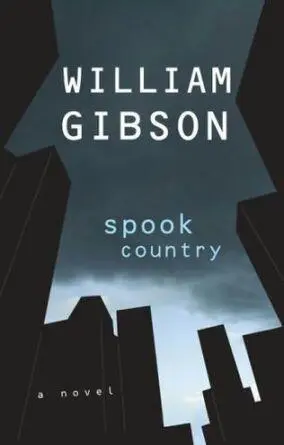
- Название:Spook Country
- Автор:
- Издательство:G. P. PUTNAM’S SONS
- Жанр:
- Год:2007
- Город:NEW YORK
- ISBN:нет данных
- Рейтинг книги:4 / 5. Голосов: 1
-
Избранное:Добавить в избранное
- Отзывы:
-
Ваша оценка:
Spook Country: краткое содержание, описание и аннотация
Предлагаем к чтению аннотацию, описание, краткое содержание или предисловие (зависит от того, что написал сам автор книги «Spook Country»). Если вы не нашли необходимую информацию о книге — напишите в комментариях, мы постараемся отыскать её.
, the challenge of writing about the present-day world drove him to create perhaps his best novel yet, and in
he remains at the top of his game. It's a stripped-down thriller that reads like the best DeLillo (or the best Gibson), with the lives of a half-dozen evocative characters connected by a tightly converging plot and by the general senses of unease and wonder in our networked, post-9/11 time.
Spook Country — читать онлайн бесплатно полную книгу (весь текст) целиком
Ниже представлен текст книги, разбитый по страницам. Система сохранения места последней прочитанной страницы, позволяет с удобством читать онлайн бесплатно книгу «Spook Country», без необходимости каждый раз заново искать на чём Вы остановились. Поставьте закладку, и сможете в любой момент перейти на страницу, на которой закончили чтение.
Интервал:
Закладка:
“Your company’s down here?” she asked Bigend, as he turned the Maybach into an alleyway that looked as though a Bradley fighting vehicle would be the wise man’s ride of choice.
Past a delirious frozen surge of graffiti, a sort of street-fractal Hokusai wave, and under a lowering lip of coiled razor wire topping chain-link gates.
“Yes,” he said, steering onto a concrete ramp rising fifteen feet as it hugged a wall that seemed to her as though it must belong to some city infinitely older than Los Angeles. Babylon, perhaps, its only graffiti cuneiform and discreet, furtive clerkish hen-scratchings applied to the odd brick.
The Maybach came to a temporary halt on a flat, truck-length platform, facing an articulated metal door. There were bulbous growths of smoked black plastic above this, pods housing cameras and perhaps other things as well. The door, decorated with a black pointillist portrait of Andre the Giant, Orwellian in scale, rose slowly, Andre’s somber, thyroidal gaze giving way to halogen brilliance. Bigend drove forward into a hangar-like space, smaller than Bobby Chombo’s empty factory but still impressive. Half a dozen identical silver sedans were parked there in a row, beside a brand-new yellow forklift and tall, tidy stacks of new gypsum wallboard.
Bigend stopped the car. A ball-capped guard in black uniform shorts and matching short-sleeved shirt regarded them from behind mirrored glasses. A laden, multicompartmented black holster was strapped to his right thigh.
She felt a sudden intense desire to get out of the Maybach, and acted on it.
The door opened like some disturbing hybrid of bank vault and Armani evening purse, perfectly balanced bombproof solidity meeting sheer cosmetic slickness. The gritty concrete floor, blotched with crumbs of gypsum, felt comforting in contrast. The guard gestured with a remote. She heard segmented steel start to rattle down behind them.
“This way, please,” said Bigend, over the clatter of the closing door. He stepped away from the Maybach without bothering to close his door, so she left hers open as well and followed him. She looked back, just as she was catching up with him, and saw it sitting open, its interior a soft, mouthlike cavern of gray lambskin under the high-resolution brilliance of the garage’s lighting.
“We’re losing the better part of the neighborhood’s edge, as the reclamation continues,” he said, guiding her around a ten-foot stack of drywall.
“‘Better part’?”
“Majority of. I’ll miss it, myself. It unsettles visitors. Unsettled is good. Last week we opened a new suite of offices in Beijing. I’m not satisfied, not at all. Three floors in a new building, really nothing we could do with them. But it’s Beijing.” He shrugged. “What choice do we have?”
She didn’t know, so said nothing. He led her up a wide flight of stairs and into what was obviously in the process of becoming a foyer. Another guard, studying CCTV windows on a panel display, ignored them.
They stepped into an elevator, its every surface taped over with white-dusted layers of corrugated cardboard. Bigend lifted a flap of the stuff and touched the controls. They rose two floors and the door opened. He gestured for her to go ahead.
She stepped out onto a scuffed runway of more of the same cardboard, taped across a floor of some smooth gray product. The cardboard ran to a conference table, six chairs on a side. Above this, on the wall beyond, hung Anton Corbijn’s portrait of her, in perfect resolution on a screen perhaps thirty feet on the diagonal.
“A wonderful image,” he said, as she looked from it back to him.
“I’ve never been entirely comfortable with it.”
“Because the celebrity self is a sort of tulpa,” he said.
“A what?”
“A projected thought-form. A term from Tibetan mysticism. The celebrity self has a life of its own. It can, under the right circumstances, indefinitely survive the death of its subject. That’s what every Elvis sighting is about, literally.”
All of which reminded her very much of how Inchmale looked at these things, though really she believed it too.
“What happens,” she asked him, “if the celebrity self dies first?”
“Very little,” he said. “That’s usually the problem. But images of this caliber serve as a hedge against that. And music is the most purely atemporal of media.”
“‘The past isn’t dead. It’s not even past,’” quoting Inchmale quoting Faulkner. “Would you mind changing channels?”
He gestured toward the screen. The Hook appeared in her place, the Soviet cargo helicopter, photographed from below. “What do you make of all this?” The smile flashed like a lighthouse. There were no apparent windows in this room, and at the moment this screen was the sole source of light.
“You like unsettled?”
“Yes?”
“Then you like me.”
“I do like you. And something would be very wrong if you weren’t. Unsettled.”
She went to the conference table and ran a finger along its black surface, leaving a faint trace in gypsum dust. “Is there really a magazine?”
“Everything,” said Bigend, “is potential.”
“Everything,” she said, “is potential bullshit.”
“Think of me as a patron. Please.”
“I don’t like the sound of that, thanks.”
“In the early 1920s,” Bigend said, “there were still some people in this country who hadn’t yet heard recorded music. Not many, but a few. That’s less than a hundred years ago. Your career as a ‘recording artist’”—making the quotes with his hands—“took place toward the end of a technological window that lasted less than a hundred years, a window during which consumers of recorded music lacked the means of producing that which they consumed. They could buy recordings, but they couldn’t reproduce them. The Curfew came in as that monopoly on the means of production was starting to erode. Prior to that monopoly, musicians were paid for performing, published and sold sheet music, or had patrons. The pop star, as we knew her”—and here he bowed slightly, in her direction—“was actually an artifact of preubiquitous media.”
“Of—?”
“Of a state in which ‘mass’ media existed, if you will, within the world.”
“As opposed to?”
“Comprising it.”
The light in the room changed, as he said this. She raised her eyes to the screen, where a metallic blue ant-glyph had taken over the screen.
“What’s in Chombo’s container?” she asked.
“It’s not Chombo’s container.”
“Your container.”
“It’s not our container.”
“‘Our’ being you and who?”
“You.”
“It’s not my container.”
“Just as I said,” said Bigend. And smiled.
“Whose is it, then?”
“I don’t know. But I believe you might be able to find out.”
“What’s in it?”
“We don’t know that either.”
“What does Chombo have to do with it?”
“Chombo, evidently, has found a way to know where it is, at least periodically.”
“Why don’t you just ask him?”
“Because it’s a secret. He’s being paid handsomely to keep it a secret, and his personality is such, as you’ve noted, that he likes having a secret.”
“Who’s paying him, then?”
“That seems to be even more of a secret.”
“Do you think it might be the container’s owner?”
“Or its ultimate addressee, should it ever acquire one? I don’t know. But you, Hollis, are the person I’ve found whom Bobby is most likely to talk to.”
“You weren’t there. He wasn’t that glad to have Alberto bring me around. There were no suggestions of further invitations.”
“That’s where I’m convinced you’re wrong,” he said. “When he’s gotten used to the idea that you’re available for more face time, you may well hear from him.”
Читать дальшеИнтервал:
Закладка:
Похожие книги на «Spook Country»
Представляем Вашему вниманию похожие книги на «Spook Country» списком для выбора. Мы отобрали схожую по названию и смыслу литературу в надежде предоставить читателям больше вариантов отыскать новые, интересные, ещё непрочитанные произведения.

Обсуждение, отзывы о книге «Spook Country» и просто собственные мнения читателей. Оставьте ваши комментарии, напишите, что Вы думаете о произведении, его смысле или главных героях. Укажите что конкретно понравилось, а что нет, и почему Вы так считаете.