William Gibson - Spook Country
Здесь есть возможность читать онлайн «William Gibson - Spook Country» весь текст электронной книги совершенно бесплатно (целиком полную версию без сокращений). В некоторых случаях можно слушать аудио, скачать через торрент в формате fb2 и присутствует краткое содержание. Город: NEW YORK, Год выпуска: 2007, Издательство: G. P. PUTNAM’S SONS, Жанр: Современная проза, на английском языке. Описание произведения, (предисловие) а так же отзывы посетителей доступны на портале библиотеки ЛибКат.
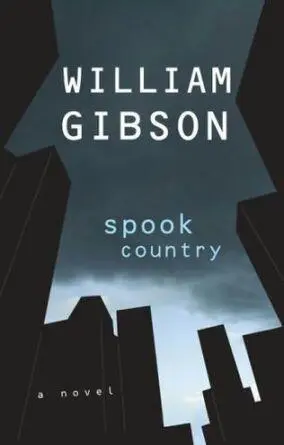
- Название:Spook Country
- Автор:
- Издательство:G. P. PUTNAM’S SONS
- Жанр:
- Год:2007
- Город:NEW YORK
- ISBN:нет данных
- Рейтинг книги:4 / 5. Голосов: 1
-
Избранное:Добавить в избранное
- Отзывы:
-
Ваша оценка:
Spook Country: краткое содержание, описание и аннотация
Предлагаем к чтению аннотацию, описание, краткое содержание или предисловие (зависит от того, что написал сам автор книги «Spook Country»). Если вы не нашли необходимую информацию о книге — напишите в комментариях, мы постараемся отыскать её.
, the challenge of writing about the present-day world drove him to create perhaps his best novel yet, and in
he remains at the top of his game. It's a stripped-down thriller that reads like the best DeLillo (or the best Gibson), with the lives of a half-dozen evocative characters connected by a tightly converging plot and by the general senses of unease and wonder in our networked, post-9/11 time.
Spook Country — читать онлайн бесплатно полную книгу (весь текст) целиком
Ниже представлен текст книги, разбитый по страницам. Система сохранения места последней прочитанной страницы, позволяет с удобством читать онлайн бесплатно книгу «Spook Country», без необходимости каждый раз заново искать на чём Вы остановились. Поставьте закладку, и сможете в любой момент перейти на страницу, на которой закончили чтение.
Интервал:
Закладка:
Inchmale said that the Curfew had been built on the literal sonic foundation of Heidi’s stubbornness and militant lack of imagination, but that knowing that had never made it any easier to get along with her, and that that had been true from the very start. Hollis had always thought she’d agreed with that, but just now it seemed more viscerally true than she’d ever felt it to be, before.
“I’m out of here,” Heidi said, giving Hollis’s shoulder a quick squeeze, a really exceptional display of warmth, for her.
“Goodbye…Laura.”
Watching her march back across the lobby, past the cruciform settee and out of sight.
23. TWO MOORS
B rown left Milgrim in the Korean’s laundry for a very long time. Eventually a younger Korean, perhaps the proprietor’s son, arrived with a brown-bagged Chinese meal, which he presented to Milgrim with no comment. Milgrim cleared a space among the magazines on the plywood coffee table and unpacked his lunch. Plain rice, boneless chicken nuggets in red dye no. 3, fluorescent-green vegetable segments, finely sliced brown mystery meat. Milgrim preferred the plastic fork to the chopsticks. If you were in prison, he encouraged himself, you’d find this food a treat. Unless you were in a Chinese prison, some less-cooperative part of himself suggested, but he worked his way through it all, methodically. With Brown, it was best to eat what you could when the opportunity presented itself.
As he ate, he thought about the twelfth-century heresy of the Free Spirit. Either God was everything, believed the brethren of the Free Spirit, or God was nothing. And God, to them, was very definitely everything. There was nothing that wasn’t God, and indeed how could there be? Milgrim had never been one for metaphysics, but now the combination of his captivity, medication on demand, and this text was starting to reveal the pleasure to be had from metaphysical contemplation. Particularly if you were contemplating these Free Spirit guys, who seemed to have been a combination of Charlie Manson and Hannibal Lecter.
And insofar as everything was equally of God, they taught, those who were most in touch with the Godness in every last thing would make it a point to do anything at all, particularly anything still forbidden by those who hadn’t yet gotten the Free Spirit message. To which end they went around having sex with anybody they could get to hold still for it, or not, as the case might be—rape being viewed as particularly righteous, and murder equally so. It was like a secret religion of mutually empowered sociopaths, and Milgrim thought it was probably the gnarliest single example of human behavior he’d ever heard of. Someone like Manson, for instance, simply wouldn’t have been able to get any traction, had he landed among the brothers and sisters of the Free Spirit. Probably, Milgrim guessed, Manson would’ve hated it. What good would it be to be Charlie Manson in a whole society of serial killers and rapists, each one convinced that he or she was directly manifesting the Holy Spirit?
But the other aspect of the Free Spirit that fascinated him, and this applied to the whole text, was how these heresies would get started, often spontaneously generating around some single medieval equivalent of your more outspoken homeless mumbler. Organized religion, he saw, back in the day, had been purely a signal-to-noise proposition, at once the medium and the message, a one-channel universe. For Europe, that channel was Christian, and broadcasting from Rome, but nothing could be broadcast faster than a man could travel on horseback. There was a hierarchy in place, and a highly organized methodology of top-down signal dissemination, but the time lag enforced by tech-lack imposed a near-disastrous ratio, the noise of heresy constantly threatening to overwhelm the signal.
The rattle of the door distracted him from these thoughts. He looked up from the remains of his lunch and witnessed the entrance of an extremely large black man, very tall and very wide, who wore a stout thigh-length black leather coat, double-breasted and belted, and a black wool watch cap, pulled low around his ears. The watch cap put Milgrim in mind of the knitted woolen headgear Crusaders wore beneath their helmets, and that in turn made the leather barnstormer resemble a sort of elongated cuirass. A black knight stepping into the laundry from the early evening cold.
Milgrim wasn’t sure that there had actually been black knights, but couldn’t a Moor have converted, some African giant, and been made a knight in the service of Christ? Compared to that Free Spirit, it seemed the likeliest of scenarios.
Now the black knight had stepped up to the Korean’s counter, and was asking him if he could clean furs. The Korean couldn’t, he said, and the knight nodded, accepting that. The knight looked over and met Milgrim’s gaze. Milgrim nodded too, unsure why.
The knight left. Through the window, Milgrim saw him join a second and remarkably similar black man, in yet another black, double-breasted, belted leather coat. They turned south, down Lafayette, in their matching black wool skullcaps, and instantly were gone.
As Milgrim tidied away his empty foam bowl and his foil dishes, he experienced a nagging sensation of having failed to pay adequate attention to something. Try as he might, he couldn’t remember what that might have been.
It had been a very long day.
24. POPPIES
V otive candles had been lit in her darkened room. Beside the luminous cottons of the all-white bed, the water pitcher had been filled. She put the carton, dead Jimmy Carlyle’s envelope of hundred-dollar bills, and her makeshift evening purse on the long-legged marble-topped table in the kitchenette.
She used the small unsharpened blade in the handle of the kitchenette’s corkscrew to slit the transparent tape sealing the carton.
There was a note, in an oddly Sumerian-looking script, on a rectangle of plain gray card, resting on a fold of bubble wrap. “You need your own. Press On. H.”
She set that aside and lifted the fold of bubble wrap. Something black and matte silver. She drew out what she took to be a more aggressively styled version of the wireless helmet she’d used to view the squid at Bobby Chombo’s. Through the cutaway shell, she saw the same few simple touch pads. She turned the thing over, looking for a manufacturer’s logo, but found none. She did find MADE IN CHINA in minute bas-relief, but then most things were.
She tried it on, intending to do no more than glance at herself in a candlelit mirror, but she must have touched one of the control surfaces. “A locative installation, in your room,” Odile said, sounding as if she were inches from Hollis’s ear. She found herself atop the turned-down bed, clutching Bigend’s headgear, so unexpected had this been. “Monet’s poppies. Rotch.” Rotch? “The poppies and whatever background, they are equiluminant.”
And there they were, quivering slightly, reddish orange, arrayed as a field that filled her room, level with the height of the bed.
She moved her head from side to side, scanning the effect. “This becomes part of a series. The artist’s Argenteuil series. Rotch.” There it was again. “She fill spaces everywhere with Monet’s poppies. Call me when you have received this. We must talk, also about Chombo.” She pronounced it “Shombo.”
“Odile?” But it had been a recording. Still crouching on the bed, she sat down and ran her left hand through the poppies she knew weren’t there. She almost thought she could feel them. She swung her legs over the side and found the floor, poppies around her knees. Wading through them, toward the layered drapes, she felt momentarily as though they floated atop captive, unmoving water. The artist might not have intended that, she thought.
Читать дальшеИнтервал:
Закладка:
Похожие книги на «Spook Country»
Представляем Вашему вниманию похожие книги на «Spook Country» списком для выбора. Мы отобрали схожую по названию и смыслу литературу в надежде предоставить читателям больше вариантов отыскать новые, интересные, ещё непрочитанные произведения.

Обсуждение, отзывы о книге «Spook Country» и просто собственные мнения читателей. Оставьте ваши комментарии, напишите, что Вы думаете о произведении, его смысле или главных героях. Укажите что конкретно понравилось, а что нет, и почему Вы так считаете.