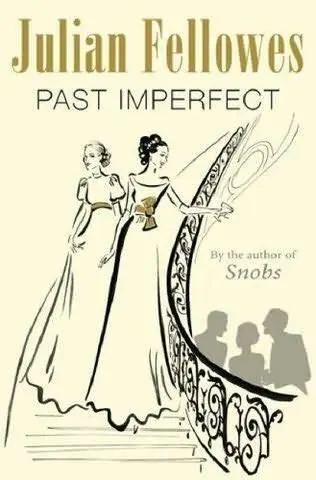
Julian Fellowes - Past Imperfect
Здесь есть возможность читать онлайн «Julian Fellowes - Past Imperfect» весь текст электронной книги совершенно бесплатно (целиком полную версию без сокращений). В некоторых случаях можно слушать аудио, скачать через торрент в формате fb2 и присутствует краткое содержание. Жанр: Современная проза, на английском языке. Описание произведения, (предисловие) а так же отзывы посетителей доступны на портале библиотеки ЛибКат.
- Название:Past Imperfect
- Автор:
- Жанр:
- Год:неизвестен
- ISBN:нет данных
- Рейтинг книги:3 / 5. Голосов: 1
-
Избранное:Добавить в избранное
- Отзывы:
-
Ваша оценка:
Past Imperfect: краткое содержание, описание и аннотация
Предлагаем к чтению аннотацию, описание, краткое содержание или предисловие (зависит от того, что написал сам автор книги «Past Imperfect»). Если вы не нашли необходимую информацию о книге — напишите в комментариях, мы постараемся отыскать её.
Past Imperfect — читать онлайн бесплатно полную книгу (весь текст) целиком
Ниже представлен текст книги, разбитый по страницам. Система сохранения места последней прочитанной страницы, позволяет с удобством читать онлайн бесплатно книгу «Past Imperfect», без необходимости каждый раз заново искать на чём Вы остановились. Поставьте закладку, и сможете в любой момент перейти на страницу, на которой закончили чтение.
Интервал:
Закладка:
‘How perfectly lovely,’ said Jennifer, looking around, provoking a severe look from her husband, which I understood. Anything giving away that they were not regular visitors was to be suppressed. Jennifer grasped this too, of course, but had obviously made the interesting decision not to play along with his self-importance. Bridget, needless to say, was retreating into one of her silent-but-ironic moods, but I couldn’t spare the time to administer to it. I was back at Gresham, which I never thought to be again, and I was determined to enjoy it.
The Tapestry Drawing Room was on the corner of the garden front, and the easiest way to reach it was through an oval anteroom at the back of the hall, where facing doors led left, to the dining room, and right, to our destination. It was a lovely place. The walls were lined in a kind of dusty blue moiré, with cream panelling edged in gilt up to the dado, and high panelled doorcases with over-door paintings set into them, taking the cream and gilt on up to the ceiling. Against the huge spaces of blue hung a set of Gobelin tapestries, celebrating a series of victories, achieved, I am pretty sure, by Marlborough. I forget precisely why they were here. Maybe an earlier Claremont had been in part responsible for the great duke’s glory; in fact, now I am writing it I think that was why they were upped to an earldom in the 1710s. Beneath our feet was a ravishing Aubusson carpet, with its slight, distinctive wrinkling, and on it sat various magnificent pieces of furniture, most spectacularly a pedestal clock, seven foot high on its plinth, its inlaid case embellished with gilding, which had been presented to the third Earl by the Empress Catherine of Russia in return for some unspecified personal service, which no one had ever convincingly explained. The butler we had spoken to during the interval held a tray of glasses and a couple of maids were wandering about with more wine and bits of food. Lady Claremont, with that amazing eye for detail that had clearly not deserted her, had provided mini-savouries in the form of angels on horseback and tiny, pick-up bits of Welsh Rabbit or mushrooms on itsy bits of toast, all of which would be welcome, even after eating dinner.
‘There you are. We couldn’t believe our eyes when we saw you.’ Lady Claremont kissed me swiftly and efficiently on one cheek, not for her the double-kiss import of the 1970s. ‘You should have let us know you were coming.’ I presented my party, who all shook hands. Jennifer alone thanked her for inviting us and Tarquin tried to start a conversation about the famous clock on which, needless to say, he had a great deal of information at his fingertips. But she had spent a life avoiding just such overtures, and soon gave a nod and a smile to indicate she had heard enough. Then she turned to her ancient neighbour, introducing me. ‘Do you remember Mrs Davenport?’ Since the woman did look a bit familiar I nodded as I shook her wizened hand. ‘He was here all the time at the end of the Sixties,’ Lady Claremont explained with a gay laugh. ‘We used to feel terribly sorry for him.’ She looked at me indulgently and I could sense my throat tightening at the prospect of what was coming next, but nothing could stop her as she looked about to gain the maximum audience. ‘He was so in love with Serena!’
And she and the said Mrs Davenport laughed happily together at the memory of my roiling misery, which could still keep me awake at nights, and which I had thought private and brilliantly concealed from all but me. I smiled by way of response, to show I too thought it a terrific joke that I had wandered through these same charming rooms with my heart actually hurting in my chest. But her steady, even voice served to calm my remembered pain, as she chatted on about this and that, Serena and the other children, the lovely weather, the ghastly government, all standard stuff for a drinks party at a country house. I was interested that she had not mentioned the event we shared, that made an effective end to those dreams of long ago. Of course, it is a relatively modern American import, the notion that we must ‘have these things out,’ while the old, English traditions of letting sleeping dogs lie, and brushing things under the carpet, have been spurned. But who gains from this constant picking at the scabs of life? ‘We have to talk,’ says at least one character in almost every television drama these days, until one longs to scream at the screen, ‘Why? Just let it go!’ But I was not surprised Lady Claremont had avoided the culture of revisiting old wounds. In a way, her asking me up for a drink was her way of saying, ‘It’s all right. Like you, we’ve moved on. After so many years, surely we can have a chat again like normal people without even mentioning it.’ And if she had made fun of my love pangs, still I appreciated her courtesy in this.
By the time I’d concluded my ruminations the tide of the party had separated us. Tarquin, having listened to the exchange with glee, could not decide whether to turn our hostess’s ribbing into a way to belittle me and thereby derive some fun from my failed romance of long ago, or whether the mere fact that I had been to Gresham sufficiently often for Lady Claremont even to be aware that I was in love with her daughter and to welcome me now as an old friend entitled me to special handling. I left him to his indecisive review. Across the room, Jennifer had unearthed somebody they actually knew and seemed to be chatting quite merrily, and Bridget, as usual making a virtue of being out of her depth, was sulking, so I was essentially alone again in this, the haunting, painful setting of my earlier self.
Clutching my glass, nodding and smiling, I pushed back through the crush into the oval anteroom. We had passed through it quickly on our way in but, as I remembered so well, it was a lovely place, not huge but delicate and inviting, upholstered in a light and feminine chintz, and filled with light and feminine things. In this house it served as the boudoir and Lady Claremont’s desk sat against one wall, a beautifully carved bureau plat, its surface littered with papers and letters and lists of things-to-do. I looked idly at a set of small Flemish paintings depicting the five senses, painted by David Teniers the younger some time in the 1650s. I had always admired them and I greeted them now like old friends. How delicate they were, how fine the detail, how strange that, since the paint first dried, not one, not two, but twenty generations had been born, had planned, had dreamed, had coped with disappointment and had died. I wandered over to the dining-room doors. They were closed but I turned the handle and pushed one open, startling a maid who was finishing laying the table. ‘More than fourteen for breakfast?’ I smiled to show that I came in peace.
She relaxed a little, answering in a rich, warm Yorkshire accent, ‘We’re nineteen tomorrow. And that’s with two of the ladies staying in bed.’
‘I remember the rule was always that fourteen or under ate breakfast in the small dining room. More than that and it was laid in here.’
I had succeeded in catching her attention. In fact, she was quite curious. She looked at me more closely. ‘Did you used to stay here, then?’
‘I did. At one time. It’s reassuring to know that nothing’s changed.’ Actually, this was true. It was reassuring to find so much was still the same here, in this isolated appendix of my life, when almost everything had changed elsewhere. Although I later learned there was an element of illusion in this and that the estate, along with the country, had taken a downturn during the Seventies, successfully reversed from the mid-Eighties onwards in the hands of a new and gifted manager.
In fact, this happy story was true for many families I had known before their temporary fall. It should have been true for all of them, really, had not too many succumbed to that most dangerous of modern fashions among the born-rich, the desire to prove, to themselves and to everyone else, that their money is a reflection of their own brains and talent. The advantage of this is that it obviates the need to feel grateful to their forebears, or obliged to respect their successful, self-made acquaintance, who might otherwise demand some kind of moral superiority over those whose enviable position owes all to the efforts of others. The disadvantage, of course, is that it is not true. In denial of which, rich but silly aristocrats up and down the land will blithely launch into schemes they do not understand and investments that have no real worth, on the word of advisors without either judgement or merit, until their ignorance inevitably overturns them. I could name at least twenty men of my acquaintance who would be worth many millions more than they are if they had never left their bedrooms and come downstairs. And more than a few who began with everything and ended up with literally almost nothing. In this field I suspect that women, more pragmatic as a rule and less needy of self-worth when it comes to having a ‘head for business,’ have generally proved more sensible. Certainly, Lady Claremont would never have allowed her dearly loved spouse to get his hands on the wheel, or even near it, when it came to steering the Gresham inheritance.
Читать дальшеИнтервал:
Закладка:
Похожие книги на «Past Imperfect»
Представляем Вашему вниманию похожие книги на «Past Imperfect» списком для выбора. Мы отобрали схожую по названию и смыслу литературу в надежде предоставить читателям больше вариантов отыскать новые, интересные, ещё непрочитанные произведения.












Обсуждение, отзывы о книге «Past Imperfect» и просто собственные мнения читателей. Оставьте ваши комментарии, напишите, что Вы думаете о произведении, его смысле или главных героях. Укажите что конкретно понравилось, а что нет, и почему Вы так считаете.