Joanne Harris - Blackberry Wine
Здесь есть возможность читать онлайн «Joanne Harris - Blackberry Wine» весь текст электронной книги совершенно бесплатно (целиком полную версию без сокращений). В некоторых случаях можно слушать аудио, скачать через торрент в формате fb2 и присутствует краткое содержание. Жанр: Современная проза, на английском языке. Описание произведения, (предисловие) а так же отзывы посетителей доступны на портале библиотеки ЛибКат.
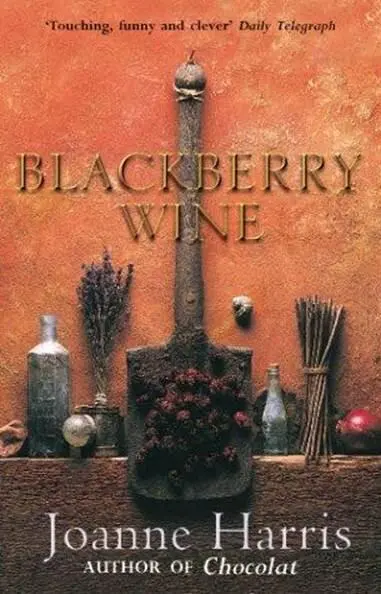
- Название:Blackberry Wine
- Автор:
- Жанр:
- Год:неизвестен
- ISBN:нет данных
- Рейтинг книги:4 / 5. Голосов: 2
-
Избранное:Добавить в избранное
- Отзывы:
-
Ваша оценка:
Blackberry Wine: краткое содержание, описание и аннотация
Предлагаем к чтению аннотацию, описание, краткое содержание или предисловие (зависит от того, что написал сам автор книги «Blackberry Wine»). Если вы не нашли необходимую информацию о книге — напишите в комментариях, мы постараемся отыскать её.
‘Harris is at her best when detailing the sensual pleasures of taste and smell. As chocoholics stand advised to stock up on some of their favourite bars before biting into Chocolat, so boozers everywhere should get a couple of bottles in before opening Blackberry Wine’ – Helen Falconer, Guardian
‘Joanne Harris has the gift of conveying her delight in the sensuous pleasures of food, wine, scent and plants… [Blackberry Wine] has all the appeal of a velvety scented glass of vintage wine’ – Lizzie Buchan, Daily Mail
‘If Joanne Harris didn’t exist, someone would have to invent her, she’s such a welcome antidote to the modern preoccupation with the spare, pared down and non-fattening. Not for her the doubtful merits of an elegant and expensive sparkling water or an undressed rocket salad. In her previous novel, Chocolat, she invoked the scent and the flavour of rich, dark, sweet self-indulgence. In Blackberry Wine she celebrates the sensuous energy that can leap from a bottle after years of fermentation… Harris bombards the senses with the smells and tastes of times past… Harris’s talent lies in her own grasp of the quality she ascribes to wine, “layman’s alchemy, the magic of everyday things.” She is fanciful and grounded at the same time – one moment shrouded in mystery, the next firmly planted in earth. Above all, she has wit’ – -Jenni Murray, Sunday Express
***
Jay Mackintosh's memories are revived by the delivery of a bottle of home-brewed wine from a long-vanished friend. Jay, disillusioned by adulthood, escapes to a derelict farmhouse in France. There he faces old demons and the beautiful Marise, a woman who hides a terrible secret.
Blackberry Wine — читать онлайн бесплатно полную книгу (весь текст) целиком
Ниже представлен текст книги, разбитый по страницам. Система сохранения места последней прочитанной страницы, позволяет с удобством читать онлайн бесплатно книгу «Blackberry Wine», без необходимости каждый раз заново искать на чём Вы остановились. Поставьте закладку, и сможете в любой момент перейти на страницу, на которой закончили чтение.
Интервал:
Закладка:
‘Joe?’
The old man’s voice was almost too faint to hear.
‘I’ll sithee, then.’
It’s what he always used to say as a sign of disapproval, or when signalling the end of a discussion.
‘Joe?’
But Joe had already gone.
34
Pog Hill, Summer 1977
IT REALLY STARTED WITH ELVIS. MID-AUGUST, THAT WAS, AND Jay’s mother grieved with a vehemence which was almost genuine. Perhaps because they were the same age, he and she. Jay felt it, too, even though he’d never been an especial fan. That overcast sense of doom, the feeling that things were coming apart at the centre, unravelling like a ball of string. There was death in the air that August, a dark edge to the sky, an unidentifiable taste. There were more wasps that summer than he ever remembered before – long, curly, brown wasps which seemed to scent the end coming and turned spiteful early. Jay was stung twelve times – once in the mouth as he swigged a bottle of Coke, lucky not to be taken to Casualty – and together Gilly and he burned seven nests. Gilly and Jay started a crusade against the wasps that summer. On hot, moist afternoons, when the insects were sleepy and more docile, the two of them went wasping. They would find the nests, stuff the hole with shredded newspaper and firelighters and flame the whole thing. As the fire took and smoke poured into the nest the wasps would come flying out, some buzzing and burning like German aircraft in old black-and-white war movies, darkening the air and sighing, an eerie, chill sound, as they spread, bewildered and enraged, over the war zone. Gilly and Jay lay quiet in a hollow near by, far enough away from the danger spot, but as close as they dared, watching. Needless to say, this tactic was Gilly’s idea. She would squat, eyes wide and bright, as close as she could. No wasp ever stung her. She seemed as immune to them as a honey badger to bees, and as naturally lethal. Jay was secretly terrified, crouching in the hollows with his head down and pounding with black exhilaration, but the fear was addictive and they sought it time and again, clinging to each other and laughing in terror and excitement. Once, urged by Gilly, Jay put two Black Cat bangers into a nest under a dry-stone wall and lit the fuses. The nest blew apart, but smokelessly, scattering stunned and angry wasps everywhere. One managed to get into the T-shirt he was wearing and stung him again and again. It felt like being shot, and Jay screamed and rolled on the ground. But the wasp was indestructible, twitching and stinging even as he crushed it beneath his frantic body. They killed it at last by tearing off the shirt and dousing it in lighter fluid. Later Jay counted nine separate stings. Autumn loomed close, smelling of fire.
35
Lansquenet, April 1999
HE SAW HER AGAIN THE NEXT DAY. AS APRIL RIPENED TOWARDS May the vines had grown taller, and Jay occasionally saw her at work amongst the plants, dusting with fungicides, inspecting the shoots, the soil. She would not speak to him. She seemed enclosed in a capsule of isolation, profile turned towards the earth. He saw her in a succession of overalls, bulky jumpers, men’s shirts, jeans, boots, her bright hair pulled back severely under her beret. Difficult to make out her shape beneath them. Even her hands were cartoonish in overlarge gloves. Jay tried to talk to her several times with no success. Once he called at her farm, but there was no answer to his knock, though he was sure he could hear someone behind the door.
‘I’d have nothing to do with her,’ said Caro Clairmont when he mentioned the incident. ‘She never talks to anyone in the village. She knows what we all think of her.’
They were on the terrasse of the Café des Marauds. Caro had taken to joining him there after church while her husband collected cakes from Poitou’s. In spite of her exaggerated friendliness, there was something unpleasant about Caro which Jay could not quite analyse. Perhaps her willingness to speak ill of others. When Caro was there Joséphine kept her distance and Narcisse scrutinized his seed catalogue with studied indifference. But she remained one of the few people from the village who seemed happy to answer questions. And she knew all the gossip.
‘You should talk to Mireille,’ she advised, sugaring her coffee extravagantly. ‘One of my dearest friends. Another generation, of course. The things she’s had to bear from that woman. You can’t imagine.’ She blotted her lipstick carefully on a napkin before taking the first sip. ‘I’ll have to introduce you one day,’ she said.
As it happened, no introduction was necessary. Mireille Faizande sought him out herself a few days later, taking him completely by surprise. It was warm. Jay had begun work on his vegetable garden some days earlier, and now that the major repairs to the house were completed, he was spending a few hours a day in the garden. He hoped somehow that physical exertion might give him the insight he needed to finish his book. The radio was hanging from a nail sticking out of the side of the house, and the oldies station was playing. He had brought out a couple of bottles of beer from the kitchen, which he had left in a bucket of water to cool. Stripped to the waist, with an old straw hat he had found in the house to keep the sun from his eyes, he hadn’t anticipated visitors.
He was hacking at a stubborn root when he noticed her standing there. She must have been waiting for him to look up.
‘Oh, I’m sorry.’ Jay straightened up, surprised. ‘I didn’t see you.’
She was a large shapeless woman, who should have looked motherly but did not. Huge breasts rolling, hips like boulders, she looked curiously solid , the comfortable wadding of fat petrified into something harder than flesh. Beneath the brim of her straw hat her mouth turned downwards, as if in perpetual grief.
‘It’s a long way out,’ she said. ‘I’d forgotten how long.’ Her local accent was very pronounced, and for a moment Jay barely understood what she was saying. Behind him the radio was playing ‘Here Comes the Sun’, and he could see Joe’s shadow just behind her, the light gleaming off the bald patch at his crown.
‘Madame Faizande-’
‘Let’s not be formal, please. Call me Mireille. I’m not disturbing you, héh ?’
‘No. Of course not. I was just about to call it a day, anyhow.’
‘Oh.’ Her eyes flicked briefly over the half-finished vegetable patch. ‘I didn’t realize you were a gardener.’
Jay laughed.
‘I’m not. Just an enthusiastic amateur.’
‘You’re not planning on maintaining the vineyard, héh ?’ Her voice was sharp. He shook his head.
‘I’m afraid that’s probably beyond me.’
‘Selling it, then?’
‘I don’t think so.’
Mireille nodded.
‘Héh , I thought you might have come to some agreement,’ she said. ‘With her.’ The words were almost toneless. Against the dark fabric of her skirt her arthritic hands twisted and moved.
‘With your daughter-in-law?’
Mireille nodded.
‘She’s always had her eye on this land,’ she said. ‘It’s higher above the marshes than her place. It’s better drained. It never floods in winter or dries up in summer. It’s good land.’
Jay looked at her uncertainly.
‘I know there was a… misunderstanding,’ he said carefully. ‘I know Marise expected… perhaps if she spoke to me we could arrange-’
‘I will top any price she offers you for the land,’ said Mireille abruptly. ‘It’s bad enough that she has my son’s farm, héh , without having my father’s land, too. My father’s farm,’ she repeated in a louder voice, ‘which should have been my son’s, where he should have raised his children. If it hadn’t been for her.’
Читать дальшеИнтервал:
Закладка:
Похожие книги на «Blackberry Wine»
Представляем Вашему вниманию похожие книги на «Blackberry Wine» списком для выбора. Мы отобрали схожую по названию и смыслу литературу в надежде предоставить читателям больше вариантов отыскать новые, интересные, ещё непрочитанные произведения.







Обсуждение, отзывы о книге «Blackberry Wine» и просто собственные мнения читателей. Оставьте ваши комментарии, напишите, что Вы думаете о произведении, его смысле или главных героях. Укажите что конкретно понравилось, а что нет, и почему Вы так считаете.