Hermann Hesse - The Glass Bead Game
Здесь есть возможность читать онлайн «Hermann Hesse - The Glass Bead Game» весь текст электронной книги совершенно бесплатно (целиком полную версию без сокращений). В некоторых случаях можно слушать аудио, скачать через торрент в формате fb2 и присутствует краткое содержание. Год выпуска: 1969, Жанр: Современная проза, Социально-психологическая фантастика, на английском языке. Описание произведения, (предисловие) а так же отзывы посетителей доступны на портале библиотеки ЛибКат.
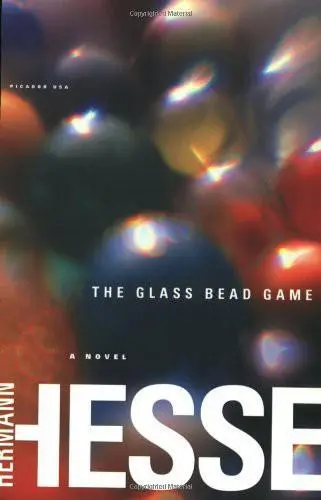
- Название:The Glass Bead Game
- Автор:
- Жанр:
- Год:1969
- ISBN:нет данных
- Рейтинг книги:4 / 5. Голосов: 2
-
Избранное:Добавить в избранное
- Отзывы:
-
Ваша оценка:
The Glass Bead Game: краткое содержание, описание и аннотация
Предлагаем к чтению аннотацию, описание, краткое содержание или предисловие (зависит от того, что написал сам автор книги «The Glass Bead Game»). Если вы не нашли необходимую информацию о книге — напишите в комментариях, мы постараемся отыскать её.
Something like chess but far more intricate, the game of Magister Ludi known as the Glass Bead Game is thought in its purest form, a synthesis through which philosophy, art, music and scientific law are appreciated simultaneously. The scholar-players are isolated within Castalia, an autonomous elite institution devoted wholly to the mind and the imagination…
The Glass Bead Game — читать онлайн бесплатно полную книгу (весь текст) целиком
Ниже представлен текст книги, разбитый по страницам. Система сохранения места последней прочитанной страницы, позволяет с удобством читать онлайн бесплатно книгу «The Glass Bead Game», без необходимости каждый раз заново искать на чём Вы остановились. Поставьте закладку, и сможете в любой момент перейти на страницу, на которой закончили чтение.
Интервал:
Закладка:
At this time he once again carefully studied the Constitution and Statutes of the Order. His escape from the Province would not, he saw, be so hard to accomplish, so nearly impossible as he had initially imagined. He did have the right to resign his office on grounds of conscience, and even to leave the Order. The Order’s vow was not a lifetime matter, although members had claimed this freedom seldom, and a member of the highest Board never. What made the step seem so difficult to him was not so much the strictness of the law but the hierarchic spirit itself, the loyalty within his own heart. Of course he was not planning to skip out; he was preparing a circumstantial petition for release, and that dear fellow Tegularius was working day and night at it. But he had no confidence in the success of this petition. He would receive soothing assurances, admonishments, would perhaps be offered a vacation in Mariafels, where Father Jacobus had recently died, or perhaps in Rome. But the authorities would not let him go; that seemed more and more clear. To release him would violate all the traditions of the Order. If the Board were to do so, it would be admitting that his request was justified, admitting that life in Castalia, and what was more in such a high post, might in some circumstances not be satisfying to a man, might mean renunciation and imprisonment.
ELEVEN
THE CIRCULAR LETTER
WE ARE APPROACHING the end of our tale. As we have already indicated, our knowledge of this end is fragmentary, rather more in the nature of a legend than of a historical narrative. We shall have to be content with that. We therefore take all the more pleasure in being able to fill out this next-to-last chapter of Knecht’s life with an authentic document, namely with that voluminous memorandum in which the Glass Bead Game Master himself presents the authorities with the reasons for his decision and asks them to release him from his office.
As we have repeatedly stated, Joseph Knecht no longer believed in the success of this memorandum which he had had so conscientiously prepared. We must admit, moreover, that when the time came he wished he had neither written nor handed in this “petition.” He suffered the fate of all who exercise a natural and initially unconscious power over other men: this power is not exercised without a certain cost to its possessor. Although the Magister had been glad to win his friend Tegularius’s support for his plans, and to have made him a promoter and associate in them, the consequences went far beyond what he had conceived or wished. He had coaxed or misled Fritz into undertaking a task whose value he himself, as its author, no longer believed in; but when his friend at last presented him with the fruits of his labors, he could no longer undo the work. Nor, since the purpose of the assignment had been to make Fritz better able to bear their separation, could he lay the data aside and leave them unused without thoroughly offending and disappointing his friend. At the time, we are convinced, Knecht would much rather have brusquely resigned his office and declared his withdrawal from the Order instead of choosing the roundabout mode of the “petition,” which in his eyes had become virtually a farce. But consideration for Tegularius caused him to restrain his impatience for a while longer.
It would no doubt be interesting if we had his industrious friend’s manuscript at our disposal. It consisted mainly of historical material meant to serve as proof or illustration; but we may safely assume that it contained a good many sharp and witty epigrams on the hierarchy, as well as on the world and world history. But even if this document, composed as it was in months of tenacious labor, were still in existence — as it quite possibly may be — we would have to forbear from publishing it here, since this book of ours would not be the proper place for it.
Our concern is only with the use the Magister Ludi made of his friend’s work. When Tegularius solemnly presented this document to him, he accepted it with cordial words of gratitude and appreciation, and knowing what pleasure this would give, asked Fritz to read it aloud. For several days, therefore, Tegularius spent half an hour in the Magister’s garden, for it was summertime, and read with gusto the many pages of his manuscript. Often the reading was interrupted by peals of laughter on the part of both. These were good days for Tegularius. Afterward, however, Knecht went into seclusion in order to compose his letter to the Board. We present here its exact text. No further commentary on it is necessary.
The Magister Ludi’s Letter to the
Board of Educators
Various considerations have prompted me, the Magister Ludi, to present to the Board a special request in this separate and somewhat more private memorandum, instead of including it in my official report. Although I am appending this memorandum to the official accounting that is now due, and await an official reply, I regard it rather as a circular letter to my colleagues in office.
Every Magister is required to inform the Board of any hindrances or danger to his conducting his office in keeping with the Rule. Although I have endeavored to serve with all my strength, the conduct of my office is (or seems to me to be) threatened by a danger which resides in my own person, although that is probably not its sole origin. At any rate, I see my suitability to serve as Magister Ludi as imperiled, and this by circumstances beyond my control. To put it briefly: I have begun to doubt my ability to officiate satisfactorily because I consider the Glass Bead Game itself in a state of crisis. The purpose of this memorandum is to convince the Board that the crisis exists, and that my awareness of it demands that I seek a position other from the one I now hold.
Permit me to clarify the situation by a metaphor. A man sits in an attic room engaged in a subtle work of scholarship. Suddenly he becomes aware that fire has broken out in the house below. He will not consider whether it is his function to see to it, or whether he had not better finish his tabulations. He will run downstairs and attempt to save the house. Here I am sitting in the top story of our Castalian edifice, occupied with the Glass Bead Game, working with delicate, sensitive instruments, and instinct tells me, my nose tells me, that down below something is burning, our whole structure is imperiled, and that my business now is not to analyze music or define rules of the Game, but to rush to where the smoke is.
Most of us brothers of the Order take Castalia, our Order, our system of scholarship and schooling, together with the Game and everything associated with it, as much for granted as most men take the air they breathe and the ground they stand on. Hardly anyone ever thinks that this air and this ground could sometime not be there, that we might some day lack air or find the ground vanishing from under us. We have the good fortune of living well protected in a small, neat, and cheerful world, and the great majority of us, strange as it may seem, hold to the fiction that this world has always existed and that we were born into it. I myself spent my younger years in this extremely pleasant delusion, although I was perfectly well aware of the reality that I was not born in Castalia, but only sent here by the educational authorities and raised here. I knew also that Castalia, the Order, the Board, the colleges, the Archives, and the Glass Bead Game have not always existed, are by no means a product of nature, but a belated and noble creation of man’s will, and transitory like all such things. I knew all this, but it had no reality for me; I simply did not think of it, ignored it, and I knew that more than three-quarters of us will live and die in this strange and pleasant illusion.
Читать дальшеИнтервал:
Закладка:
Похожие книги на «The Glass Bead Game»
Представляем Вашему вниманию похожие книги на «The Glass Bead Game» списком для выбора. Мы отобрали схожую по названию и смыслу литературу в надежде предоставить читателям больше вариантов отыскать новые, интересные, ещё непрочитанные произведения.






Обсуждение, отзывы о книге «The Glass Bead Game» и просто собственные мнения читателей. Оставьте ваши комментарии, напишите, что Вы думаете о произведении, его смысле или главных героях. Укажите что конкретно понравилось, а что нет, и почему Вы так считаете.