Hermann Hesse - The Glass Bead Game
Здесь есть возможность читать онлайн «Hermann Hesse - The Glass Bead Game» весь текст электронной книги совершенно бесплатно (целиком полную версию без сокращений). В некоторых случаях можно слушать аудио, скачать через торрент в формате fb2 и присутствует краткое содержание. Год выпуска: 1969, Жанр: Современная проза, Социально-психологическая фантастика, на английском языке. Описание произведения, (предисловие) а так же отзывы посетителей доступны на портале библиотеки ЛибКат.
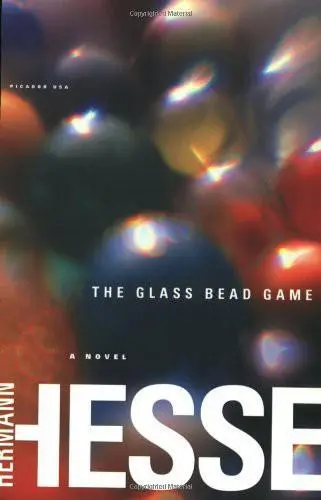
- Название:The Glass Bead Game
- Автор:
- Жанр:
- Год:1969
- ISBN:нет данных
- Рейтинг книги:4 / 5. Голосов: 2
-
Избранное:Добавить в избранное
- Отзывы:
-
Ваша оценка:
The Glass Bead Game: краткое содержание, описание и аннотация
Предлагаем к чтению аннотацию, описание, краткое содержание или предисловие (зависит от того, что написал сам автор книги «The Glass Bead Game»). Если вы не нашли необходимую информацию о книге — напишите в комментариях, мы постараемся отыскать её.
Something like chess but far more intricate, the game of Magister Ludi known as the Glass Bead Game is thought in its purest form, a synthesis through which philosophy, art, music and scientific law are appreciated simultaneously. The scholar-players are isolated within Castalia, an autonomous elite institution devoted wholly to the mind and the imagination…
The Glass Bead Game — читать онлайн бесплатно полную книгу (весь текст) целиком
Ниже представлен текст книги, разбитый по страницам. Система сохранения места последней прочитанной страницы, позволяет с удобством читать онлайн бесплатно книгу «The Glass Bead Game», без необходимости каждый раз заново искать на чём Вы остановились. Поставьте закладку, и сможете в любой момент перейти на страницу, на которой закончили чтение.
Интервал:
Закладка:
“Are you very sorry about the old house?” Knecht asked.
“Very sorry,” Tito said passionately, and repeated his question: “Can you understand anyone’s acting like that?”
“Things become understandable if you look at them in the right light,” the Magister said. “An old house is a fine thing, and if the two had stood side by side and your father were choosing between them, he probably would have kept the old one. Certainly, old houses are beautiful and distinguished, especially so handsome a one as this. But it is also a beautiful thing to build one’s own house, and when an ambitious young man has the choice of comfortably and submissively settling into a finished nest, or building an entirely new one, one can well see that he may decide to build. As I know your father — and I knew him when he was a spirited fellow just about as old as you are — the sale of the house probably hurt no one more than himself. He had had a painful conflict with his father and his family, and it seems his education in our Castalia was not altogether the right thing for him. At any rate it could not deter him from several impatient acts of passion. Probably the sale of the house was one of those acts. He meant it as a thrust at tradition, a declaration of war upon his family, his father, the whole of his past and his dependency. At least that is one way to see it. But man is a strange creature, and so another idea does not appear altogether improbable to me, the idea that by selling this old house your father wanted primarily to hurt himself rather than the family. To be sure, he was angry at the family; they had sent him to our elite schools, had given him our land of education, only to confront him on his return with tasks, demands, and claims he could not handle. But I would rather go no further in psychological analysis. In any case the story of this sale shows how telling the conflict between fathers and sons can be — this hatred, this love turned to hate. In forceful and gifted personalities this conflict rarely fails to develop — world history is full of examples. Incidentally, I could very well imagine a later young Designori who would make it his mission in life to regain possession of the house for the family at all costs.”
“Well,” Tito exclaimed, “wouldn’t you think he was right?”
“I would not like to judge him. If a later Designori recalls the greatness of his family and the obligations that such greatness imposes, if he serves the city, the country, the nation, justice, and welfare with all his energies and in the process grows so strong that he can recover the house, then he will be a worthy person and we would want to take our hats off to him. But if he knows no other goal in life besides this house business, then he is merely obsessed, a fanatic, a man surrendering to a passion, and in all probability someone who never grasped the meaning of such youthful conflicts with a father and so went on shouldering their load long after he became a man. We can understand and even pity him, but he will not increase the fame of his lineage. It is fine when an old family remains affectionately attached to its residence, but rejuvenation and new greatness spring solely from sons who serve greater goals than the aims of the family.”
Although on this walk Tito listened attentively and quite willingly to his father’s guest, on other occasions he exhibited dislike and fresh defiance. In this man, whom his otherwise discordant parents both seemed to hold in high esteem, Tito sensed a power which threatened his own pampered freedom, so that at times he treated Knecht with outright rudeness. Each time, however, he would be sorry and try to make up for such breaches, for it offended his self-esteem to have shown weakness in the face of the serene courtesy that surrounded the Magister like a coat of shining armor. Secretly, too, in his inexperienced and rather unruly heart, he sensed that this was a man he might love and revere.
He felt this particularly one half-hour when he came upon Knecht alone, waiting for his father, who was busy with affairs. As Tito entered the room he saw their guest sitting still, with eyes half closed, in a statuesque pose, radiating such tranquility and peace in his meditation that the boy instinctively checked his stride and began to tiptoe out of the room again. But at that point the Magister opened his eyes, gave him a friendly greeting, rose, indicated the piano in the room, and asked whether he liked music.
Tito said he did, although he had not had music lessons for quite some time and had left off practicing because he was not doing so well in school and those drill-masters who called themselves teachers were always keeping after him. Still and all he’d always enjoyed listening to music. Knecht opened the piano, sat down at it, found it was tuned, and played an andante movement of Scarlatti’s which he had recently used as the basis for a Glass Bead Game exercise. Then he stopped, and seeing the boy rapt and attentive, began outlining more or less what took place in such an exercise. He dissected the music, giving examples of some of the analytical methods that could be used and the ways the music could be translated into the hieroglyphs of the Game.
For the first time Tito saw the Magister not as a guest, not as a learned celebrity whom he resented as a danger to his own self-esteem. Rather, he saw him at his work, a man who had acquired a subtle, exacting art and practiced it with a masterly hand. Tito could only dimly sense the meaning of that art, but it seemed to be deserving of full devotion and to call forth all the powers of an integrated personality. That this man thought him grown-up and intelligent enough to be interested in these complicated matters also gave him greater assurance. He grew quiet, and during this half-hour he began to divine the sources of this remarkable man’s cheerfulness and unruffled calm.
During this last period Knecht’s official activities were almost as strenuous as they had been in the difficult time after his assumption of office. He was determined to leave all the areas under his control in exemplary condition. Moreover, he achieved this aim, although he failed in his further aim of making his own person appear dispensable, or at least easily replaceable. That is almost always the case with the highest offices in our Province. The Magister hovers rather like a supreme ornament, a gleaming insigne, above the complex affairs of his domain. He comes and goes rapidly, flirting amiably by, says a few words, nods an assent, suggests an assignment by a gesture, and is already gone, already talking to the next subordinate. He plays on his official apparatus like a musician on his instrument, seems to expend no force and scarcely any thought, yet everything runs as it should. But every official in this apparatus knows what it means when the Magister is away or ill, what it means to find a substitute for him even for a few hours or a day.
Knecht spent his time rushing once more through the whole principality of the Vicus Lusorum, checking everything and especially taking pains to secretly groom his Shadow for the task the man would soon confront, that of representing him in all earnest. But all the while he could observe that at heart he had already liberated himself from all this, had moved far away from it. The preciosity of this well-arranged little world no longer enraptured him. He saw Waldzell and his magisterial function as something that already virtually lay behind him, a region he had passed through, which had given him a great deal and taught him much, but which could no longer tempt him to new accomplishments, to a fresh outpouring of energy. More and more, during this period of slow breaking loose and bidding farewell, he came to see the real reason for his alienation and desire to escape. It was probably not, he thought, his knowledge of the dangers to Castalia and his anxiety about her future, but simply that a hitherto idle and empty part of his self, of his heart and soul, was now demanding the right to fulfill itself.
Читать дальшеИнтервал:
Закладка:
Похожие книги на «The Glass Bead Game»
Представляем Вашему вниманию похожие книги на «The Glass Bead Game» списком для выбора. Мы отобрали схожую по названию и смыслу литературу в надежде предоставить читателям больше вариантов отыскать новые, интересные, ещё непрочитанные произведения.









Обсуждение, отзывы о книге «The Glass Bead Game» и просто собственные мнения читателей. Оставьте ваши комментарии, напишите, что Вы думаете о произведении, его смысле или главных героях. Укажите что конкретно понравилось, а что нет, и почему Вы так считаете.