J.M. le Clézio - Desert
Здесь есть возможность читать онлайн «J.M. le Clézio - Desert» весь текст электронной книги совершенно бесплатно (целиком полную версию без сокращений). В некоторых случаях можно слушать аудио, скачать через торрент в формате fb2 и присутствует краткое содержание. Город: Jaffrey, Год выпуска: 2009, ISBN: 2009, Издательство: Verba Mundi Books, Жанр: Современная проза, на английском языке. Описание произведения, (предисловие) а так же отзывы посетителей доступны на портале библиотеки ЛибКат.
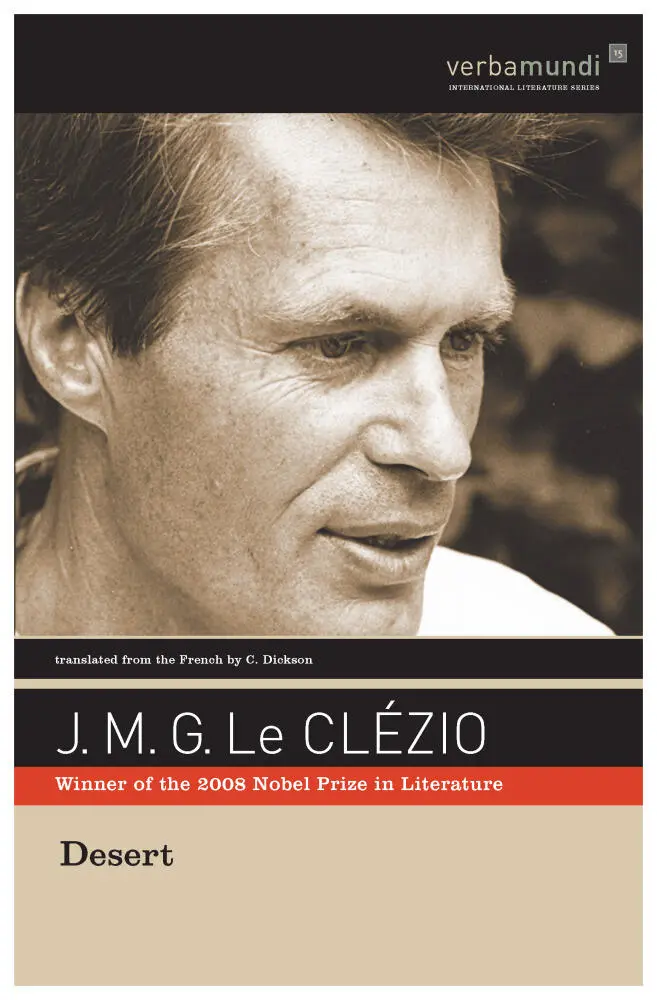
- Название:Desert
- Автор:
- Издательство:Verba Mundi Books
- Жанр:
- Год:2009
- Город:Jaffrey
- ISBN:978-1-56792-386-5
- Рейтинг книги:5 / 5. Голосов: 1
-
Избранное:Добавить в избранное
- Отзывы:
-
Ваша оценка:
Desert: краткое содержание, описание и аннотация
Предлагаем к чтению аннотацию, описание, краткое содержание или предисловие (зависит от того, что написал сам автор книги «Desert»). Если вы не нашли необходимую информацию о книге — напишите в комментариях, мы постараемся отыскать её.
Available for the first time in English translation, Desert is a novel composed of two alternating narratives, set in counterpoint. The first takes place in the desert between 1909 and 1912 and evokes the migration of a young adolescent boy, Nour, and his people, the Blue Men, notorious warriors of the desert. Driven from their lands by French colonial soldiers, Nour's tribe has come to the valley of the Saguiet El Hamra to seek the aid of the great spiritual leader known as Water of the Eyes. The religious chief sends them out from the holy city of Smara into the desert to travel still further. Spurred on by thirst, hunger, and suffering, Nour's tribe and others flee northward in the hopes of finding a land that can harbor them at last.
The second narrative relates the contemporary story of Lalla, a descendant of the Blue Men. Though she is an orphan living in a shantytown known as the Project near a coastal city in Morocco, the blood of her proud, obstinate tribe runs in her veins. All too soon, Lalla must flee to escape a forced marriage with an older, wealthy man. She travels to France, undergoing many trials there, from working as a hotel maid to becoming a highly-paid fashion model, and yet she never betrays the blood of her ancestors.
Desert — читать онлайн бесплатно полную книгу (весь текст) целиком
Ниже представлен текст книги, разбитый по страницам. Система сохранения места последней прочитанной страницы, позволяет с удобством читать онлайн бесплатно книгу «Desert», без необходимости каждый раз заново искать на чём Вы остановились. Поставьте закладку, и сможете в любой момент перейти на страницу, на которой закончили чтение.
Интервал:
Закладка:
“One day, oh, one day, the crow will turn white, the sea will go dry, we will find honey in the desert flower, we will make bedding of acacia sprays, oh, one day, the snake will spit no more poison, and rifle bullets will bring no more death, for that will be the day I will leave my love…”
Where was such a clear gentle voice coming from? Nour could feel his consciousness slipping still farther out, beyond this world, beyond this sky, toward the land where there are black clouds filled with rain, wide deep rivers where the water never stops flowing.
“One day, oh, one day, the wind will cease to blow over the earth, the grains of sand will be sweet as sugar, under each white stone on the path, a spring will be awaiting me, one day, oh, one day, the bees will sing for me, for that will be the day I will leave my love…”
Out there, the mysterious sounds of the storm rumble; out there cold and death reign supreme.
“One day, oh, one day, there will be the night sun, and puddles of moon water will gather upon the earth, the gold of the stars will rain from the sky, one day, oh, one day, I’ll see my shadow dancing for me, for that will be the day I will leave my love…”
The new order is coming from there, the order that is driving the blue men from the desert, that is giving rise to fear everywhere.
“One day, oh, one day, the sun will go black, the earth will split open to its very core, the sea will cover the sand, one day, oh, one day, my eyes will see no light, my lips will be unable to say your name, my heart will stop beating, for that will be the day I will leave my love…”
The stranger’s voice faded away in a murmur, and Nour could once again hear the slow sad song of the blind warrior talking to himself, his face turned toward the sky he could not see.
One evening Ma al-Aïnine’s caravan arrived on the rim of the Drâa, on the far side of the mountains. There, as they descended toward the west, they caught sight of the smoke coming from Larhdaf’s and Saadbou’s camps. When they met back up with one another there was a surge of new hope. Nour’s father came to see him and helped him carry his load.
“Where are we? Is this the place?” asked the blind warrior.
Nour explained to him that they had made it across the desert and that they weren’t far from their goal.
That night there was a sort of celebration. For the first time in a very long time the sounds of guitars and drums were heard, and the clear song of flutes.
The night was milder in the valley, and there was grass for the animals. With his mother and father, Nour ate millet bread and dates, and the blind warrior also got his share. He spoke with them about the long road they had traveled from the Saguiet al-Hamra to the tomb of Sidi Mohammed al-Quenti. Afterward, they walked together, guiding the blind warrior through the fields of brush to the dried bed of the Drâa.
There were many people and animals, because the people and animals of the great sheik’s caravan had been joined by the nomads of the Drâa, those of the wells of Tassouf, the people of Messeïed, of Tcart, of al-Gaba, of Sidi Brahim al-Aattami, everyone whom poverty and the threat of the arrival of the French had driven from the coastal regions and who had heard that the great sheik Ma al-Aïnine was en route for a holy war to expel the foreigners from the lands of the Faithful.
So the gaps in the ranks of men and women that death had made could no longer be seen. One no longer saw that most of the men were wounded or ill, or that the little children were slowly dying in their mothers’ arms, burning up with fever and dehydration.
All that could be seen, on all sides of the black bed of the dried river, were human shapes walking slowly along, and herds of goats and sheep, and men riding their camels, their horses, all heading toward something, toward their destiny.
For days they walked up the huge Drâa Valley, over the tract of crackled sand, hard as kiln-baked clay, over the black bed of the river where the sun blazed at its zenith like a flame. On the other side of the valley, Larhdaf and Saadbou’s men rode their horses up a narrow torrent, and the men, women, and herds followed the path they opened. Now it was Ma al-Aïnine’s warriors who were going in last, mounted on their camels, and Nour was walking with them, guiding the blind warrior. Most of Ma al-Aïnine’s soldiers were on foot, using their rifles and spears to help themselves scale the ravines.
That same evening, the caravan reached the deep well, the one that was called Aïn Rhatra, not far from Torkoz, at the foot of the mountains. Just as he did every evening, Nour went to fetch water for the blind warrior, and they performed their ablutions and said their prayer. Then Nour settled in for the night not far from the sheik’s warriors. Ma al-Aïnine didn’t pitch his tent. He slept out of doors, like the men of the desert, simply wrapped in his white cloak, crouching on his saddle blanket. Night fell rapidly, because they were near the high mountains. The chill made the men shiver. Next to Nour, the blind warrior no longer sang. Maybe he didn’t dare, due to the presence of the sheik, or maybe he was too exhausted to say anything.
When Ma al-Aïnine ate his evening meal with his warriors, he had a little food and tea brought over for Nour and his companion. It was the tea especially that made them feel better, and Nour thought he’d never had anything better to drink. The food and the fresh water of the well were like a light in their bodies that restored all of their strength. Nour ate the bread, watching the seated shape of the old man wrapped in the large white cloak.
From time to time, people approached the sheik to ask for his blessing. He welcomed them, had them sit down at his side, and offered them a piece of his bread, talked to them. They went away after having kissed a flap of his cloak. They were nomads from the Drâa, shepherds in rags, or blue women carrying their small children rolled up in their cloaks. They wanted to see the sheik, to glean a little strength, a little hope, to have him soothe the wounds on their bodies.
Later, during the night, Nour woke with a start. He saw the blind warrior leaning over him. The face filled with suffering glowed in the starlight. As Nour shrank back, almost frightened, the man said softly, “Will he restore my sight? Will I be able to see again?”
“I don’t know,” said Nour.
The warrior whimpered and fell back to the ground, head in the dust.
Nour looked around. On the floor of the valley, at the foot of the mountains, there was not a sign of movement, not a sound. Everywhere, people were sleeping, rolled up in their covers to stave off the cold. Alone, sitting on his saddle blanket, as if weariness did not exist for him, Ma al-Aïnine was motionless, eyes fixed on the night landscape.
So then Nour lay down on his side, cheek resting against his arm, and he watched the old man who was praying for a long time, and once again, it was as if he were slipping away into an interminable dream, a dream much greater than himself, which led him out toward another world.
Each day at sunrise the men were on their feet. They took up their burdens in silence, and the women rolled the young children up on their backs. The animals rose too, pawing the ground and making the first dust rise, for the old man’s order had entered them, spreading through them along with the warmth of the sun and the giddiness of the wind.
They pursued their march northward, through the jagged mountains of the Taïssa, along narrow passes as blistering hot as the sides of a volcano.
Sometimes in the evening, when they arrived at a well, blue men and women, emerging from the desert, ran up to them with offerings of dates, sour milk, millet bread. The great sheik gave them his blessing, for they had brought their small children who had stomach ailments or eye infections. Ma al-Aïnine anointed them with a little dirt mixed with his saliva, he laid his hands on their foreheads; then the women went off, returned to their red desert just as they had come. Men also came at times with their rifles and spears to join the troop. They were peasants with coarse features, with blond or red hair and strange green eyes.
Читать дальшеИнтервал:
Закладка:
Похожие книги на «Desert»
Представляем Вашему вниманию похожие книги на «Desert» списком для выбора. Мы отобрали схожую по названию и смыслу литературу в надежде предоставить читателям больше вариантов отыскать новые, интересные, ещё непрочитанные произведения.








Обсуждение, отзывы о книге «Desert» и просто собственные мнения читателей. Оставьте ваши комментарии, напишите, что Вы думаете о произведении, его смысле или главных героях. Укажите что конкретно понравилось, а что нет, и почему Вы так считаете.