J.M. le Clézio - Desert
Здесь есть возможность читать онлайн «J.M. le Clézio - Desert» весь текст электронной книги совершенно бесплатно (целиком полную версию без сокращений). В некоторых случаях можно слушать аудио, скачать через торрент в формате fb2 и присутствует краткое содержание. Город: Jaffrey, Год выпуска: 2009, ISBN: 2009, Издательство: Verba Mundi Books, Жанр: Современная проза, на английском языке. Описание произведения, (предисловие) а так же отзывы посетителей доступны на портале библиотеки ЛибКат.
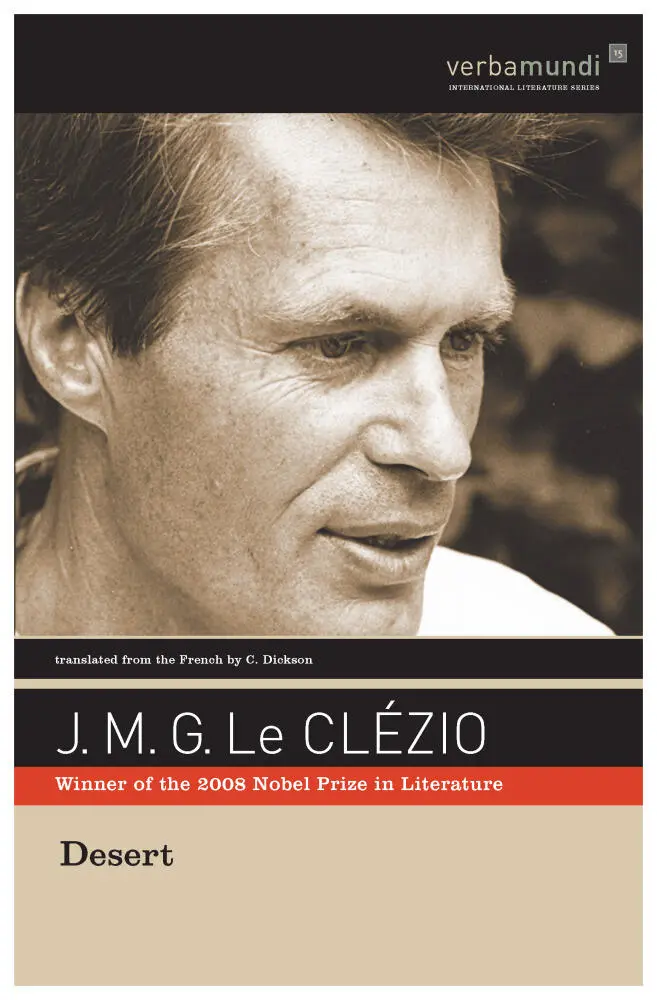
- Название:Desert
- Автор:
- Издательство:Verba Mundi Books
- Жанр:
- Год:2009
- Город:Jaffrey
- ISBN:978-1-56792-386-5
- Рейтинг книги:5 / 5. Голосов: 1
-
Избранное:Добавить в избранное
- Отзывы:
-
Ваша оценка:
Desert: краткое содержание, описание и аннотация
Предлагаем к чтению аннотацию, описание, краткое содержание или предисловие (зависит от того, что написал сам автор книги «Desert»). Если вы не нашли необходимую информацию о книге — напишите в комментариях, мы постараемся отыскать её.
Available for the first time in English translation, Desert is a novel composed of two alternating narratives, set in counterpoint. The first takes place in the desert between 1909 and 1912 and evokes the migration of a young adolescent boy, Nour, and his people, the Blue Men, notorious warriors of the desert. Driven from their lands by French colonial soldiers, Nour's tribe has come to the valley of the Saguiet El Hamra to seek the aid of the great spiritual leader known as Water of the Eyes. The religious chief sends them out from the holy city of Smara into the desert to travel still further. Spurred on by thirst, hunger, and suffering, Nour's tribe and others flee northward in the hopes of finding a land that can harbor them at last.
The second narrative relates the contemporary story of Lalla, a descendant of the Blue Men. Though she is an orphan living in a shantytown known as the Project near a coastal city in Morocco, the blood of her proud, obstinate tribe runs in her veins. All too soon, Lalla must flee to escape a forced marriage with an older, wealthy man. She travels to France, undergoing many trials there, from working as a hotel maid to becoming a highly-paid fashion model, and yet she never betrays the blood of her ancestors.
Desert — читать онлайн бесплатно полную книгу (весь текст) целиком
Ниже представлен текст книги, разбитый по страницам. Система сохранения места последней прочитанной страницы, позволяет с удобством читать онлайн бесплатно книгу «Desert», без необходимости каждый раз заново искать на чём Вы остановились. Поставьте закладку, и сможете в любой момент перейти на страницу, на которой закончили чтение.
Интервал:
Закладка:
Nour lay down beside him, wrapped in his woolen cloak, his head resting upon the bundle, and he went to sleep with his eyes open, looking up at the sky and listening to the voice of the man who was talking to himself.
Desert nights were cold, but Nour’s tongue and lips continued to burn, and it seemed as if red-hot coins were placed on his eyelids. The wind blew over the rocks, making the men shiver with fever in their rags. Somewhere in the midst of the sleeping warriors, the old sheik draped in his white cloak was looking out at the night, not sleeping, as he had done for months. His gaze wandered through the maze of stars bathing the earth in their soft light. Sometimes, he walked a short way among the sleeping men. Then he went back to sit in his place and drink some tea, slowly, listening to the coals crackling in the brazier.
Days passed in that way, burning and grueling, while the herds of men and animals made their way northward up the valley. Now they were following the trail to Tindouf, through the arid plateau of the Hamada. The sons of Ma al-Aïnine, along with the most able-bodied men, rode on ahead to scout out the narrow valleys of the Ouarkziz Mountains, but that route was too difficult for the women and children, and the sheik decided to follow the trail to the east.
Nour walked at the end of the caravan with the blind warrior clutching his shoulder. Each day the bundle of provisions grew lighter, and Nour knew there would not be enough to get to the end of the journey.
Now they were walking along the immense plateau of stones, very close to the sky. Sometimes they crossed crevasses, great black wounds in the white rock, slides of knifelike stones. The blind warrior squeezed Nour’s shoulder and arm very tightly to keep from falling.
The men had worn out their goatskin shoes, and many of them had wrapped their feet in strips of their garments to stop the bleeding. The women went barefoot because they were used to it since their childhood, but at times a sharper stone cut into their skin, and they moaned as they walked.
The blind warrior never talked during the day. His dark face was hidden by his blue cloak and the bandage covering his eyes like the hood of a falcon. He walked without complaining, and ever since Nour had become his guide, he was no longer afraid of getting lost. Only when he could feel evening coming on, when Larhdaf and Saadbou’s men, far out ahead in the valleys, called out in their chanting voices the signal to halt, the blind warrior would always ask with the same anxiousness, “Is this the place? Have we arrived? Tell me, have we arrived in the place where we will stop at last?”
Nour looked around and saw nothing but the endless stretch of stone and dust, the changeless earth beneath the sky. He untied his bundle and simply said, “No, this isn’t it yet.”
Then, as he did every evening, the blind warrior would drink a few swallows from the waterskin, eat a few dates and some bread, stretch out on the ground, and continue to talk about things in his land, about the great holy city of Chinguetti, near Lake Chinchan. He talked about the oasis where the water is green, where the palm trees are immense and their fruit is as sweet as honey, where the shady groves are filled with the song of birds and the laughter of young girls on their way to fetch water. He talked about all of that in a sort of singsong voice, softly, as if he were rocking himself to ease the suffering. At times, his companions came to sit with him; they shared bread and dates with Nour, or they made tea from chiba weed. They listened to the blind warrior’s monologue, then they too spoke of their land, of the wells in the South, Atar, Oujeft, Tamchakatt, and of the great city of Oualata. They spoke a strange, gentle language like that of the prayers, and their thin faces were the color of metal. When the sun was nearing the horizon, and the deserted plateau grew bright with light, they knelt down and prayed, foreheads in the dust. Nour helped the blind warrior bow down facing eastward, then he lay down, wrapped in his cloak, and listened to the sound of the men’s voices until sleep crept over him.
That is how they crossed the Ouarkziz Mountains, following the fissures and the dried beds of torrents. The caravan was spread out across the entire plateau, from one end of the horizon to the other. The huge column of red dust rose each day in the blue sky, slanting in the wind. The herd of goats and sheep, the pack camels walked amidst the men, blinding them with dust. Far behind them, old people, sick women, abandoned children, wounded warriors walked in the excruciating light, heads bowed, legs wobbling, leaving drops of blood here and there in their tracks.
The first time Nour saw someone fall by the side of the trail without a sound, he wanted to stop; but the blue warriors and those who were walking with him pushed him onward, not saying anything, because there was nothing else to do. Now Nour no longer stopped. Sometimes there would be the shape of a body in the dust, arms and legs drawn in, as if it were asleep. It was an old man, or woman, that the pain and exhaustion had stopped there, by the side of the trail, struck in the back of the head as if with a hammer, the body already desiccated. The blowing wind would throw handfuls of sand over it, would soon cover it over, without anyone having to dig a grave.
Nour thought of the old woman who had given him some tea back there in the Smara camp. Maybe she too had fallen one day, struck down by the sun, and the desert sand had covered her over. But he didn’t think about her for very long, because each step he took was like someone’s death, wiping his memory clean, as if crossing the desert had to destroy everything, burn everything out of his memory, make him into a diVerent boy. The hand of the blind warrior pushed him onward when Nour’s legs slowed with fatigue, and perhaps, without that hand lying on his shoulder, he too would have fallen by the side of the trail, arms and legs drawn in.
There were always new mountains on the horizon; the plateau of stones and sand seemed endless, like the sea. Each evening, when he heard the signal for the halt being called, the blind warrior would say to Nour, “Is this it? Have we arrived?”
And then he would say, “Tell me what you can see.”
But Nour simply answered, “No, this isn’t it yet. There’s nothing but desert, we have to keep walking.”
Despair was beginning to spread amongst the people. Even the warriors of the desert, Ma al-Aïnine’s invincible blue men, were exhausted, and their eyes looked shamed, like those of men who have lost faith.
They remained seated in small groups, rifles cradled in their arms, without talking. When Nour went to see his mother and father to ask them for water, it was their silence that frightened him the most. It was as if the threat of death had afflicted the people, and they no longer had the strength to love one another.
Most of the people in the caravan, the women, the children, were lying prostrate on the ground, waiting for the sun to die out on the horizon. They no longer even had the strength to say the prayer, despite the call of Ma al-Aïnine’s religious men echoing over the plateau. Nour stretched himself out on the ground, resting his head upon his nearly empty bundle, and watched the fathomless sky changing color while he listened to the voice of the blind man singing.
Sometimes he felt as if it were all a dream, a terrible interminable dream he was having with his eyes open, a dream that was pulling him along the star routes, over the earth as smooth and hard as polished stone. Then all of the suffering was like thrusting spears, and he moved onward without understanding what was tearing at him. It was as if he had stepped outside of himself, abandoning his body on the burnt earth, his motionless body on the desert of stones and sand, like a stain, a pile of old forgotten rags, and his soul was venturing out into the icy sky, out amongst the stars, covering in the wink of an eye all of the space that his life would never be enough to apprehend. Then he saw, appearing like mirages, the extraordinary cities with palaces of white stone, towers, domes, large gardens streaming with pure water, trees laden with fruit, flower beds, fountains where young girls with tinkling laughter gathered. He saw it all distinctly, he slipped into the cool water, drank at the waterfalls, tasted each fruit, breathed in each smell. But what was most extraordinary was the music he heard when he left his body. He had never heard anything like it. It was the voice of a young woman singing in the Chleuh language, a gentle song that moved through the air and kept repeating the same words, like this:
Читать дальшеИнтервал:
Закладка:
Похожие книги на «Desert»
Представляем Вашему вниманию похожие книги на «Desert» списком для выбора. Мы отобрали схожую по названию и смыслу литературу в надежде предоставить читателям больше вариантов отыскать новые, интересные, ещё непрочитанные произведения.











Обсуждение, отзывы о книге «Desert» и просто собственные мнения читателей. Оставьте ваши комментарии, напишите, что Вы думаете о произведении, его смысле или главных героях. Укажите что конкретно понравилось, а что нет, и почему Вы так считаете.