J.M. le Clézio - Desert
Здесь есть возможность читать онлайн «J.M. le Clézio - Desert» весь текст электронной книги совершенно бесплатно (целиком полную версию без сокращений). В некоторых случаях можно слушать аудио, скачать через торрент в формате fb2 и присутствует краткое содержание. Город: Jaffrey, Год выпуска: 2009, ISBN: 2009, Издательство: Verba Mundi Books, Жанр: Современная проза, на английском языке. Описание произведения, (предисловие) а так же отзывы посетителей доступны на портале библиотеки ЛибКат.
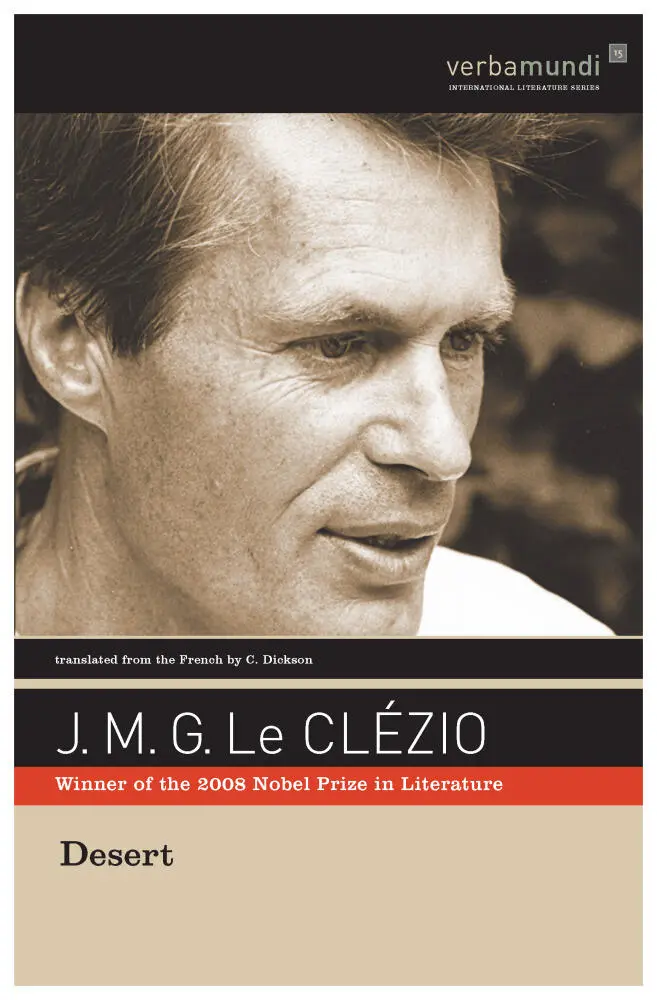
- Название:Desert
- Автор:
- Издательство:Verba Mundi Books
- Жанр:
- Год:2009
- Город:Jaffrey
- ISBN:978-1-56792-386-5
- Рейтинг книги:5 / 5. Голосов: 1
-
Избранное:Добавить в избранное
- Отзывы:
-
Ваша оценка:
Desert: краткое содержание, описание и аннотация
Предлагаем к чтению аннотацию, описание, краткое содержание или предисловие (зависит от того, что написал сам автор книги «Desert»). Если вы не нашли необходимую информацию о книге — напишите в комментариях, мы постараемся отыскать её.
Available for the first time in English translation, Desert is a novel composed of two alternating narratives, set in counterpoint. The first takes place in the desert between 1909 and 1912 and evokes the migration of a young adolescent boy, Nour, and his people, the Blue Men, notorious warriors of the desert. Driven from their lands by French colonial soldiers, Nour's tribe has come to the valley of the Saguiet El Hamra to seek the aid of the great spiritual leader known as Water of the Eyes. The religious chief sends them out from the holy city of Smara into the desert to travel still further. Spurred on by thirst, hunger, and suffering, Nour's tribe and others flee northward in the hopes of finding a land that can harbor them at last.
The second narrative relates the contemporary story of Lalla, a descendant of the Blue Men. Though she is an orphan living in a shantytown known as the Project near a coastal city in Morocco, the blood of her proud, obstinate tribe runs in her veins. All too soon, Lalla must flee to escape a forced marriage with an older, wealthy man. She travels to France, undergoing many trials there, from working as a hotel maid to becoming a highly-paid fashion model, and yet she never betrays the blood of her ancestors.
Desert — читать онлайн бесплатно полную книгу (весь текст) целиком
Ниже представлен текст книги, разбитый по страницам. Система сохранения места последней прочитанной страницы, позволяет с удобством читать онлайн бесплатно книгу «Desert», без необходимости каждый раз заново искать на чём Вы остановились. Поставьте закладку, и сможете в любой момент перейти на страницу, на которой закончили чтение.
Интервал:
Закладка:
The Hartani’s face is taut, as if the skin on his forehead and cheeks was of polished stone. Above them, space slowly fills with stars, thousands of stars. They throw out bursts of white, pulse, trace their secret figures. The two fugitives watch them, almost holding their breath, eyes wide. They can feel the pattern of the constellations settling on their faces, as if they only existed through their gaze, as if they were drinking in the soft light of night. They aren’t thinking of anything anymore, not of the path in the desert, not of the suffering they will know tomorrow or the other days; they can’t feel their wounds anymore, or hunger or thirst, or anything earthly; they have even forgotten the burn of the sun that blackened their faces and bodies, that devoured the inside of their eyes.
The starlight falls gently down like rain. It makes not a sound, raises no dust, stirs up no wind. Now it is lighting the stony field, and the area around the mouth of the well, the charred tree becomes light and frail as a wisp of smoke. The earth is no longer really flat, it has been drawn out like the prow of a boat, and now it drifts slowly forward, glides along, rocking and rolling, moving slowly through the lovely stars, while the two children holding tightly to one another, bodies buoyed, carry out the gestures of lovemaking.
New stars appear every second, tiny, hardly even possible in the blackness, and the invisible threads of their light join the others. There are myriads of gray, red, white lights intermingling with the deep blue of the night, suspended like bubbles.
Later, as the Hartani is drifting peacefully off to sleep with his face against her, Lalla watches all the signs, all the bursts of light, everything that is pulsing, flickering, or remaining fixed, like an eye. Still higher up, directly above her, is the vast Milky Way, the path traced by the blood of Gabriel’s lamb, according to what Old Naman used to say.
She drinks in the extremely soft light coming from the clusters of stars, and suddenly she has the feeling, like the words to the song Lalla Hawa’s voice sang, that it is so very close, she could simply reach out her hand and take a handful of the beautiful shimmering light. But she doesn’t move. Her hand is resting on the Hartani’s neck and listening to the blood beating in his arteries, the tranquil passage of his breathing. Night has eased the fever of the sun and the dryness. Thirst, hunger, anxiety have all been relieved by the light of the galaxy, and on her skin, like droplets, are the marks of each star in the sky.
The two children can no longer see the earth now, holding tightly to one another, they are wheeling out through the open sky.
EACH DAY ADDED a little more land. The caravan had been divided into three sections, separated by a two- or three-hour march. The one headed by Larhdaf was on the left, over by the foothills of the Haua, on the route to Sidi al-Hach. Saadbou, the youngest son of the great sheik, was leading the one on the far right, following the dried riverbed of the Jang Saccum up through the middle of the valley of the Saguiet al-Hamra. In the middle, and hanging back, Ma al-Aïnine moved along with his warriors on camelback. Then came the caravan of men, women, and children prodding their livestock out in front, following the huge cloud of red dust rising into the sky ahead of them.
Each day, they walked along the bottom of the immense valley while the sun over their heads followed the opposite path. It was the end of winter, and the rains had not yet assuaged the earth. The bottom of the Saguiet al-Hamra was as hard and crackled as an old goatskin. Even its red color burned their eyes and the skin on their faces.
In the morning, before the sun was even up, the call for the first prayer rang out. Then the sounds of the animals arose. The smoke from the braziers filled the valley. In the distance, Larhdaf’s soldiers called out their chants and were answered by Saadbou’s men. But the blue men of the great sheik prayed in silence. When the first signs of red dust rose into the air, the men set the herds to moving. Everyone picked up their bundles and started walking again over the earth, which was still cold and gray.
Slowly, day broke on the horizon, up above the Hamada. The men watched as the gleaming disk lit up the valley bottom and, already, they squinted their eyes and leaned slightly forward, as if to resist the weight and pain of the light on their brows and shoulders.
At times Larhdaf’s and Saadbou’s troops were so close that the sound of their horses’ hooves and the grumbling of their camels could be heard. Then the three dust clouds blended together in the sky and almost obscured the sun.
When the sun was at its zenith, the wind rose and swept everything clean, driving away the high walls of red dust and sand. The men stopped their herds in half circles and took shelter behind the reclining camels or up against the thorn bushes. The earth seemed as vast as the sky, as barren, as blinding.
Nour walked behind the great sheik’s troops, carrying his load of provisions in a large piece of canvas knotted around his chest. Each day from dawn to dusk, he walked in the tracks of horses and men without knowing where he was going, without being able to see his father, or his mother, or his sisters. Sometimes he would meet back up with them in the evening, when the travelers lit their twig fires for tea and porridge. He spoke to no one, and no one spoke to him. It was as if the fatigue and dryness had burned up the words in his throat.
When night was falling, and the animals had pawed out a hollow in which to sleep, Nour was able to take a look at the immense deserted valley surrounding him. Walking out a little ways from the camp, standing upon the desiccated plain, Nour felt as if he were as tall as a tree. The valley seemed boundless, an infinite expanse of stones and red sand, unchanged since the beginning of time. Scattered in the distance were the burnt shapes of small acacias, bushes, and tufts of cactuses and dwarf palms, in places where the moisture in the valley made faint dark marks. The earth took on a mineral color in the twilight. Nour stood absolutely still, waiting for darkness to descend and fill up the valley, slowly, like impalpable water.
Later, other parties of nomads came to join Ma al-Aïnine’s group. They conferred with the chieftains of the tribes, asking them where they were going and then followed the same route. Now there were several thousand of them walking along the valley toward the wells of Hausa, al-Faunat, and Yorf.
Nour no longer knew how many days it had been since the journey began. Maybe it was only one single and interminable day unfolding like that, while the sun rose and set again in the blazing sky, and the cloud of dust swirled in on itself, churning like a wave. The men following Ma al-Aïnine’s sons were far ahead; they had probably already reached the end of the Saguiet al-Hamra, beyond the tomb of Mohammed Embarek, the place where the lunar wasteland of the valley of Mesuar opens out on the plateau of the Hamada. Maybe their horses were already climbing the slopes of the rocky hills, and seeing the immense valley of the Saguiet al-Hamra opening out behind them with the billowing red-ochre clouds of Ma al-Aïnine’s people and herds.
Now, the men and women in the last column were beginning to slow down. From time to time, Nour stopped to wait for his mother and sisters’ group. He sat down on the hot stones, a flap of his cloak pulled over his head, and watched the horde moving slowly along the trail. The unmounted warriors walked bent over, staggering under the loads on their shoulders. Some of them were leaning on their rifles, their spears. Their faces were black, and through the crunching of their footsteps in the sand, Nour could hear the sound of their labored breathing.
Читать дальшеИнтервал:
Закладка:
Похожие книги на «Desert»
Представляем Вашему вниманию похожие книги на «Desert» списком для выбора. Мы отобрали схожую по названию и смыслу литературу в надежде предоставить читателям больше вариантов отыскать новые, интересные, ещё непрочитанные произведения.











Обсуждение, отзывы о книге «Desert» и просто собственные мнения читателей. Оставьте ваши комментарии, напишите, что Вы думаете о произведении, его смысле или главных героях. Укажите что конкретно понравилось, а что нет, и почему Вы так считаете.