J.M. le Clézio - Desert
Здесь есть возможность читать онлайн «J.M. le Clézio - Desert» весь текст электронной книги совершенно бесплатно (целиком полную версию без сокращений). В некоторых случаях можно слушать аудио, скачать через торрент в формате fb2 и присутствует краткое содержание. Город: Jaffrey, Год выпуска: 2009, ISBN: 2009, Издательство: Verba Mundi Books, Жанр: Современная проза, на английском языке. Описание произведения, (предисловие) а так же отзывы посетителей доступны на портале библиотеки ЛибКат.
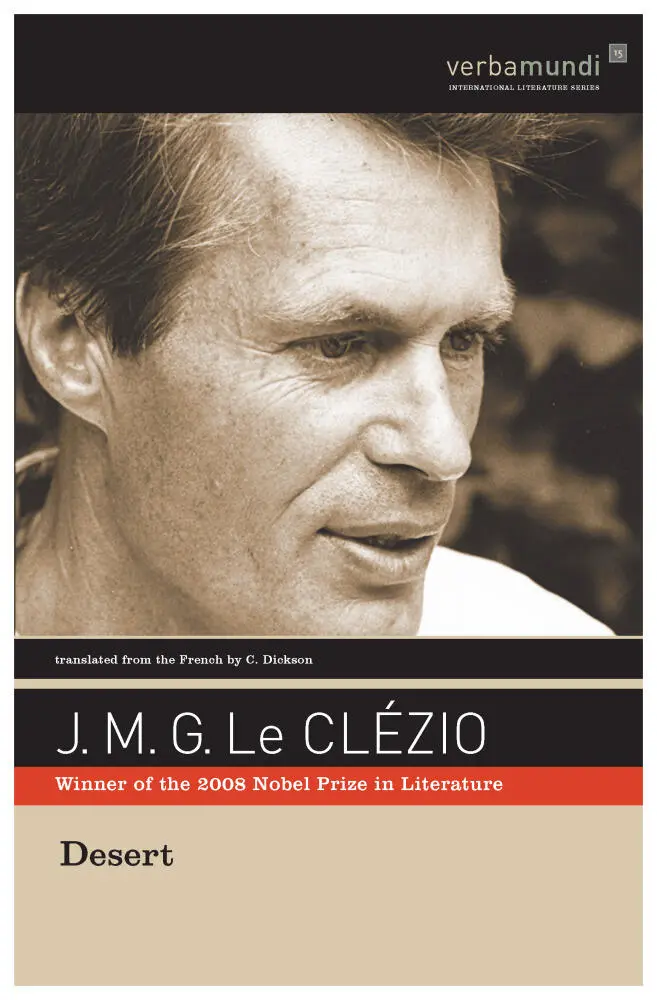
- Название:Desert
- Автор:
- Издательство:Verba Mundi Books
- Жанр:
- Год:2009
- Город:Jaffrey
- ISBN:978-1-56792-386-5
- Рейтинг книги:5 / 5. Голосов: 1
-
Избранное:Добавить в избранное
- Отзывы:
-
Ваша оценка:
Desert: краткое содержание, описание и аннотация
Предлагаем к чтению аннотацию, описание, краткое содержание или предисловие (зависит от того, что написал сам автор книги «Desert»). Если вы не нашли необходимую информацию о книге — напишите в комментариях, мы постараемся отыскать её.
Available for the first time in English translation, Desert is a novel composed of two alternating narratives, set in counterpoint. The first takes place in the desert between 1909 and 1912 and evokes the migration of a young adolescent boy, Nour, and his people, the Blue Men, notorious warriors of the desert. Driven from their lands by French colonial soldiers, Nour's tribe has come to the valley of the Saguiet El Hamra to seek the aid of the great spiritual leader known as Water of the Eyes. The religious chief sends them out from the holy city of Smara into the desert to travel still further. Spurred on by thirst, hunger, and suffering, Nour's tribe and others flee northward in the hopes of finding a land that can harbor them at last.
The second narrative relates the contemporary story of Lalla, a descendant of the Blue Men. Though she is an orphan living in a shantytown known as the Project near a coastal city in Morocco, the blood of her proud, obstinate tribe runs in her veins. All too soon, Lalla must flee to escape a forced marriage with an older, wealthy man. She travels to France, undergoing many trials there, from working as a hotel maid to becoming a highly-paid fashion model, and yet she never betrays the blood of her ancestors.
Desert — читать онлайн бесплатно полную книгу (весь текст) целиком
Ниже представлен текст книги, разбитый по страницам. Система сохранения места последней прочитанной страницы, позволяет с удобством читать онлайн бесплатно книгу «Desert», без необходимости каждый раз заново искать на чём Вы остановились. Поставьте закладку, и сможете в любой момент перейти на страницу, на которой закончили чтение.
Интервал:
Закладка:
The music lasts for a long time; it lulls her for such a long time that the shadows under the stones stretch out on the desert sand. Then Lalla can also make out the red city at the end of the immense valley. It’s not really a city like those with which Lalla is familiar, those with streets and houses. It’s a city of mud, wasted by time and worn with the wind, like the nests of termites or wasps. The light is beautiful over the red city, forming a clear pure dome of tranquility in the eternal dawn sky. The houses are grouped around the mouth of the well, and there are several trees, white acacias, standing stock-still like statues. But what Lalla notices most of all is a white tomb, as simple as an eggshell set down upon the red earth. That is where the light of the gaze is coming from, and Lalla realizes it is the dwelling place of the Blue Man.
Something terrible, yet at the same time very beautiful is reaching out to Lalla. It’s as if something deep down inside of her were being torn and broken and allowing death, the unknown to enter. The burn of the desert heat inside of her spreads, courses through her veins, mixes with her entrails. The gaze of al-Ser is terrifying and painful, because it is the suffering born of the desert: hunger, fear, death, which come, pass over her. The lovely golden light, the red city, the delicate white tomb from which the supernatural light is emanating, also carry with them sorrow, anxiety, abandonment. It is a long anguished gaze that comes because the earth is hard, and the sky wants nothing to do with men.
Lalla remains motionless, crumpled over on herself, knees on the stones. The sun is burning her shoulders and neck. She doesn’t open her eyes. Two streams of tears make little furrows in the red dust caked on her face.
When she lifts her head and opens her eyes, her vision is blurred. She needs to make an effort to see straight. The sharp silhouettes of the hills appear, then the deserted stretch of the plateau, with not a blade of grass, not a tree, only the light and the wind.
So then she begins to walk, staggering, slowly making her way back down the path leading to the valley, to the sea, to the plank and tarpaper Project. The shadows are long now, the sun is near the horizon. Lalla can feel her face swollen from the burn of the desert, and she thinks no one will be able to recognize her, now that she’s become like the Hartani.
When she gets back down near the mouth of the river, night has fallen on the Project. The electric lightbulbs make yellow dots. On the road, trucks are driving along throwing out the white beams of their headlights, idiotically.
At times Lalla runs, at other times she moves very slowly, as if she were going to stop, turn around, and flee. There are a few radios making their music mechanically in the night. The fires of the braziers are going out on their own, and in the houses of poorly fitted planks, the women and children are already rolled up in their blankets because of the night dampness. From time to time, the faint wind makes an empty can roll, a piece of corrugated iron flap. The dogs are hiding. Above the Project, the black sky is filled with stars.
Lalla walks silently through the alleys and thinks that no one here needs her, that everything is just perfect without her, as if she’d been gone for years, as if she’d never existed.
Instead of going toward Aamma’s house, Lalla walks slowly to the other end of the Project, where Old Naman lives. She’s shivering because the night air is very damp, and her knees are trembling beneath her because she hasn’t eaten anything since the day before. The day was so long up there on the plateau of stones that Lalla has the impression she’s been gone for days, maybe months. It’s as if she barely recognizes the streets of the Project, the sounds of children crying, the smell of urine and dust. Suddenly she thinks maybe months really have gone by, up there on the plateau of stones, and it only seemed like one long day. Then she thinks of Old Naman, and her throat tightens. In spite of her weakness, she starts running through the empty streets of the Project. The dogs hear her running; it makes them growl and bark a little. When she arrives in front of Naman’s house, her heart is beating very hard, and she can barely breathe. The door is cracked open; there is no light.
Old Naman is lying on his mat, just as she’d left him. He’s still breathing, very slowly, with a wheeze, and his eyes are wide open in the dark. Lalla leans over his face, but he doesn’t recognize her. His mouth is so busy trying to breathe, it can’t smile anymore.
“Naman … Naman…” Lalla murmurs.
Old Naman has no strength left. The wind of ill fortune has given him a fever, the kind that weighs on your body and on your head and keeps you from eating. The wind might carry him away. Anxiously Lalla leans down near the fisherman’s face.
She says, “You don’t want to go now? Not now, not yet?”
She wants so much to be able to hear Naman talk to her, tell her the story of the white bird who was a prince of the sea once again, or the story of the stone the Archangel Gabriel gave to human beings, and which turned black with their sins. But Old Naman can’t tell stories anymore; he barely has enough strength to raise his chest to breathe, as if there were an invisible weight upon him. Foul sweat and urine soak the thin body lying seemingly broken on the floor.
Lalla is too tired now to tell other stories, to continue talking about everything over there, across the sea, all of those cities in Spain and France.
So she sits down next to the old man and watches the night light through the open door. She listens to the wheezing breath, hears the evil sound of the wind outside, rolling tin cans around and making pieces of corrugated iron flap. Then she falls asleep, like that, sitting with her head resting on her knees. From time to time Old Naman’s choked breathing awakens her, and she asks, “Are you there? Are you still there?”
He doesn’t respond, he’s not sleeping; his gray face is turned toward the door, but his shiny eyes don’t seem to see anymore, as if they were contemplating what lies beyond.
Lalla tries to fight against sleep, because she’s afraid of what will happen if she goes to sleep. It’s like the fishermen, the ones who are far away, lost out at sea, who can’t see anything, rocked on the waves, caught in the whirling winds of the storm. They can’t ever fall asleep because then the sea will grab them, throw them down into the depths, swallow them up. Lalla wants to resist, but her eyelids close in spite of herself, and she feels herself falling backwards. She swims for a long time without knowing where she’s going, borne along on the slow sound of Old Naman’s breathing.
Then, before daybreak, she awakens with a start. She looks at the old man stretched out on the floor, his peaceful face resting against his arm. He’s not making a sound now, because he has stopped breathing. Outside, the wind has stopped blowing, the danger has passed. Everything is peaceful, as if no one ever died, anywhere.
WHEN LALLA DECIDED to leave, she didn’t say anything to anyone. She decided to leave because the man with the gray-green suit came back to Aamma’s house several times, and each time he looked at Lalla with those eyes that were as shiny and hard as black stones, and he sat on Lalla Hawa’s trunk to drink a glass of mint tea. Lalla isn’t afraid of him, but she knows if she doesn’t go away, one day he’ll force her to go to his house and marry him, because he is rich and powerful and doesn’t like anyone to resist him.
She left this morning at the crack of dawn. She didn’t even glance into the back of the house at the shape of Aamma sleeping, rolled up in her sheet. She just took a piece of blue cloth in which she put some stale bread and a few dried dates, and a gold bracelet that had belonged to her mother.
Читать дальшеИнтервал:
Закладка:
Похожие книги на «Desert»
Представляем Вашему вниманию похожие книги на «Desert» списком для выбора. Мы отобрали схожую по названию и смыслу литературу в надежде предоставить читателям больше вариантов отыскать новые, интересные, ещё непрочитанные произведения.











Обсуждение, отзывы о книге «Desert» и просто собственные мнения читателей. Оставьте ваши комментарии, напишите, что Вы думаете о произведении, его смысле или главных героях. Укажите что конкретно понравилось, а что нет, и почему Вы так считаете.