J.M. le Clézio - Desert
Здесь есть возможность читать онлайн «J.M. le Clézio - Desert» весь текст электронной книги совершенно бесплатно (целиком полную версию без сокращений). В некоторых случаях можно слушать аудио, скачать через торрент в формате fb2 и присутствует краткое содержание. Город: Jaffrey, Год выпуска: 2009, ISBN: 2009, Издательство: Verba Mundi Books, Жанр: Современная проза, на английском языке. Описание произведения, (предисловие) а так же отзывы посетителей доступны на портале библиотеки ЛибКат.
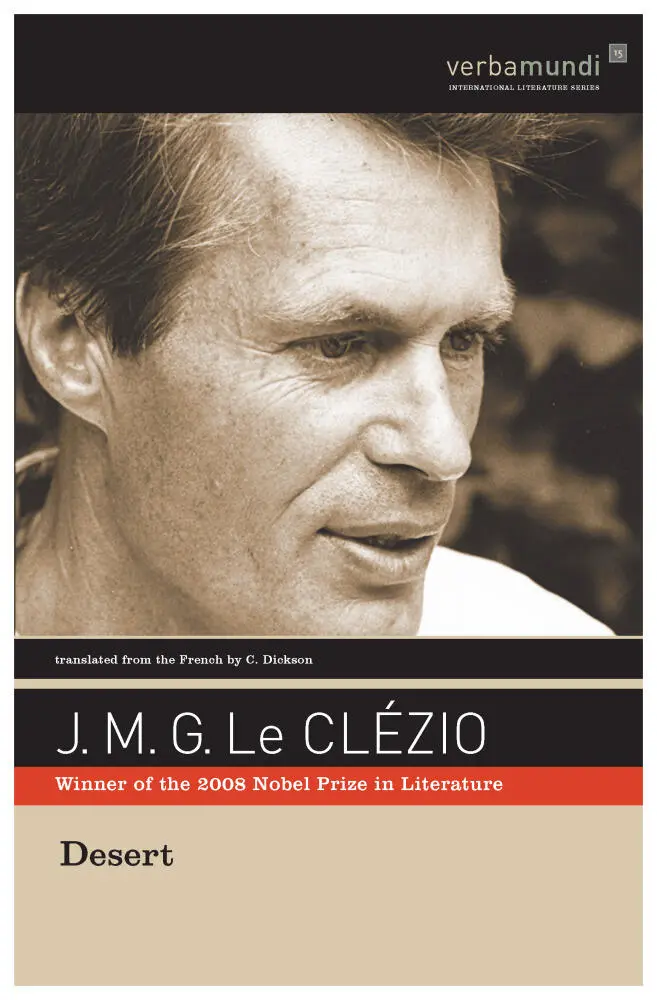
- Название:Desert
- Автор:
- Издательство:Verba Mundi Books
- Жанр:
- Год:2009
- Город:Jaffrey
- ISBN:978-1-56792-386-5
- Рейтинг книги:5 / 5. Голосов: 1
-
Избранное:Добавить в избранное
- Отзывы:
-
Ваша оценка:
Desert: краткое содержание, описание и аннотация
Предлагаем к чтению аннотацию, описание, краткое содержание или предисловие (зависит от того, что написал сам автор книги «Desert»). Если вы не нашли необходимую информацию о книге — напишите в комментариях, мы постараемся отыскать её.
Available for the first time in English translation, Desert is a novel composed of two alternating narratives, set in counterpoint. The first takes place in the desert between 1909 and 1912 and evokes the migration of a young adolescent boy, Nour, and his people, the Blue Men, notorious warriors of the desert. Driven from their lands by French colonial soldiers, Nour's tribe has come to the valley of the Saguiet El Hamra to seek the aid of the great spiritual leader known as Water of the Eyes. The religious chief sends them out from the holy city of Smara into the desert to travel still further. Spurred on by thirst, hunger, and suffering, Nour's tribe and others flee northward in the hopes of finding a land that can harbor them at last.
The second narrative relates the contemporary story of Lalla, a descendant of the Blue Men. Though she is an orphan living in a shantytown known as the Project near a coastal city in Morocco, the blood of her proud, obstinate tribe runs in her veins. All too soon, Lalla must flee to escape a forced marriage with an older, wealthy man. She travels to France, undergoing many trials there, from working as a hotel maid to becoming a highly-paid fashion model, and yet she never betrays the blood of her ancestors.
Desert — читать онлайн бесплатно полную книгу (весь текст) целиком
Ниже представлен текст книги, разбитый по страницам. Система сохранения места последней прочитанной страницы, позволяет с удобством читать онлайн бесплатно книгу «Desert», без необходимости каждый раз заново искать на чём Вы остановились. Поставьте закладку, и сможете в любой момент перейти на страницу, на которой закончили чтение.
Интервал:
Закладка:
Lalla doesn’t think about that very much herself. It’s all the same to her. She’s watching Naman’s eyes, and it’s a little bit as if she had known those seas, those countries, those houses.
The Hartani doesn’t think about it either. He’s remained like a child still, even though he’s as tall and strong as an adult. His body is slim and elongated, his face is pure and smooth like a piece of ebony. Maybe it’s because he doesn’t know how to speak the same language others do.
He still sits down on a rock, staring out into the distance, wearing his homespun robe, with the white cloth on his head drawn over his face. Around him there are still black shepherds just like him, wild, dressed in rags, whistling as they leap from rock to rock. Lalla likes coming out where they live, out to the place which is filled with white light, the place where time stands still, where you can’t grow up.
THE MAN WALKED into Aamma’s house one morning in the beginning of summer. He was a man from the city, wearing a gray suit with a green sheen, black leather shoes that were as shiny as mirrors. He came with a few gifts for Aamma and her sons, an electric mirror framed in white plastic, a transistor radio no larger than a box of matches, pens with gold-colored caps, and a bag full of sugar and canned food. When he came into the house he passed Lalla at the door but hardly looked at her. He lay all the presents on the floor; Aamma told him to sit down, and he looked around for a seat, but there were only cushions and Lalla Hawa’s wooden trunk that Aamma had brought back from the South with Lalla. The man chose to sit on the trunk after having tested it a little with the palm of his hand. The man waited for tea and sweet cakes to be brought to him.
When she learned a little later that the man had come to ask for her hand in marriage, Lalla felt very frightened. It made her head spin, and her heart started beating wildly. It wasn’t Aamma who told her about it, but Bareki, Aamma’s eldest son.
“Our mother decided to have you marry him, because he is very rich.”
“But I don’t want to get married!” Lalla shouted.
“You have nothing to say about it, you must obey your aunt,” Bareki said.
“Never! Never!” Lalla ran off shouting, her eyes filled with angry tears.
Then she went back to Aamma’s house. The man with the gray-green suit was gone, but the gifts were there. Ali, Aamma’s younger son, was even listening to music, holding the tiny transistor radio against his ear. When Lalla walked in, he gave her a knowing look.
“Why did you keep that man’s gifts? I won’t marry him,” Lalla said to Aamma coldly.
Aamma’s son snickered, “Maybe she wants to marry the Hartani!”
“Get out!” said Aamma. The young man went out with the transistor.
“You can’t force me to marry that man!” Lalla says.
“He will be a good husband for you,” responds Aamma. “He’s no longer very young, but he’s rich, he has a big house in the city, and he has lots of powerful relations. You must marry him.”
“I don’t want to get married, ever!”
Aamma remains silent for a long time. When she speaks again, her voice is softer, but Lalla stays on her guard.
“I raised you as if you were my own daughter, I love you, and today you would affront me in this way?”
Lalla looks angrily at Aamma, because for the first time she’s seeing her dishonest side.
“I don’t care,” she says. “I don’t want to marry that man. I don’t want these ridiculous gifts!”
She motions toward the electric mirror on its stand on the dried mud floor. “You don’t even have electricity!”
Then suddenly, she’s had enough. She leaves Aamma’s house and goes out to the sea. But this time she doesn’t run along the path; she walks very slowly. Today, nothing is the same. It’s as if everything has been dulled, worn down from being looked at so much.
“I’m going to have to leave,” Lalla says out loud to herself. But she immediately thinks that she doesn’t even know where to go. So then she crosses over to the other side of the dunes and walks along the wide beach, looking for Old Naman. She would so like for him to be there, as usual, sitting on a root of the old fig tree, repairing his nets. She would ask him all sorts of questions about those cities in Spain with magic names, Algeciras, Málaga, Granada, Teruel, Zaragoza, and about those ports from which ships as big as cities sail, about the roads upon which automobiles drive northward, about trains and airplanes departing. She’d like to listen to him talk for hours about those snow-capped mountains and those tunnels, those rivers that are as vast as the sea, those wheat-covered plains, immense forests, and most of all about those fragrant cities where there are white palaces, churches, fountains, stores glittering with light. Paris, Marseille, and all of those streets, houses so tall you can barely see the sky, the gardens, the cafés, the hotels, and the intersections where you meet people from all corners of the world.
But Lalla can’t find the old fisherman. There is only the white gull gliding slowly along facing the wind, wheeling over her head.
“Hey-o! Hey-o! Prince!”
The white bird swoops over Lalla a few more times, then, caught up in the wind, flies quickly away in the direction of the river.
So Lalla stays on the beach for a long time, with only the sound of the wind and the sea in her ears.
The following days, no one said a word about anything in Aamma’s house, and the man with the gray-green suit didn’t come back. The little transistor radio was already demolished, and the cans of food had all been eaten. Only the plastic electric mirror remained where it had been placed, on the tamped earth near the door.
Lalla hadn’t slept well any of those nights, trembling at the slightest sounds. She remembered stories she’d been told about girls who had been taken away by force, in the night, because they didn’t want to get married. Every morning at daybreak, Lalla went out before anyone else, to wash herself and fetch the water at the fountain. That way, she could keep an eye on the entrance to the Project.
Then came the wind of ill fortune, which blew over the land for several days in a row. The wind of ill fortune is a bizarre wind that only comes once or twice a year, at the end of winter or in the fall. The strangest thing about it is that you don’t really feel it at first. It doesn’t blow very hard, and sometimes it stops altogether, and you forget about it. It’s not a cold wind like those of the midwinter storms, when the sea unleashes its furious waves. It’s not a hot desiccating wind either, like the one that comes from the desert and lights the houses with a red glow, the one that makes sand hiss over the metal and tarpaper roofs. No, the wind of ill fortune is a very mild wind that swirls around, tosses a few gusts about, and then settles heavily on the roofs of the houses, on people’s shoulders and chests. When it’s here, the air gets hotter and heavier, as if there were a gray veil over everything.
When that slow, mild wind comes, people fall sick, almost everywhere, especially small children and elderly people, and they die. That’s why it’s called the wind of ill fortune.
When it began to blow on the Project that particular year, Lalla recognized it right away. She saw the clouds of gray dust moving over the plain, blurring the sea and the mouth of the river. Then people only went out muffled up in their cloaks in spite of the heat. There were no more wasps, and the dogs went off to hide in the hollows at the feet of the houses, with their noses in the dust. Lalla was sad, because she thought of the people the wind would sweep away in its path. So when she heard that Old Naman was sick, there was a pang in her heart and she couldn’t breathe for a minute. She’d never really had that feeling before, and she had to sit down to keep from falling.
Читать дальшеИнтервал:
Закладка:
Похожие книги на «Desert»
Представляем Вашему вниманию похожие книги на «Desert» списком для выбора. Мы отобрали схожую по названию и смыслу литературу в надежде предоставить читателям больше вариантов отыскать новые, интересные, ещё непрочитанные произведения.











Обсуждение, отзывы о книге «Desert» и просто собственные мнения читателей. Оставьте ваши комментарии, напишите, что Вы думаете о произведении, его смысле или главных героях. Укажите что конкретно понравилось, а что нет, и почему Вы так считаете.