J.M. le Clézio - Desert
Здесь есть возможность читать онлайн «J.M. le Clézio - Desert» весь текст электронной книги совершенно бесплатно (целиком полную версию без сокращений). В некоторых случаях можно слушать аудио, скачать через торрент в формате fb2 и присутствует краткое содержание. Город: Jaffrey, Год выпуска: 2009, ISBN: 2009, Издательство: Verba Mundi Books, Жанр: Современная проза, на английском языке. Описание произведения, (предисловие) а так же отзывы посетителей доступны на портале библиотеки ЛибКат.
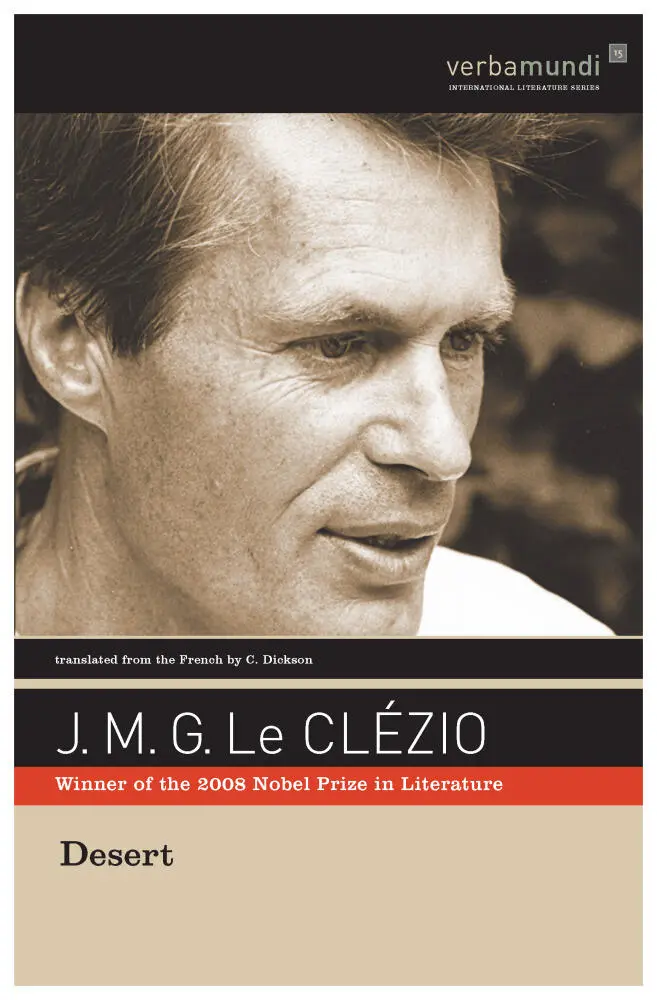
- Название:Desert
- Автор:
- Издательство:Verba Mundi Books
- Жанр:
- Год:2009
- Город:Jaffrey
- ISBN:978-1-56792-386-5
- Рейтинг книги:5 / 5. Голосов: 1
-
Избранное:Добавить в избранное
- Отзывы:
-
Ваша оценка:
Desert: краткое содержание, описание и аннотация
Предлагаем к чтению аннотацию, описание, краткое содержание или предисловие (зависит от того, что написал сам автор книги «Desert»). Если вы не нашли необходимую информацию о книге — напишите в комментариях, мы постараемся отыскать её.
Available for the first time in English translation, Desert is a novel composed of two alternating narratives, set in counterpoint. The first takes place in the desert between 1909 and 1912 and evokes the migration of a young adolescent boy, Nour, and his people, the Blue Men, notorious warriors of the desert. Driven from their lands by French colonial soldiers, Nour's tribe has come to the valley of the Saguiet El Hamra to seek the aid of the great spiritual leader known as Water of the Eyes. The religious chief sends them out from the holy city of Smara into the desert to travel still further. Spurred on by thirst, hunger, and suffering, Nour's tribe and others flee northward in the hopes of finding a land that can harbor them at last.
The second narrative relates the contemporary story of Lalla, a descendant of the Blue Men. Though she is an orphan living in a shantytown known as the Project near a coastal city in Morocco, the blood of her proud, obstinate tribe runs in her veins. All too soon, Lalla must flee to escape a forced marriage with an older, wealthy man. She travels to France, undergoing many trials there, from working as a hotel maid to becoming a highly-paid fashion model, and yet she never betrays the blood of her ancestors.
Desert — читать онлайн бесплатно полную книгу (весь текст) целиком
Ниже представлен текст книги, разбитый по страницам. Система сохранения места последней прочитанной страницы, позволяет с удобством читать онлайн бесплатно книгу «Desert», без необходимости каждый раз заново искать на чём Вы остановились. Поставьте закладку, и сможете в любой момент перейти на страницу, на которой закончили чтение.
Интервал:
Закладка:
It’s always the same; when she really wants to see him, he appears in a dip in the ground, sitting on a stone, his head wrapped up in a white cloth. He’s watching his goats and sheep. His face is black, his hands thin and strong like the hands of an old man. He shares his black bread and dates with Lalla, and he even gives a few pieces to the shepherds who have come forward. But he’s not proud about it; it’s as if what he gives is of no importance.
Lalla glances over at him every once in a while. She loves his imperturbable face, the aquiline profile, and the light that glows in his dark eyes. The Hartani is also waiting for something, but he’s perhaps the only one who knows what he’s waiting for. He doesn’t say what it is since he doesn’t know how to speak the language of human beings. But you can guess from his eyes what he’s waiting for, what he’s looking for. It’s as if part of him had been left behind in the place of his birth, beyond the rocky hills and the snow-capped mountains, in the immensity of the desert, and one day he would have to find that part of himself, in order to really be whole.
Lalla stays with the shepherd all day long, only she doesn’t get too near to him. She sits on a stone, not far away, and gazes out in the distance; she looks at the air dancing and rushing over the arid valley, the white light making sparks, and the slow meandering of the goats and sheep through the white stones.
When the days are sad, anxious, the Hartani is the only one who can be there, and who doesn’t need words. A look is enough, and he knows how to give bread and dates with nothing in exchange. He even prefers for you to stay a few steps away from him, just like the goats and the sheep, who never completely belong to anyone.
All day long, Lalla listens to the calls of the shepherds in the hills, whistling that bores through the white silence. When she goes back to the Project of planks and tarpaper, she feels freer, even if Aamma does scold her because she’s brought nothing home to eat.
That’s the kind of day it is when Aamma takes Lalla to the house of the woman who sells carpets. It’s on the other side of the river in a poor part of the city, in a big white house with narrow screened windows. When she enters the room used as a workshop, Lalla hears the sound of weaving looms. There are twenty of them, maybe more, lined up one behind the other in the milky half-light of the large room where three neon tubes are flickering. In front of the looms, little girls are squatting or sitting on stools. They work rapidly, pushing the shuttle between the warp threads, taking the small steel scissors, cutting the pile, packing the wool down on the weft. The oldest must be about fourteen; the youngest is probably not yet eight. They aren’t talking, they don’t even look at Lalla when she comes into the workshop with Aamma and the merchant woman. The merchant’s name is Zora; she is a tall woman dressed in black who always holds a flexible switch in her pudgy hands with which to whip the little girls on the legs and shoulders when they don’t work fast enough or when they talk to their workmates.
“Has she ever worked?” she asks, without even glancing at Lalla.
Aamma says she’s shown her how people used to weave in the old days. Zora nods her head. She seems very pale, maybe because of the black dress, or else because she never leaves the shop. She walks slowly over to a free loom, upon which there is a large dark red carpet with white spots.
“She can finish this one,” she says.
Lalla sits down and starts to work. She works in the large dim room for several hours, making mechanical gestures with her hands. At first she has to stop, because her fingers get tired, but she can feel the eyes of the tall pale lady on her and starts working again right away. She knows the pale woman won’t whip her with the switch because she is older than the other girls working there. When their eyes meet, Lalla feels something like a shock deep inside, and a glint of anger flares in her eyes. But the fat woman dressed in black takes it out on the smaller girls, the skinny ones who cower like she-dogs, daughters of beggars, abandoned girls who live at Zora’s house year-round and who have no money. The minute their work slows down, or if they exchange a few words in a whisper, the fat pale woman descends upon them with surprising agility and lashes their backs with her switch. But the little girls never cry. All you can hear is the whistling of the whip and the dull whack on their backs. Lalla clenches her teeth; she looks down at the ground to avoid seeing or hearing it, because she too would like to shout and lash out at Zora. But she doesn’t say anything because of the money she’s supposed to bring back to the house for Aamma. To get even, she just ties a few knots the wrong way in the red carpet.
Still, the following day Lalla just can’t stand it anymore. When the fat pale woman resumes whipping Mina — a puny, thin little girl of barely ten — with the switch because she’s broken her shuttle, Lalla stands up and says coldly, “Stop beating her!”
Zora looks at Lalla incredulously for a minute. Her pale flabby face has taken on such an idiotic expression that Lalla repeats, “Stop beating her!”
Suddenly, Zora’s features screw up in hatred. She strikes out vehemently at Lalla’s face with the switch, but only grazes her left shoulder, as Lalla manages to dodge the blow.
“You’ll see the beating I’ll give you!” Zora screams, and now there’s some color to her face.
“You bully! You wicked woman!”
Lalla grabs Zora’s switch and breaks it over her knee. Then it is fear that twists the fat woman’s face.
She backs away stuttering, “Get out! Get out! Right now! Get out!”
But Lalla is already running across the large room; she leaps outside into the sunlight; she runs without stopping all the way back to Aamma’s house. Freedom is beautiful. You can watch the clouds floating along upside down again, the wasps busying themselves around little piles of garbage, the lizards, the chameleons, the grasses quivering in the wind. Lalla sits down in front of the house, in the shade of the wall of planks, and listens eagerly to all the minute sounds.
When Aamma comes home around evening time, she simply says, “I’m not going back to work at Zora’s, ever again.”
Since that day, things here in the Project have really changed for Lalla. It’s as if she’d grown up all of a sudden, and people have started noticing her. Even Aamma’s sons aren’t like they used to be, cold and scornful. Sometimes she sort of misses the days when she was very young, when she had just arrived in the Project, and no one knew her name, and she could hide behind a shrub, in a bucket, in a cardboard box. She really enjoyed that, being like a shadow, coming and going without being seen, without being spoken to.
Old Naman and the Hartani are the only ones who haven’t changed. Naman the fisherman still tells incredible stories as he repairs his nets on the beach, or when he comes to eat corn cakes at Aamma’s house. He hardly ever catches fish anymore, but people really like him and continue to invite him over. His pale eyes are as transparent as water, and his face is stitched with deep wrinkles like scars from ancient wounds.
Aamma listens to him talk about Spain, about Marseille, or Paris, and about all the cities where he has been, where he’s walked, where he knows the names of the streets and the people who live there. Aamma asks him questions, asks him if his brother can help her find work over there.
Naman nods his head. “Why not?”
That’s his answer to everything, but he promises to write his brother all the same. Leaving the country is complicated though. You need money, papers. Aamma remains pensive, a faraway look in her eyes; she’s dreaming of white cities with so many streets, houses, automobiles. Maybe that’s what she’s waiting for.
Читать дальшеИнтервал:
Закладка:
Похожие книги на «Desert»
Представляем Вашему вниманию похожие книги на «Desert» списком для выбора. Мы отобрали схожую по названию и смыслу литературу в надежде предоставить читателям больше вариантов отыскать новые, интересные, ещё непрочитанные произведения.











Обсуждение, отзывы о книге «Desert» и просто собственные мнения читателей. Оставьте ваши комментарии, напишите, что Вы думаете о произведении, его смысле или главных героях. Укажите что конкретно понравилось, а что нет, и почему Вы так считаете.