J.M. le Clézio - Desert
Здесь есть возможность читать онлайн «J.M. le Clézio - Desert» весь текст электронной книги совершенно бесплатно (целиком полную версию без сокращений). В некоторых случаях можно слушать аудио, скачать через торрент в формате fb2 и присутствует краткое содержание. Город: Jaffrey, Год выпуска: 2009, ISBN: 2009, Издательство: Verba Mundi Books, Жанр: Современная проза, на английском языке. Описание произведения, (предисловие) а так же отзывы посетителей доступны на портале библиотеки ЛибКат.
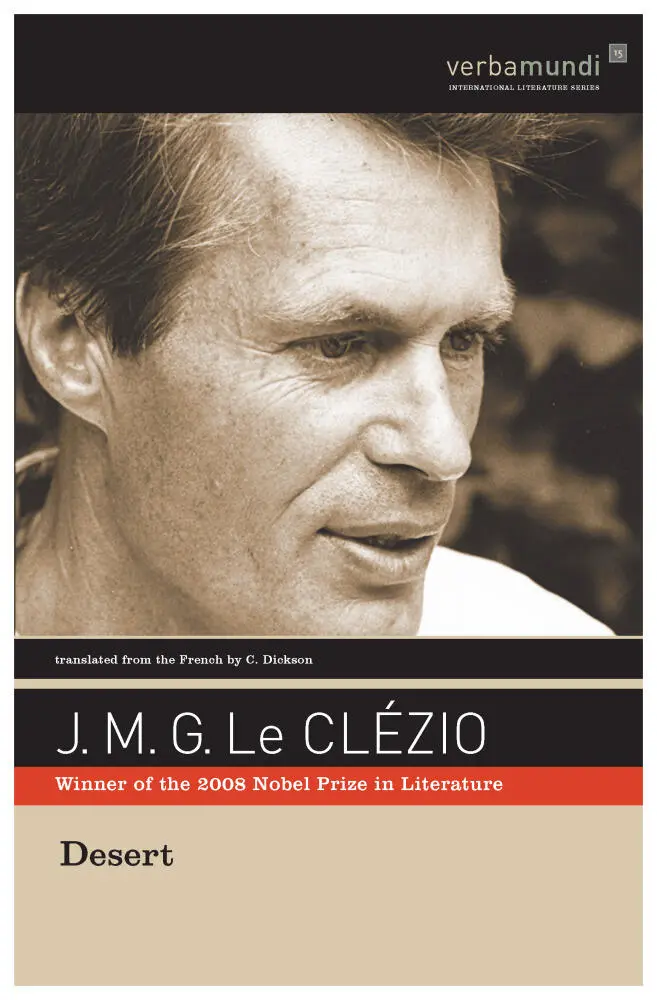
- Название:Desert
- Автор:
- Издательство:Verba Mundi Books
- Жанр:
- Год:2009
- Город:Jaffrey
- ISBN:978-1-56792-386-5
- Рейтинг книги:5 / 5. Голосов: 1
-
Избранное:Добавить в избранное
- Отзывы:
-
Ваша оценка:
Desert: краткое содержание, описание и аннотация
Предлагаем к чтению аннотацию, описание, краткое содержание или предисловие (зависит от того, что написал сам автор книги «Desert»). Если вы не нашли необходимую информацию о книге — напишите в комментариях, мы постараемся отыскать её.
Available for the first time in English translation, Desert is a novel composed of two alternating narratives, set in counterpoint. The first takes place in the desert between 1909 and 1912 and evokes the migration of a young adolescent boy, Nour, and his people, the Blue Men, notorious warriors of the desert. Driven from their lands by French colonial soldiers, Nour's tribe has come to the valley of the Saguiet El Hamra to seek the aid of the great spiritual leader known as Water of the Eyes. The religious chief sends them out from the holy city of Smara into the desert to travel still further. Spurred on by thirst, hunger, and suffering, Nour's tribe and others flee northward in the hopes of finding a land that can harbor them at last.
The second narrative relates the contemporary story of Lalla, a descendant of the Blue Men. Though she is an orphan living in a shantytown known as the Project near a coastal city in Morocco, the blood of her proud, obstinate tribe runs in her veins. All too soon, Lalla must flee to escape a forced marriage with an older, wealthy man. She travels to France, undergoing many trials there, from working as a hotel maid to becoming a highly-paid fashion model, and yet she never betrays the blood of her ancestors.
Desert — читать онлайн бесплатно полную книгу (весь текст) целиком
Ниже представлен текст книги, разбитый по страницам. Система сохранения места последней прочитанной страницы, позволяет с удобством читать онлайн бесплатно книгу «Desert», без необходимости каждый раз заново искать на чём Вы остановились. Поставьте закладку, и сможете в любой момент перейти на страницу, на которой закончили чтение.
Интервал:
Закладка:
Squatting in front of the door to her house, Aamma is cooking the flour fritters in the large pot filled with boiling oil. The earthen brazier is a red glow in the night shadows that still linger around the houses.
Now this just might be the very moment of the feast day that Lalla likes best. Still shivering from the cold sea, she sits down in front of the burning brazier and eats the sizzling fritters, savoring the sweet dough and the harsh taste of the seawater that is still in the back of her throat. Aamma notices her wet hair and scolds her a little, but not much, because it’s a feast day. Aamma’s children also come and sit down near the brazier, their eyes still swollen with sleep, and later Selim the Soussi comes. They eat the fritters without saying anything, plunging their hands into the large earthenware platter filled with amber-colored fritters. Aamma’s husband eats slowly, working his jaw as if he were chewing cud, and once in a while he stops eating to lick the drops of oil running down his hands. He does talk a little, saying trivial things that no one listens to.
There’s something like the taste of blood about this day, because it’s the day they have to kill the sheep. It’s a funny feeling, as if there were something hard and tense, like the memory of a bad dream that makes your heart beat faster. The men and women are joyful, everyone is joyful because it’s the end of the fast, and they’re going to be able to keep eating and eating to their heart’s content. But Lalla isn’t able to be completely happy because of the sheep. It’s hard to describe, it’s like something hurried inside of her, a desire to flee. She thinks about that especially on feast days. Maybe she’s like the Hartani, and she doesn’t care much for feasts.
The butcher comes to kill the sheep. Sometimes it’s Naman the fisherman because he’s Jewish and can kill a sheep with no dishonor. Or sometimes it’s a man who comes from far away, an Aissaoua with large muscular arms and a cruel face. Lalla hates him. With Naman it’s diVerent; he only does it when he’s asked, to help out, and he won’t accept anything but a piece of roast meat in return. But the butcher, he’s cruel, and he’ll only kill the sheep if he’s given money. The man takes the animal away, pulling on the rope, and Lalla runs off to the sea, so she won’t hear the wrenching cries of the sheep being dragged over to the square of tamped earth, not far from the fountain, and won’t see the blood gushing out in spurts when the butcher cuts the animal’s throat with his long, pointed knife, the steaming black blood filling up the enameled basins. But Lalla comes back soon, because deep down inside, there is that little tremor of desire, that hunger. When she nears Aamma’s house again she can hear the clear sound of fire crackling, smell the exquisite odor of roasting meat. When roasting the choice pieces of mutton, Aamma doesn’t want anyone to help her. She prefers to be left alone squatting in front of the fire, turning the spits — lengths of wire upon which the pieces of meat are strung. When the legs and chops are well done, she takes them off the fire and puts them on a large earthenware platter set directly on the coals. Then she calls Lalla, because now it’s time for the smoking. This too is one of the moments of the feast day that Lalla prefers. She sits by the fire not far from Aamma. Lalla looks at her face through the flames and smoke. Once in a while, when Aamma casts a handful of moist herbs or green wood onto the fire, wafts of black smoke arise.
Aamma talks a little, at times, as she’s preparing the meat, and Lalla listens to her along with the crackling of the fire, the shouts of children playing around them, and the voices of men; she smells the hot, strong odor soaking into the skin on her face, permeating her hair, her clothing. Lalla cuts the meat into fine strips with a small knife and places them on racks of green wood hanging above the fire, right where the smoke separates from the flames. This is also the moment when Aamma speaks of the old days, of life in the South, on the other side of the mountains, in the place where the desert sands begin and where the freshwater springs are as blue as the sky.
“Tell me about Hawa, please, Aamma,” Lalla says again.
And since the day is a long one, and there is nothing else to do but watch the strips of meat drying in the whirling smoke, using a twig to shift them from time to time, or else licking your fingers to keep from getting burned, Aamma starts talking. Her voice is slow and hesitant at first, as if she were making an effort to remember, and it goes well with the heat of the sun that is moving very slowly across the blue sky, with the crackling of the flames, with the smell of the meat and the smoke.
“Lalla Hawa” (that’s what Aamma calls her) “was older than I, but I remember the first time she came to the house very well, accompanied by your father. She came from the South, from the open desert, and that’s where he had met her, because her tribe was from the South, from the Saguiet al-Hamra, near the holy city of Smara, and her tribe belonged to the family of the great Ma al-Aïnine, the one who was called Water of the Eyes. But the tribe had to leave their lands because the soldiers of the Christians drove them all — men, women, and children — from their home, and they walked for days and months through the desert. That is what your mother told us later. In those days, people in the Souss Valley were poor, but we were happy to be together because your father loved Lalla Hawa very much. She laughed and sang, and she even played the guitar; she used to sit in front of the door to our house and sing songs…”
“What did she use to sing, Aamma?”
“Songs from the South, some of them in the language of the Chleuhs, songs about Assaka, Goulimine, Tan-Tan, but I wouldn’t be able to sing them like she did.”
“That doesn’t matter, Aamma, just sing so I can hear it.”
So then Aamma sings in a low voice, through the sound of the crackling flame. Lalla holds her breath to better hear her mother’s song.
“One day, oh, one day, the crow will turn white, the sea will go dry, we will find honey in the desert flower, we will make up a bed of acacia sprays, oh, one day, the snake will spit no more poison, and rifle bullets will bring no more death, but that will be the day I will leave my love…”
Lalla listens to the voice murmuring in the fire without being able to see Aamma’s face, as if her mother’s voice were reaching her ears.
“One day, oh, one day, the wind will cease to blow in the desert, the grains of sand will become as sweet as sugar, under each white stone a spring will be awaiting me, one day, oh, one day, the bees will sing a song for me, for on that day I will have lost my love…”
But now Aamma’s voice has changed, it is louder and more lilting, it goes up high like the voice of the flute, it rings out like copper bells; it isn’t her voice anymore, it’s a perfectly new voice, the voice of some unknown young woman who is singing through the curtain of flames for Lalla, just for Lalla.
“One day, oh, one day, the sun will shine at night, and puddles of moon water will gather in the desert, when the sky is so low I can touch the stars, one day, oh, one day, I’ll see my shadow dancing before me, and that will be the day I will lose my love…”
The distant voice slips over Lalla like a shiver, envelops her, and her eyes get blurry as she watches the flames dance in the sunlight. The silence that follows the words of the song lasts a very long time, and in the background Lalla can hear the sounds of music and drums beating for the feast. Now she is alone, as if Aamma had gone, leaving her there with the strange voice singing the song.
“One day, oh, one day, I will look into the mirror and see your face, and I will hear the sound of your voice in the bottom of the well, and I will recognize your footsteps in the sand, one day, oh, one day, I will learn the day of my death, for that will be the day I will lose my love…”
Читать дальшеИнтервал:
Закладка:
Похожие книги на «Desert»
Представляем Вашему вниманию похожие книги на «Desert» списком для выбора. Мы отобрали схожую по названию и смыслу литературу в надежде предоставить читателям больше вариантов отыскать новые, интересные, ещё непрочитанные произведения.







Обсуждение, отзывы о книге «Desert» и просто собственные мнения читателей. Оставьте ваши комментарии, напишите, что Вы думаете о произведении, его смысле или главных героях. Укажите что конкретно понравилось, а что нет, и почему Вы так считаете.