J.M. le Clézio - Desert
Здесь есть возможность читать онлайн «J.M. le Clézio - Desert» весь текст электронной книги совершенно бесплатно (целиком полную версию без сокращений). В некоторых случаях можно слушать аудио, скачать через торрент в формате fb2 и присутствует краткое содержание. Город: Jaffrey, Год выпуска: 2009, ISBN: 2009, Издательство: Verba Mundi Books, Жанр: Современная проза, на английском языке. Описание произведения, (предисловие) а так же отзывы посетителей доступны на портале библиотеки ЛибКат.
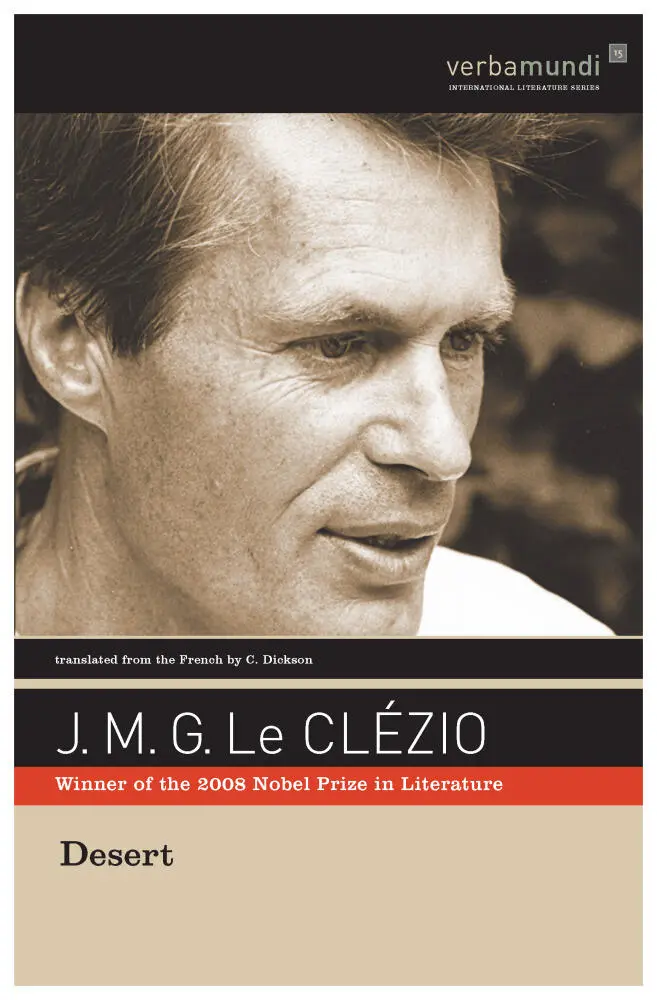
- Название:Desert
- Автор:
- Издательство:Verba Mundi Books
- Жанр:
- Год:2009
- Город:Jaffrey
- ISBN:978-1-56792-386-5
- Рейтинг книги:5 / 5. Голосов: 1
-
Избранное:Добавить в избранное
- Отзывы:
-
Ваша оценка:
Desert: краткое содержание, описание и аннотация
Предлагаем к чтению аннотацию, описание, краткое содержание или предисловие (зависит от того, что написал сам автор книги «Desert»). Если вы не нашли необходимую информацию о книге — напишите в комментариях, мы постараемся отыскать её.
Available for the first time in English translation, Desert is a novel composed of two alternating narratives, set in counterpoint. The first takes place in the desert between 1909 and 1912 and evokes the migration of a young adolescent boy, Nour, and his people, the Blue Men, notorious warriors of the desert. Driven from their lands by French colonial soldiers, Nour's tribe has come to the valley of the Saguiet El Hamra to seek the aid of the great spiritual leader known as Water of the Eyes. The religious chief sends them out from the holy city of Smara into the desert to travel still further. Spurred on by thirst, hunger, and suffering, Nour's tribe and others flee northward in the hopes of finding a land that can harbor them at last.
The second narrative relates the contemporary story of Lalla, a descendant of the Blue Men. Though she is an orphan living in a shantytown known as the Project near a coastal city in Morocco, the blood of her proud, obstinate tribe runs in her veins. All too soon, Lalla must flee to escape a forced marriage with an older, wealthy man. She travels to France, undergoing many trials there, from working as a hotel maid to becoming a highly-paid fashion model, and yet she never betrays the blood of her ancestors.
Desert — читать онлайн бесплатно полную книгу (весь текст) целиком
Ниже представлен текст книги, разбитый по страницам. Система сохранения места последней прочитанной страницы, позволяет с удобством читать онлайн бесплатно книгу «Desert», без необходимости каждый раз заново искать на чём Вы остановились. Поставьте закладку, и сможете в любой момент перейти на страницу, на которой закончили чтение.
Интервал:
Закладка:
Even the days are longer, it’s hard to understand, but from the moment the sun rises until dusk, you’d think a whole month had gone by.
Lalla likes fasting in that way, when the sun burns down and dryness sweeps over everything. The gray dust leaves the taste of stone in your mouth, and from time to time you have to suck on the little lemon-flavored herbs or the bitter chiba leaves, being very careful to spit out your saliva.
During the fasting period, Lalla goes to see the Hartani up in the rocky hills every day. He too goes without eating or drinking all day long, but it doesn’t change anything about the way he is, and his face is always the same burnt color. His eyes shine brightly in the shadow of his face, his teeth gleam in his smile. The only difference is that he covers himself up completely in his homespun robe, to prevent water loss from his body. He stands there on one leg like that, motionless in the sun, the other foot resting on his calf just under the knee, and he gazes out into the distance, over where the reflections are dancing in the air, over in the direction of the herd of goats and sheep.
Lalla sits down beside him on a flat stone, she listens to the sounds coming from all sides of the mountain, the insect calls, the whistling of the shepherds, and also the cracking sounds made by the heat dilating the stones and the wind passing. She’s in no hurry, because during the fast, she doesn’t have to go fetch water or dead wood for cooking.
It’s great to be in the midst of all of this dryness when you’re fasting because it is as if an intense feeling of suffering were stretched tight everywhere, like an insistent gaze. At night, the moon appears on the edge of the rocky hills, completely round, dilated. Then Aamma serves the chickpea soup with bread, and everyone eats quickly; even Selim, Aamma’s husband, who is called the Soussi, eats hurriedly, without putting olive oil on his bread like he usually does. No one says a word, there are no stories. Lalla would rather like to talk, she’d have so many things to say, a little feverishly, but she knows that it’s not possible, for one mustn’t break the silence of the fast. That’s the way it is when you fast, you also fast with words and with your whole head. And you walk slowly, dragging your feet a bit, and you don’t point at things or people with your finger, you don’t whistle with your mouth.
Sometimes the children forget that they’re fasting because it’s difficult to control yourself all the time. Then they burst out laughing, or they take off running through the streets, kicking up clouds of dust and making all the dogs start barking. But the old ladies shout after them and throw stones, and they soon stop running, maybe it’s also because they lack strength due to the fast.
It all lasts for so long that Lalla doesn’t really remember anymore what it was like before the fast began. Then one day Aamma goes off toward the hills to buy a sheep, and everyone knows that the day is drawing near. Aamma goes alone, because she says that Selim the Soussi is incapable of buying anything worthwhile. She walks away along the narrow path that snakes up toward the rocky hills, where the shepherds live. Lalla and the children follow her at a distance. When she reaches the hills, Lalla looks around to see if the Hartani is there, but she knows very well it’s no use: the shepherd doesn’t like people, and he flees when inhabitants of the Project come to buy sheep. The Hartani’s adopted parents shear the sheep. They have built a corral of branches stuck into the ground, and they are sitting in the shade waiting.
Other sheep traders are there, and shepherds too. A strange odor of animal fat and urine hangs over the dry earth, and the sharp bleating of imprisoned animals can be heard coming from the pens of branches. A lot of people have come from the Project, even some from the towns; they left their cars at the entrance to the Project where the road ends and followed the path on foot. They’re people from the North, with yellow skin, gentlemen dressed in suits, or else peasants from the South, Soussis, Fassis, people from Mogador. They know there are a lot of shepherds in the area, sometimes they know relatives or friends and hope to get a fine animal for a good price, clinch a good deal. So they are standing by the pens, haggling, making motions with their hands, leaning over the fences to get a better look at the sheep.
Aamma walks deliberately through the market. She doesn’t stop, she just walks around the pens, looking rapidly at the animals, but she sees immediately what they’re worth. When she’s looked in all the pens, it’s obvious she’s chosen the sheep she wants. So then she goes to see the trader and asks his price. And since she wants that particular sheep and no other, she barely even haggles over the price and gives the owner his money right away. She was careful to bring a rope, and one of the shepherds puts it around the sheep’s neck. That’s it, now all that needs to be done is to bring the sheep back home. Aamma’s eldest son, the one who is called Bareki, has the honor of leading the sheep back. It’s a big strong sheep with a dirty yellow fleece that smells strongly of urine, but Lalla feels a little sorry for the sheep when it goes by, head hanging and eyes frightened because the boy is pulling with all his might on the rope and strangling it. Then they tie the sheep up behind Aamma’s house in a shed of old boards made especially for it, and they give the sheep as much food and water as it wants for the last few days of its life.
So then one fine morning when Lalla wakes up, she knows immediately it’s feast day. She knows it without needing anyone to tell her, just opening her eyes and seeing the cast of the light. She is on her feet in a second, out in the street with the other children, and already the rumor of the feast is beginning to run through the air, to rise over the houses of planks and tarpaper, like the sound of birds.
Lalla runs over the cold earth as fast as she can; she crosses fields, runs along the narrow path that leads to the sea. When she arrives at the top of the dunes, the sea wind hits her all at once, so hard that her nostrils close up, and she stumbles backward. The sea is dark and brutal, but the sky is still such a soft, light gray that Lalla isn’t afraid anymore. She undresses quickly and, without hesitating, dives headfirst into the water. The unfurling wave covers her, rushes against her eyelids and eardrums, into her nostrils. The saltwater fills her mouth, runs down her throat. But on this day, Lalla isn’t afraid of the sea; she drinks in large gulps of the saltwater and comes out of the wave staggering, as if drunk, blinded with the salt. Then she goes back into the wave that swells up around her.
Just then, the all-white seagull Lalla likes so much passes slowly overhead, mewing softly. Lalla waves at it, and she shouts out names at random to make it come:
“Hey! Kalla! Illa! Zemzar! Horriya! Habib! Cherara! Haïm…”
When she shouts that last name, the gull cocks its head and looks at her, and starts circling over the young girl.
“Haïm! Haïm!” shouts Lalla again, and now she’s sure it’s the name of the seafarer who was once lost at sea, because it’s a name that means the Wanderer.
“Haïm! Haïm! Come here, please!”
But the white gull circles over once more and then flies away on the wind, down the beach, over to the place the other gulls gather every morning before taking flight for the city dump.
Lalla shivers a little because she’s just this minute felt the chill of the wind and sea. The sun will soon be up. The pink and yellow flush is nascent behind the rocky hills where the Hartani lives. The light makes the drops of water on Lalla’s skin sparkle, because she has goose bumps. The wind is blowing hard, and the sand has almost completely covered Lalla’s blue dress. Without waiting to dry, she gets dressed and goes off half running, half walking, toward the Project.
Читать дальшеИнтервал:
Закладка:
Похожие книги на «Desert»
Представляем Вашему вниманию похожие книги на «Desert» списком для выбора. Мы отобрали схожую по названию и смыслу литературу в надежде предоставить читателям больше вариантов отыскать новые, интересные, ещё непрочитанные произведения.







Обсуждение, отзывы о книге «Desert» и просто собственные мнения читателей. Оставьте ваши комментарии, напишите, что Вы думаете о произведении, его смысле или главных героях. Укажите что конкретно понравилось, а что нет, и почему Вы так считаете.