J.M. le Clézio - Desert
Здесь есть возможность читать онлайн «J.M. le Clézio - Desert» весь текст электронной книги совершенно бесплатно (целиком полную версию без сокращений). В некоторых случаях можно слушать аудио, скачать через торрент в формате fb2 и присутствует краткое содержание. Город: Jaffrey, Год выпуска: 2009, ISBN: 2009, Издательство: Verba Mundi Books, Жанр: Современная проза, на английском языке. Описание произведения, (предисловие) а так же отзывы посетителей доступны на портале библиотеки ЛибКат.
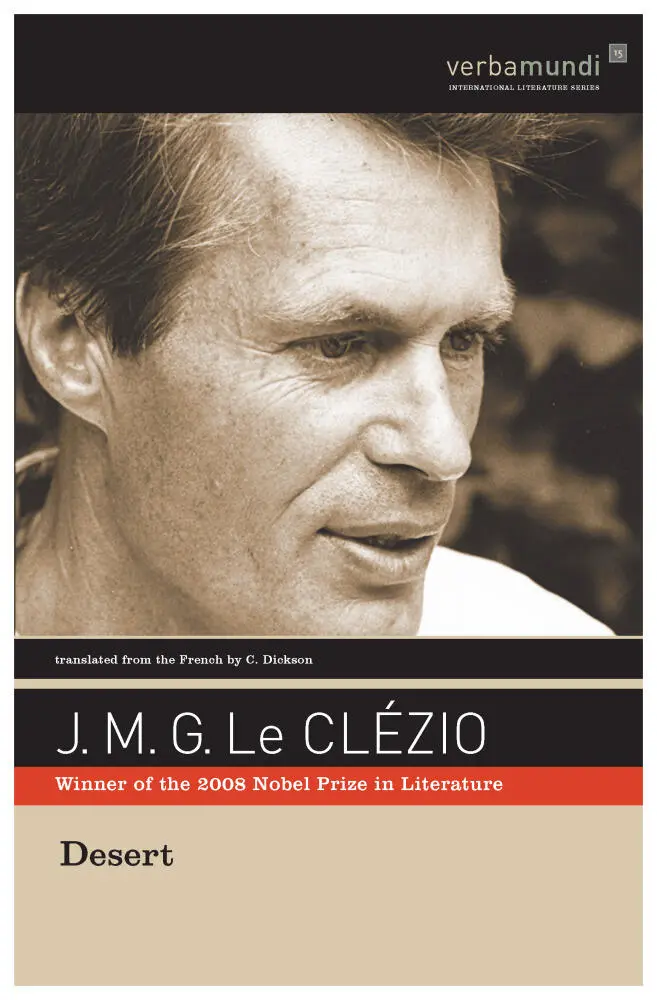
- Название:Desert
- Автор:
- Издательство:Verba Mundi Books
- Жанр:
- Год:2009
- Город:Jaffrey
- ISBN:978-1-56792-386-5
- Рейтинг книги:5 / 5. Голосов: 1
-
Избранное:Добавить в избранное
- Отзывы:
-
Ваша оценка:
Desert: краткое содержание, описание и аннотация
Предлагаем к чтению аннотацию, описание, краткое содержание или предисловие (зависит от того, что написал сам автор книги «Desert»). Если вы не нашли необходимую информацию о книге — напишите в комментариях, мы постараемся отыскать её.
Available for the first time in English translation, Desert is a novel composed of two alternating narratives, set in counterpoint. The first takes place in the desert between 1909 and 1912 and evokes the migration of a young adolescent boy, Nour, and his people, the Blue Men, notorious warriors of the desert. Driven from their lands by French colonial soldiers, Nour's tribe has come to the valley of the Saguiet El Hamra to seek the aid of the great spiritual leader known as Water of the Eyes. The religious chief sends them out from the holy city of Smara into the desert to travel still further. Spurred on by thirst, hunger, and suffering, Nour's tribe and others flee northward in the hopes of finding a land that can harbor them at last.
The second narrative relates the contemporary story of Lalla, a descendant of the Blue Men. Though she is an orphan living in a shantytown known as the Project near a coastal city in Morocco, the blood of her proud, obstinate tribe runs in her veins. All too soon, Lalla must flee to escape a forced marriage with an older, wealthy man. She travels to France, undergoing many trials there, from working as a hotel maid to becoming a highly-paid fashion model, and yet she never betrays the blood of her ancestors.
Desert — читать онлайн бесплатно полную книгу (весь текст) целиком
Ниже представлен текст книги, разбитый по страницам. Система сохранения места последней прочитанной страницы, позволяет с удобством читать онлайн бесплатно книгу «Desert», без необходимости каждый раз заново искать на чём Вы остановились. Поставьте закладку, и сможете в любой момент перейти на страницу, на которой закончили чтение.
Интервал:
Закладка:
The bathhouse is a large brick hangar built right beside the river. This is where Aamma brought Lalla when she first arrived in the Project, and Lalla had never seen anything like it. There is but one large room with tubs of hot water and ovens where the stones are heated. It’s open one day for women, the next day for men. Lalla really likes this room because a lot of light comes through the windows set up high in the walls under the corrugated iron roof. The bathhouse is only open in summer because water is scarce here. The water comes from a large tank, built on a rise, and it runs down an open-air conduit to the bathhouse, where it cascades into a large cement pool that looks like a washtub. That’s where Aamma and Lalla go to bathe later, after the hot tub, pouring large jugs of cold water over their bodies and letting out little gasps because it makes them shiver.
There is something else that Lalla also really likes about this place. It’s the steam that fills up the whole room like white fog, piling up in layers all the way to the ceiling and escaping through the windows, making the light fluctuate. When you first walk into the room, you feel as if you’re suffocating for a minute, because of the steam. Then you take off your clothes and leave them folded on a chair, at the back of the hangar. The first few times, Lalla was embarrassed; she didn’t want to undress herself in front of the other women, because she wasn’t used to baths. She thought the others were making fun of her because she didn’t have any breasts and her skin was very white. But Aamma scolded her and made her take off all of her clothes; then she tied her long hair up in a bun, wrapping a strip of canvas around it. Now she doesn’t mind getting undressed. She doesn’t even pay any attention to the others anymore. At first, she thought it was horrid because there were very ugly and very old women, with skin wrinkled up like dead trees, or else fat fleshy ones, with breasts dangling down like waterskins, or still others who were sick, their legs covered with ulcers and varicose veins. But now Lalla doesn’t see them in the same way any longer. She pities the ugly and sick women; she’s not afraid of them anymore. And also, the water is so beautiful, so pure, the water that has fallen straight from the sky into the large tank, the water is so new that it must certainly heal the ill.
That’s the way it is when Lalla enters the tub water for the first time after the long months of the dry season: it envelops her body all at once, closing so tightly over her skin, over her legs, over her belly, over her chest, that Lalla momentarily loses her breath.
The water is very hot, very heavy; it brings the blood to the surface of the skin, dilates the pores, sends its waves of heat deep into the body, as if it had taken on the force of the sun and the sky. Lalla slides down into the bathtub until the scalding water comes up over her chin and touches her lips, then stops just under her nostrils. Afterward, she remains like that for a long time without moving, gazing up at the corrugated roof that seems to be swaying under the trails of steam.
Then Aamma comes with a handful of soapwort and some pumice powder, and she scrubs Lalla’s body to get the sweat and the dust off, scrubs her on the back, the shoulders, the legs. Lalla docilely submits, because Aamma is very good at soaping and scrubbing down; afterward she goes over to the washtub, and she submerges herself in the cool, almost cold water, and it closes up her pores, smooths her skin, tightens her nerves and muscles. This is the bath she takes with the other women, listening to the sound of the waterfall coming from the tank; this is the water Lalla prefers. It is clear like the water from the mountain springs, it is light, it slips over her clean skin like over a worn stone, it leaps up into the light, splashing back up in thousands of drops. Under the waterspout, the women wash their long heavy hair. Even the ugliest bodies grow beautiful through the crystal-clear water; the cold raises voices, makes shrill laughter ring out. Aamma throws huge armfuls at Lalla’s face, and her extremely white teeth gleam in her copper face. The sparkling drops roll slowly down her dark breasts, her abdomen, her thighs. The water wears and polishes your skin, makes the palms of your hands very soft. It’s cold, despite the steam filling the hangar.
Aamma envelops Lalla in a large towel, she wraps a sort of cloth around herself that she knots on her breast. Together, they walk toward the back of the hangar where their clothes were left folded on chairs. They sit down, and Aamma starts to slowly comb out Lalla’s hair, one strand at a time, preening each of them carefully between the fingers of her left hand, to extract the nits.
That’s great too, like in a dream, because Lalla is gazing straight out ahead, not thinking of anything, exhausted from all the water, drowsy from the heavy steam struggling up to the windows where the sunlight wavers, numbed from the noise of the voices and the laughter of the women, from the splashing water, the humming of the ovens where the stones are heating. So she is sitting on the metal chair, her bare feet resting on the cool cement floor, shivering in her large wet towel, and Aamma’s adroit hands are combing tirelessly through her hair, pulling it out, preening it, while the last drops of water run down her cheeks and along her back.
Then, when everything is finished, and they’ve put their clothes back on, they go and sit down together outside, in the warmth of the setting sun, and they drink mint tea in small glasses decorated with gold designs, almost without speaking to one another, as if they had been on a long journey and had had their fill of the world’s marvels. It’s a long road back to the Project of planks and tarpaper on the other side of the river. The night is already blue-black, and the stars are shimmering between the clouds when they get home.
THERE ARE DAYS that aren’t like all the others — feast days — and those are the days you sort of live for, wait for, hope for. When the day is near, no one speaks of anything else in the streets of the Project, in the houses, over by the fountain. Everyone is impatient and wants the feast day to come faster. Sometimes Lalla wakes up in the morning, her heart thumping, with a strange tingling in her arms and legs, because she thinks that today is the day. She jumps out of bed without even taking the time to run her hands through her hair and goes out into the street to run through the cold morning air, while the sun hasn’t yet appeared and, except for a few birds, everything is gray and silent. But since there isn’t a soul stirring in the Project, she realizes the day hasn’t come yet, and all she can do is go back and get under her blankets again, unless she decides to make the most of it and go sit in the dunes to watch the first rays of sunlight touching the crests of the waves.
One thing that is long, and slow, that makes impatience seethe deep in the bodies of men and women, is fasting. Because throughout the days leading up to the feast, people eat very little, only just before and just after daylight, and they don’t drink anything either. So, as time goes by, there is a kind of emptiness that spreads inside your body, that burns, that makes a buzzing sound in your ears. Even so, Lalla likes to fast, because when you don’t eat or drink for hours on end, days on end, it’s as if the inside of your body is being cleansed. The hours seem longer, and fuller, because you pay attention to the slightest little things. The children stop going to school, the women stop working in the fields, the boys stop going to the town. Everyone sits around in the shade of the shacks and the trees, conversing a little and watching the shadows move with the sun.
When you haven’t eaten for days, the sky seems cleaner too, bluer and smoother over the white earth. Sounds ring out louder, and longer, as if you were inside a cave, and the light seems lovelier, purer.
Читать дальшеИнтервал:
Закладка:
Похожие книги на «Desert»
Представляем Вашему вниманию похожие книги на «Desert» списком для выбора. Мы отобрали схожую по названию и смыслу литературу в надежде предоставить читателям больше вариантов отыскать новые, интересные, ещё непрочитанные произведения.











Обсуждение, отзывы о книге «Desert» и просто собственные мнения читателей. Оставьте ваши комментарии, напишите, что Вы думаете о произведении, его смысле или главных героях. Укажите что конкретно понравилось, а что нет, и почему Вы так считаете.