J.M. le Clézio - Desert
Здесь есть возможность читать онлайн «J.M. le Clézio - Desert» весь текст электронной книги совершенно бесплатно (целиком полную версию без сокращений). В некоторых случаях можно слушать аудио, скачать через торрент в формате fb2 и присутствует краткое содержание. Город: Jaffrey, Год выпуска: 2009, ISBN: 2009, Издательство: Verba Mundi Books, Жанр: Современная проза, на английском языке. Описание произведения, (предисловие) а так же отзывы посетителей доступны на портале библиотеки ЛибКат.
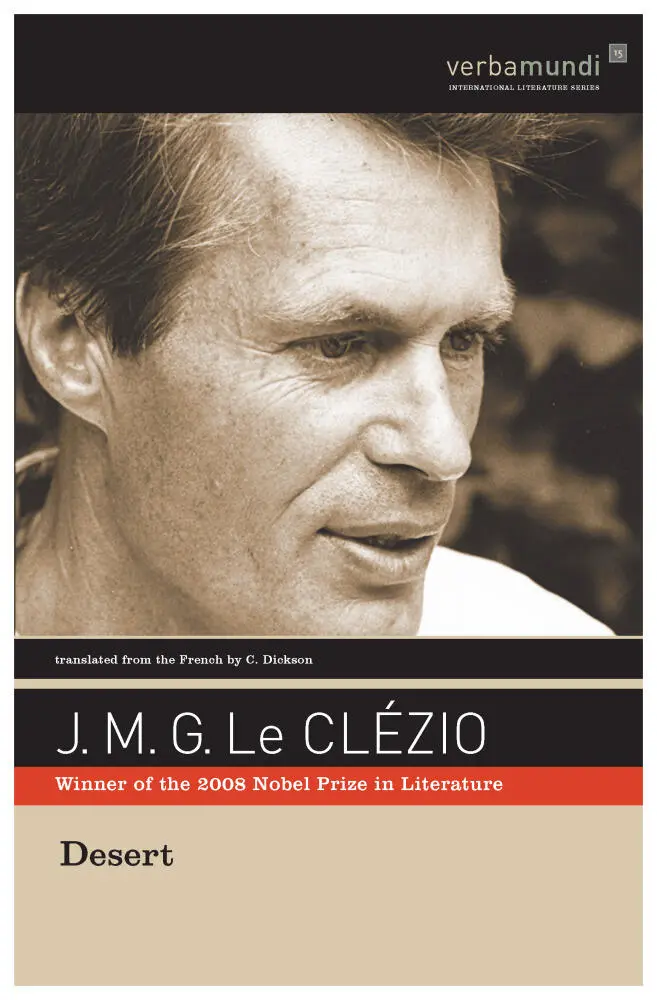
- Название:Desert
- Автор:
- Издательство:Verba Mundi Books
- Жанр:
- Год:2009
- Город:Jaffrey
- ISBN:978-1-56792-386-5
- Рейтинг книги:5 / 5. Голосов: 1
-
Избранное:Добавить в избранное
- Отзывы:
-
Ваша оценка:
Desert: краткое содержание, описание и аннотация
Предлагаем к чтению аннотацию, описание, краткое содержание или предисловие (зависит от того, что написал сам автор книги «Desert»). Если вы не нашли необходимую информацию о книге — напишите в комментариях, мы постараемся отыскать её.
Available for the first time in English translation, Desert is a novel composed of two alternating narratives, set in counterpoint. The first takes place in the desert between 1909 and 1912 and evokes the migration of a young adolescent boy, Nour, and his people, the Blue Men, notorious warriors of the desert. Driven from their lands by French colonial soldiers, Nour's tribe has come to the valley of the Saguiet El Hamra to seek the aid of the great spiritual leader known as Water of the Eyes. The religious chief sends them out from the holy city of Smara into the desert to travel still further. Spurred on by thirst, hunger, and suffering, Nour's tribe and others flee northward in the hopes of finding a land that can harbor them at last.
The second narrative relates the contemporary story of Lalla, a descendant of the Blue Men. Though she is an orphan living in a shantytown known as the Project near a coastal city in Morocco, the blood of her proud, obstinate tribe runs in her veins. All too soon, Lalla must flee to escape a forced marriage with an older, wealthy man. She travels to France, undergoing many trials there, from working as a hotel maid to becoming a highly-paid fashion model, and yet she never betrays the blood of her ancestors.
Desert — читать онлайн бесплатно полную книгу (весь текст) целиком
Ниже представлен текст книги, разбитый по страницам. Система сохранения места последней прочитанной страницы, позволяет с удобством читать онлайн бесплатно книгу «Desert», без необходимости каждый раз заново искать на чём Вы остановились. Поставьте закладку, и сможете в любой момент перейти на страницу, на которой закончили чтение.
Интервал:
Закладка:
Old Naman has a very particular, long, drawn-out way of saying Mlaaoune — damned by God — that makes the children shudder. He stops for a moment to use up the rest of the pitch in the pot. Then he hands it to Lalla without saying a word, and she has to run over to the fire to fill it with boiling pitch. Thankfully, he waits for her to come back before continuing the story.
“Then the Egyptian said to the emir, ‘Did you not once punish a man for stealing gold from a merchant?’
“‘Yes, I did,’ said the emir, ‘because he was a thief.’
“‘Know that the man was innocent,’ said the Egyptian, ‘and falsely accused, and that he has put a curse on you. It is he who sent the drought, for he is the ally of spirits and demons.’”
When evening comes like this out on the beach, while you’re listening to Old Naman’s deep voice, it’s sort of as if time no longer existed, or as if it had been turned back, to another very long and very gentle time, and Lalla wishes Naman’s story would never end, even if it had to last for days and nights, and she and the other children would fall asleep, and when they awakened, they would still be there listening to Naman’s voice.
“‘What must be done to stop this curse?’ asked the emir. The Egyptian looked him straight in the eyes: ‘You must realize there is but one remedy, and I will tell you what it is since you have asked me to reveal it to you. You must sacrifice your only daughter, she whom you love more than anything in the world. Go, leave her to be eaten by the wild beasts of the forest, and the drought which has stricken your land will cease.’
“Then the emir began to weep and to cry out in pain and anger, but as he was a good man, he allowed the Egyptian to leave freely. When the people of the land learned all of this, they also wept, for they dearly loved Leila, the daughter of their king. But the sacrifice had to be made, and the emir decided to take his daughter into the forest to allow her to be eaten by the wild beasts. However, there was one young man in the kingdom who loved Leila more than any of the others, and he was determined to save her. He had inherited from one of his relatives, a magician, a ring that gave the one who possessed it the power to be transformed into an animal. However, once transformed he could never return to his original form, and he would be immortal. The night of the sacrifice came, and the emir went into the forest along with his daughter…”
The air is smooth and pure, the line of the horizon is infinite. Lalla looks out as far as she can see, as if she had been turned into a gull and were flying straight out over the sea.
“The emir reached the middle of the forest; he had his daughter dismount from the horse and tied her to a tree. Then he left her, weeping in sorrow, for the cries of the ferocious beasts could already be heard as they approached their victim…”
At times, the sound of the waves on the beach is more distinct, as if the sea were drawing nearer. But it’s just the wind blowing, and when it coils round in the hollows of the dunes, it sends spurts of sand that shoot up and mix with the smoke.
“In the forest, tied to the tree, poor Leila was trembling with fright, and calling out to her father to save her because she couldn’t bear to die like that, devoured by the wild beasts… Already a large wolf was moving toward her, and she could see his eyes glowing like flames in the night. Then all of a sudden a sweet music broke forth in the forest. It was such beautiful, pure music that Leila was no longer afraid, and all the ferocious beasts of the forest stopped to listen…”
Old Naman’s hands take the brushes, one after the other, and with a slow twirling motion, run them along the hull of the boat. Lalla and the children watch them too, as if the brushes were telling a story.
“The celestial music resounded throughout the forest, and as they listened, the wild beasts lay down on the ground and became as gentle as lambs, for the song that came from the heavens bewildered them, troubled their souls. Leila also listened to the music with delight, and soon her bonds came loose on their own, and she began to walk through the forest, and wherever she went, the invisible musician was above her, hidden in the leaves of the trees. And the wild beasts were lying along the path, and they licked the princess’s hands without causing her the slightest harm….”
The air is so transparent now, the light so soft, that you think you’re in another world.
“Thus Leila came back to her father’s house in the morning, after having walked all night long, and the music followed her all the way to the gates of the palace. When the people saw this, they were very happy because they loved the princess dearly. And no one noticed a little bird flying discreetly from branch to branch. And that very same morning the rain began to fall upon the earth…”
Naman stops painting for a minute; Lalla and the children stare at his copper face in which his green eyes are shining. But no one asks any questions, no one utters a word.
“And the bird Balaabilou sang on in the rain, because he was the one who had saved the life of the princess he loved. And since he could not return to his original form, he came every night to perch on the branch of a tree next to Leila’s window and sing his sweet music to her. It is even said that after her death, the princess was also turned into a bird, and she joined Balaabilou to sing in the forests and gardens with him forevermore.”
When the story is finished, Naman says nothing more; he continues working on his boat, running his pitch paintbrushes with a twirling motion along the hull. The light wanes because the sun is slipping over to the other side of the horizon. The sky becomes very yellow, with a hint of green, the hills seem to be cut out of tarpaper. The smoke from the bonfire is thin, light, it can barely be seen against the sunlight, like the smoke of a single cigarette.
The children drift off, one after another. Lalla remains alone with Old Naman. He finishes his work without saying anything. Then he goes off as well, walking slowly along the beach, carrying his paintbrushes and his pot of pitch. Then the only thing left next to Lalla is the dying fire. Darkness quickly reaches deep into the sky, all of the intense blue of day is gradually turning into the black of night. The sea grows calm at this particular time, no one knows why. The waves fall very lazily on the sandy beach, extending their skirts of purple foam. The first bats begin to zigzag over the sea in search of insects. There are a few mosquitoes, a few gray moths that have lost their way. Lalla listens to the muffled cry of the nighthawk in the distance. All that is left of the fire are a few red embers still burning with no flame or smoke, like strange throbbing beasts hidden amidst the ashes. When the last ember goes out, after having flared for just a few seconds, like a dying star, Lalla rises to her feet and walks away.
THERE ARE TRACKS almost everywhere in the dust of the old paths, and Lalla plays at following them. Sometimes they don’t lead anywhere, when they’re bird or insect tracks. Sometimes they lead you to a hole in the ground, or else to the door of a house. It was the Hartani who had shown her how to follow the tracks without getting thrown off by the surroundings, the grass, the flowers, or the shiny stones. When the Hartani is following a track, he’s exactly like a dog. His eyes gleam, his nostrils flare, his whole body tenses and leans forward. Sometimes he even lies down on the ground to better smell the trail.
Lalla really likes the paths around the dunes. She remembers the first few days after arriving in the Project, after her mother had died from the fevers. She remembers her journey in the tarp-covered truck, and her father’s sister, the one named Aamma, being wrapped up in the large, gray, woolen cloak, with her face covered because of the desert dust. The journey had lasted several days, and every day Lalla had sat at the back of the truck under the stifling tarp, amidst dusty bags and bundles. Then one day, through the opening in the tarp, she had seen the deep blue sea stretching down the length of foam-fringed beach, and she’d started to cry, without knowing if it was from joy or fatigue.
Читать дальшеИнтервал:
Закладка:
Похожие книги на «Desert»
Представляем Вашему вниманию похожие книги на «Desert» списком для выбора. Мы отобрали схожую по названию и смыслу литературу в надежде предоставить читателям больше вариантов отыскать новые, интересные, ещё непрочитанные произведения.











Обсуждение, отзывы о книге «Desert» и просто собственные мнения читателей. Оставьте ваши комментарии, напишите, что Вы думаете о произведении, его смысле или главных героях. Укажите что конкретно понравилось, а что нет, и почему Вы так считаете.