J.M. le Clézio - Desert
Здесь есть возможность читать онлайн «J.M. le Clézio - Desert» весь текст электронной книги совершенно бесплатно (целиком полную версию без сокращений). В некоторых случаях можно слушать аудио, скачать через торрент в формате fb2 и присутствует краткое содержание. Город: Jaffrey, Год выпуска: 2009, ISBN: 2009, Издательство: Verba Mundi Books, Жанр: Современная проза, на английском языке. Описание произведения, (предисловие) а так же отзывы посетителей доступны на портале библиотеки ЛибКат.
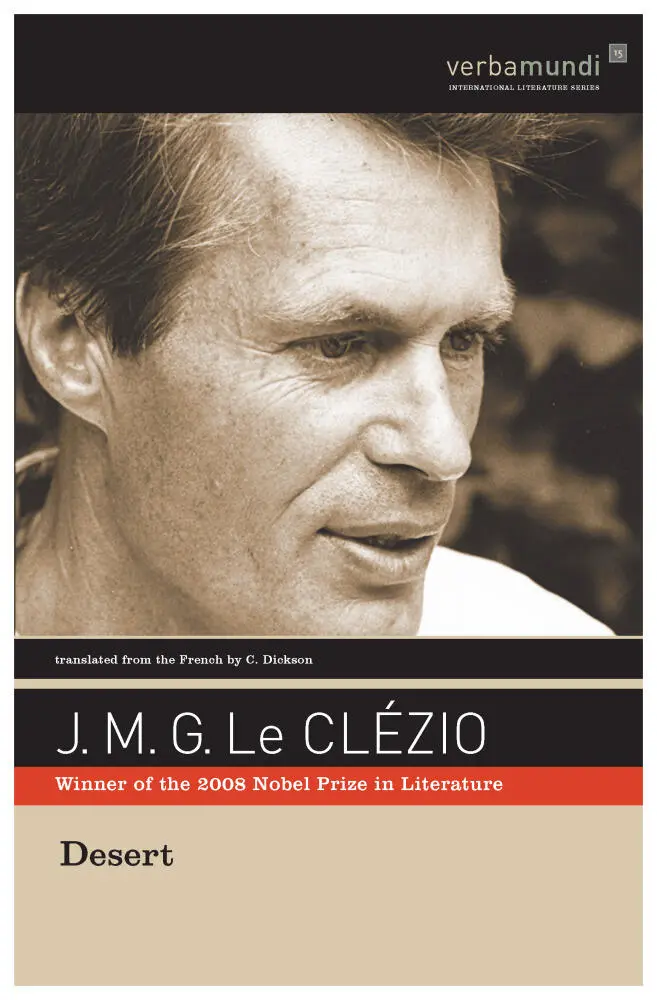
- Название:Desert
- Автор:
- Издательство:Verba Mundi Books
- Жанр:
- Год:2009
- Город:Jaffrey
- ISBN:978-1-56792-386-5
- Рейтинг книги:5 / 5. Голосов: 1
-
Избранное:Добавить в избранное
- Отзывы:
-
Ваша оценка:
Desert: краткое содержание, описание и аннотация
Предлагаем к чтению аннотацию, описание, краткое содержание или предисловие (зависит от того, что написал сам автор книги «Desert»). Если вы не нашли необходимую информацию о книге — напишите в комментариях, мы постараемся отыскать её.
Available for the first time in English translation, Desert is a novel composed of two alternating narratives, set in counterpoint. The first takes place in the desert between 1909 and 1912 and evokes the migration of a young adolescent boy, Nour, and his people, the Blue Men, notorious warriors of the desert. Driven from their lands by French colonial soldiers, Nour's tribe has come to the valley of the Saguiet El Hamra to seek the aid of the great spiritual leader known as Water of the Eyes. The religious chief sends them out from the holy city of Smara into the desert to travel still further. Spurred on by thirst, hunger, and suffering, Nour's tribe and others flee northward in the hopes of finding a land that can harbor them at last.
The second narrative relates the contemporary story of Lalla, a descendant of the Blue Men. Though she is an orphan living in a shantytown known as the Project near a coastal city in Morocco, the blood of her proud, obstinate tribe runs in her veins. All too soon, Lalla must flee to escape a forced marriage with an older, wealthy man. She travels to France, undergoing many trials there, from working as a hotel maid to becoming a highly-paid fashion model, and yet she never betrays the blood of her ancestors.
Desert — читать онлайн бесплатно полную книгу (весь текст) целиком
Ниже представлен текст книги, разбитый по страницам. Система сохранения места последней прочитанной страницы, позволяет с удобством читать онлайн бесплатно книгу «Desert», без необходимости каждый раз заново искать на чём Вы остановились. Поставьте закладку, и сможете в любой момент перейти на страницу, на которой закончили чтение.
Интервал:
Закладка:
The most beautiful thing when the Hartani is talking in this way is that nothing disturbs the silence. The sun burns down on the plateau of stones, on the red cliffs. The wind blows at times, slightly chilly, or you can hear the faint swish of sand running down the grooves in the rocks. With his long hands and agile fingers, the Hartani makes a snake slipping along the bottom of a ravine appear, then it stops, head uplifted. That’s when a large white ibis takes flight, flapping its wings. In the night sky, the moon is round, and with his index finger the Hartani lights up the stars, one, one more, still another… In summer, the rain begins to fall; the water runs into the streams, filling out a round pond where mosquitoes hover. Straight into the center of the blue sky, the Hartani throws a triangular stone that rises, rises, and — whish! — it suddenly opens and turns into a tree with infinite foliage filled with birds.
Sometimes the Hartani uses his face to imitate people or animals. He can do the turtle really well, squinching up his lips, head down between his shoulders, back rounded. It makes Lalla laugh every time. Just like the first time. Or sometimes he does the camel, lips pushed out in front, front teeth bared. He also does a very good job of imitating the heroes he’s seen in the movies. Tarzan, or Maciste, and all of the comic book characters.
Every now and again, Lalla brings him pocket-sized comics that she takes from Aamma’s eldest son or that she buys with her savings. There are the stories of Akim, of Roch Rafal, stories that are set on the moon or on other planets, and small Mickey Mouse or Donald Duck comic books. She can’t read what’s written, but she has Aamma’s son tell her the story two or three times, and she knows them by heart. But at any rate, the Hartani doesn’t feel like hearing the story. He takes the small books, and he has a strange way of looking at them, holding them diagonally and cocking his head a little to one side. Afterwards, when he’s looked at all the pictures closely, he leaps to his feet and imitates Roch Rafal or Akim on the back of an elephant (a rock plays the part of the elephant).
But Lalla never stays with the Hartani for very long, because there always comes a time when his face seems to close up. She doesn’t really understand what happens when the face of the young shepherd turns sullen and stiff, and there is such a faraway look in his eyes. It’s like when a cloud passes in front of the sun, when the night falls very suddenly on the hills in the valley bottoms. It’s terrible, because Lalla really wants to hold on to the moment the Hartani seemed happy, to his smile, the light that gleamed in his eyes. But it’s impossible. All of a sudden the Hartani is gone, like an animal. He jumps up and disappears in the wink of an eye, without Lalla being able to tell where he’s gone. But she doesn’t try to hold him back anymore. There are even certain days, when there’s been so much light up on the plateau of stones, when the Hartani has been talking with his hands and making so many extraordinary things appear, that Lalla prefers to leave first. She stands up and without running, without looking back, makes her way down to the path that leads to the plank and tarpaper Project. Maybe from having spent so much time with the Hartani, she has grown to be like him now.
As a matter of fact, people don’t like it very much that she goes to see the Hartani so often. Perhaps they’re afraid she’ll become mejnoun too, that she’ll catch the evil spirits that are in the shepherd’s body. Aamma’s eldest son says that the Hartani is a thief, because he has gold in a small leather bag that he wears around his neck. But Lalla knows that’s not true. The Hartani found that gold one day in the bed of a dried-up torrent. He took Lalla by the hand and guided her down to the bottom of the crevice and down there, in the gray sand of the torrent, Lalla had seen the gold dust shining.
“He’s not the right kind of boy for you,” says Aamma when Lalla comes back from the plateau of stones.
Lalla’s face is now just as black as the Hartani’s, because the burning sun is stronger up there.
Sometimes Aamma adds, “After all, you don’t want to marry the Hartani, do you?”
“Why not?” Lalla answers. And she shrugs her shoulders.
She doesn’t want to get married; she never even thinks about it. The idea of getting married to the Hartani makes her start laughing.
Nevertheless, whenever she can, once she’s decided she’s finished her work, Lalla leaves the Project and heads toward the hills where the shepherds are. It’s east of the Project, up where the lands without water, the high cliffs of red stone, begin. She enjoys walking along the very white path that snakes through the hills, listening to the shrill music of the crickets, observing the marks left by snakes in the sand.
A little farther along, she hears the whistling of shepherds. They are mostly young children, boys and girls who are scattered about almost everywhere in the hills with herds of goats and sheep. They whistle like that to call to one another, to talk to one another, to scare off the wild dogs.
Lalla enjoys walking through the hills, eyes squinted tight because of the white light, with all of those whistling sounds echoing out on all sides. It makes her shiver a bit, in spite of the heat; it makes her heart beat faster. Sometimes she plays at answering them. The Hartani showed her how to do that, by putting two fingers in her mouth.
When the young shepherds come to see her on the path, they keep their distance from her at first, because they’re rather wary. They have smooth faces, the color of burnt copper, with rounded foreheads and an odd color of hair, almost red. It’s the desert sun and wind that have burnt their skin and hair. They are ragged, dressed only in long cream-colored canvas shirts, or dresses made from flour sacks. They don’t come close because they speak Chleuh, and they don’t understand the language that the people from the valley speak. But Lalla likes them, and they aren’t afraid of her. Sometimes she brings them things to eat, whatever she was able to sneak out of Aamma’s house, a little bread, some biscuits, dried dates.
Hartani is the only one who can keep them company, because he’s a shepherd like them, and because he doesn’t live with the people from the Project. When Lalla is with him, far out in the middle of the plateau of stones, they approach, jumping from one rock to another, without making a sound. But they whistle every now and again just to let you know. When they arrive, they gather round the Hartani, talking very rapidly in their strange language that makes a sound like birds. Then they leave again very quickly, leaping over the plateau of stones, still whistling, and sometimes the Hartani takes off running along with them, and even Lalla tries to follow them, but she can’t jump as fast as they can. They all laugh real hard when they see her, and they start running again, letting out great bursts of joyful laughter.
They share a meal on the white rocks in the middle of the plateau. Under their shirts, they carry a bit of cloth that contains a little black bread, a few dates, figs, some dried cheese. They give a piece to the Hartani, a piece to Lalla, and in exchange she gives them some of her white bread. Sometimes she brings a red apple that she bought at the Cooperative. The Hartani takes out his little knife with no handle and cuts the apple into slivers so everyone can have a piece.
It’s fine up on the plateau of stones in the afternoon. The sunlight is constantly bouncing off the sharp-edged stones; you’re surrounded with sparkles. The sky is deep blue, dark, without that white haze that comes from the sea and the rivers. When the wind blows hard, you have to sink down into the holes in the rocks to protect yourself from the cold, and then you can hear nothing but the sound of the air whistling over the earth, through the bushes. It makes a sound like the sea, but slower, longer. Lalla listens to the shepherds and the distant bleating of the herds. Those are the sounds she loves most in the world, along with the calls of gulls and the crashing of the waves. They’re sounds as if nothing bad could ever happen on earth.
Читать дальшеИнтервал:
Закладка:
Похожие книги на «Desert»
Представляем Вашему вниманию похожие книги на «Desert» списком для выбора. Мы отобрали схожую по названию и смыслу литературу в надежде предоставить читателям больше вариантов отыскать новые, интересные, ещё непрочитанные произведения.







Обсуждение, отзывы о книге «Desert» и просто собственные мнения читателей. Оставьте ваши комментарии, напишите, что Вы думаете о произведении, его смысле или главных героях. Укажите что конкретно понравилось, а что нет, и почему Вы так считаете.