J.M. le Clézio - Desert
Здесь есть возможность читать онлайн «J.M. le Clézio - Desert» весь текст электронной книги совершенно бесплатно (целиком полную версию без сокращений). В некоторых случаях можно слушать аудио, скачать через торрент в формате fb2 и присутствует краткое содержание. Город: Jaffrey, Год выпуска: 2009, ISBN: 2009, Издательство: Verba Mundi Books, Жанр: Современная проза, на английском языке. Описание произведения, (предисловие) а так же отзывы посетителей доступны на портале библиотеки ЛибКат.
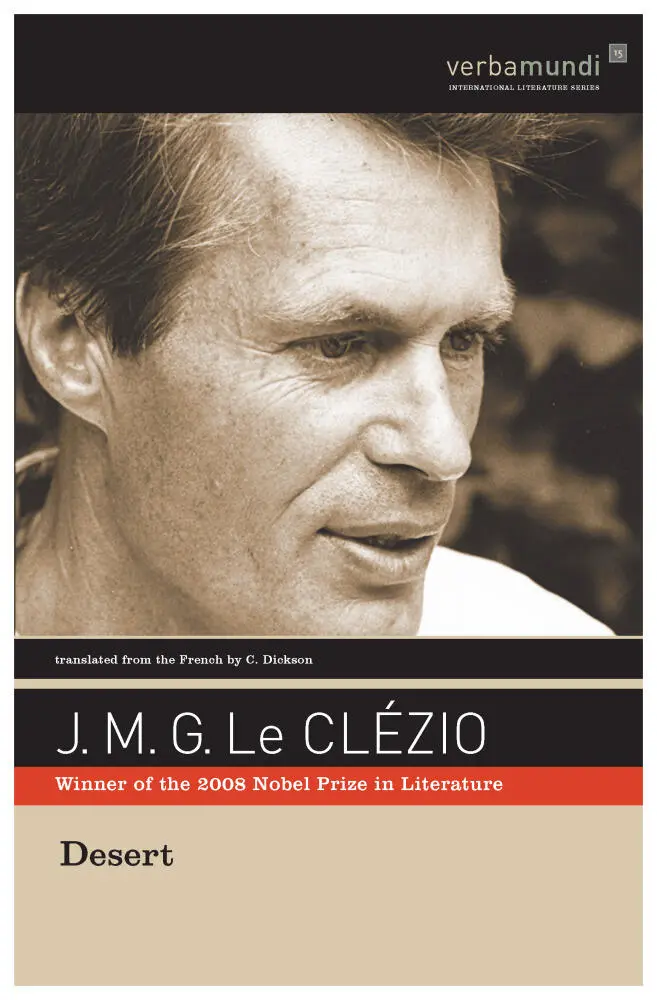
- Название:Desert
- Автор:
- Издательство:Verba Mundi Books
- Жанр:
- Год:2009
- Город:Jaffrey
- ISBN:978-1-56792-386-5
- Рейтинг книги:5 / 5. Голосов: 1
-
Избранное:Добавить в избранное
- Отзывы:
-
Ваша оценка:
Desert: краткое содержание, описание и аннотация
Предлагаем к чтению аннотацию, описание, краткое содержание или предисловие (зависит от того, что написал сам автор книги «Desert»). Если вы не нашли необходимую информацию о книге — напишите в комментариях, мы постараемся отыскать её.
Available for the first time in English translation, Desert is a novel composed of two alternating narratives, set in counterpoint. The first takes place in the desert between 1909 and 1912 and evokes the migration of a young adolescent boy, Nour, and his people, the Blue Men, notorious warriors of the desert. Driven from their lands by French colonial soldiers, Nour's tribe has come to the valley of the Saguiet El Hamra to seek the aid of the great spiritual leader known as Water of the Eyes. The religious chief sends them out from the holy city of Smara into the desert to travel still further. Spurred on by thirst, hunger, and suffering, Nour's tribe and others flee northward in the hopes of finding a land that can harbor them at last.
The second narrative relates the contemporary story of Lalla, a descendant of the Blue Men. Though she is an orphan living in a shantytown known as the Project near a coastal city in Morocco, the blood of her proud, obstinate tribe runs in her veins. All too soon, Lalla must flee to escape a forced marriage with an older, wealthy man. She travels to France, undergoing many trials there, from working as a hotel maid to becoming a highly-paid fashion model, and yet she never betrays the blood of her ancestors.
Desert — читать онлайн бесплатно полную книгу (весь текст) целиком
Ниже представлен текст книги, разбитый по страницам. Система сохранения места последней прочитанной страницы, позволяет с удобством читать онлайн бесплатно книгу «Desert», без необходимости каждый раз заново искать на чём Вы остановились. Поставьте закладку, и сможете в любой момент перейти на страницу, на которой закончили чтение.
Интервал:
Закладка:
“It doesn’t matter, I want to hear you talk about him again, and about the man called Ma al-Aïnine, Water of the Eyes.”
So Aamma stops mashing the dough. She sits on the floor and starts talking, because deep down, she really likes to tell stories.
“I already told you about this, it was long ago, in a time that neither your mother nor I knew, for it was when your mother’s grandmother was a child that the great al-Azraq, he who was called the Blue Man, died, and Ma al-Aïnine was just a young man in those days.”
Lalla knows all of their names well, she’s heard them often since she was a small child, and still, each time she hears them, it gives her a little shiver, as if something deep down inside of her had been stirred.
“Al-Azraq was from the same tribe as your mother’s grandmother, he lived far to the south, beyond the Drâa, even beyond the Saguiet al-Hamra, and in those days, there wasn’t a single foreigner in the land; the Christians weren’t allowed in. In those days, the warriors of the desert were undefeated, and all of the territories south of the Drâa belonged to them, for a very long way, deep into the heart of the desert, all the way down to the holy city of Chinguetti.”
Each time Aamma tells the story of al-Azraq, she adds a new detail, a new sentence, or else she changes something, as if she didn’t want the story to ever finish. Her voice is loud, somewhat singsong, it rings out oddly in the dark house with the sound of the corrugated iron cracking in the sunlight and the humming of wasps.
“He was called al-Azraq because before becoming a saint, he’d been a desert warrior far to the south, in the region of Chinguetti, because he was a nobleman and the son of a sheik. But one day, God called upon him, and he became a saint, he abandoned the blue attire of the desert and dressed himself in a woolen robe like the poor, and he walked barefoot through the land from city to city with a staff as if he were a beggar. But God wanted him to stand out from other beggars, and so God made the skin of his hands and face remain blue, and the color could never be washed away no matter the amount of water he used. The blue color remained on his face and hands, and when the people saw it, despite the worn woolen robe, they understood he wasn’t a beggar, but a true warrior of the desert, a blue man that God had called upon, and that is why they gave him that name. Al-Azraq, the Blue Man…”
As she speaks, Aamma rocks back and forth lightly, as if she were marking the beat to music. Or sometimes she is quiet for a long time, leaning over the large earthenware platter, busily breaking up the dough and bringing it back together again to flatten it out with her closed fists.
Lalla waits, without saying anything, for her to go on.
“No one from back in those days is still alive,” says Aamma. “Everything that is said about him comes from tales, his legend, what can be remembered. But now there are people who don’t want to believe that anymore, who say it’s all lies.”
Aamma hesitates because she’s choosing what she’s going to say carefully.
“Al-Azraq was a great saint,” she says. “He knew how to heal sick people, even those who were sick in their heads, those who had lost their minds. He would live anywhere, in the shacks of shepherds, small sheds of leaves built around the foot of trees, or even in caves high in the mountains. People came from far and wide to see him and ask for his help. One day, an old man brought his son who was blind, and he said, ‘Heal my son, you who have received God’s blessing, heal him and I will give you everything I have.’ And he showed him a bag full of gold that he had brought with him. Al-Azraq said, ‘Of what use can your gold be here?’ and he motioned out toward the desert, without a drop of water, without a piece of fruit. And he took the old man’s gold and threw it on the ground, and the gold turned into scorpions and snakes that fled into the distance, and the old man began to tremble with fear. Then al-Azraq said to the old man, ‘Are you willing to go blind in place of your son?’ The old man answered, ‘I am very old, what use are my eyes to me? Let my son see, and I will be happy.’ Immediately, the young man recovered his sight and was dazzled by the sunlight. But when he saw that his father was blind, he was no longer happy. ‘Give my father his sight back,’ he said, ‘for it was I whom God condemned.’ Then al-Azraq granted them both the gift of sight, because he knew they were good-hearted. And he continued his journey toward the sea and stopped to live in a place just like this, near the dunes by the seaside.”
Aamma remains silent for a moment. Lalla thinks of the dunes, the place where al-Azraq lived, she hears the sound of the wind and the sea.
“The fishermen gave him food every day because they knew that the Blue Man was a saint, and they sought his blessing. Some came from very far away, from the fortified towns in the South; they came to hear him speak. But al-Azraq did not teach the Sunna with words, and when someone came to ask of him, ‘Teach me the Way,’ he simply told his beads for hours without saying anything else. Then he said to the visitor, ‘Go and gather wood for the fire, go and fetch some water,’ as if the visitor were his servant. He would say to him, ‘Fan me,’ and he even spoke to him with harsh words, accusing him of being lazy and lying, as if the visitor were his slave.”
Aamma speaks slowly in the dim house, and Lalla believes she can hear the voice of the Blue Man.
“That’s how he taught the Sunna, not with spoken words, but with gestures and prayers, to force the visitors to become humble in their hearts. But when simple people came, or children, al-Azraq was very kind to them, he said very gentle words to them, he told them marvelous tales, because he knew their hearts were not hardened and that they were truly close to God. They were the ones for whom he sometimes performed miracles, to help them because they had no other recourse.”
Aamma hesitates. “Did I ever tell you about the miracle of the source he made spring up from under a stone?”
“Yes, but tell me again,” says Lalla.
That’s the story she loves most in the whole world. Every time she hears it, she feels something strange, like a feverish chill, moving deep down inside of her, as if she were going to cry. She thinks about how it all happened, very long ago, at the gates to the desert, in a village of mud and palm trees with a large empty square where the wasps hum and the water from the fountain shines in the sun, smooth as a mirror reflecting the clouds in the sky. There’s no one in the village square because the sun is burning down very hard, and all the people have taken shelter in the shade of their homes. From time to time, a slow ruffle of scorched air passes over the still water of the fountain, like an open eye watching the sky, and casts a fine white powder on its surface, forming an imperceptible milky veil that melts quickly away. The water is clear and deep, blue-green, silent, very still in the hollow of red earth in which women’s feet have left glistening prints. Only the wasps come and go over the water, skimming the surface, then turn back toward the houses from which the smoke of the braziers is rising.
“It’s the story of a woman who went to fetch a jug of water at the fountain. No one remembers her name now because it all happened so long ago. But she was a very old woman who had very little strength left, and when she reached the fountain she began to weep and lament because it was such a long way for her to carry the water back home. She remained there, squatting on the ground, weeping and moaning. Then all of a sudden, without her hearing him come, al-Azraq was standing beside her…”
Читать дальшеИнтервал:
Закладка:
Похожие книги на «Desert»
Представляем Вашему вниманию похожие книги на «Desert» списком для выбора. Мы отобрали схожую по названию и смыслу литературу в надежде предоставить читателям больше вариантов отыскать новые, интересные, ещё непрочитанные произведения.










Обсуждение, отзывы о книге «Desert» и просто собственные мнения читателей. Оставьте ваши комментарии, напишите, что Вы думаете о произведении, его смысле или главных героях. Укажите что конкретно понравилось, а что нет, и почему Вы так считаете.