J.M. le Clézio - Desert
Здесь есть возможность читать онлайн «J.M. le Clézio - Desert» весь текст электронной книги совершенно бесплатно (целиком полную версию без сокращений). В некоторых случаях можно слушать аудио, скачать через торрент в формате fb2 и присутствует краткое содержание. Город: Jaffrey, Год выпуска: 2009, ISBN: 2009, Издательство: Verba Mundi Books, Жанр: Современная проза, на английском языке. Описание произведения, (предисловие) а так же отзывы посетителей доступны на портале библиотеки ЛибКат.
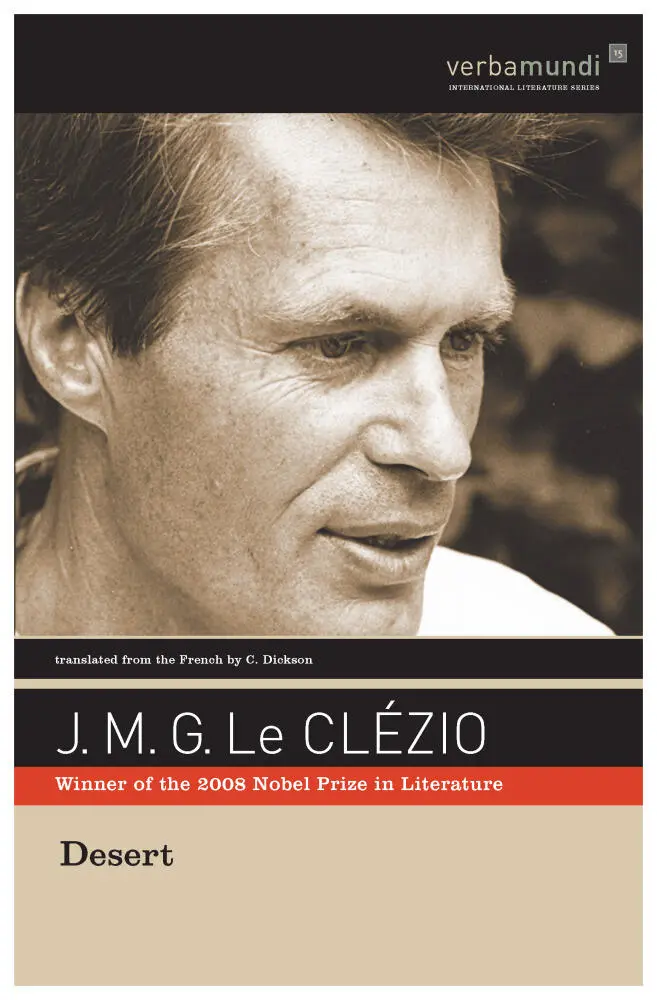
- Название:Desert
- Автор:
- Издательство:Verba Mundi Books
- Жанр:
- Год:2009
- Город:Jaffrey
- ISBN:978-1-56792-386-5
- Рейтинг книги:5 / 5. Голосов: 1
-
Избранное:Добавить в избранное
- Отзывы:
-
Ваша оценка:
Desert: краткое содержание, описание и аннотация
Предлагаем к чтению аннотацию, описание, краткое содержание или предисловие (зависит от того, что написал сам автор книги «Desert»). Если вы не нашли необходимую информацию о книге — напишите в комментариях, мы постараемся отыскать её.
Available for the first time in English translation, Desert is a novel composed of two alternating narratives, set in counterpoint. The first takes place in the desert between 1909 and 1912 and evokes the migration of a young adolescent boy, Nour, and his people, the Blue Men, notorious warriors of the desert. Driven from their lands by French colonial soldiers, Nour's tribe has come to the valley of the Saguiet El Hamra to seek the aid of the great spiritual leader known as Water of the Eyes. The religious chief sends them out from the holy city of Smara into the desert to travel still further. Spurred on by thirst, hunger, and suffering, Nour's tribe and others flee northward in the hopes of finding a land that can harbor them at last.
The second narrative relates the contemporary story of Lalla, a descendant of the Blue Men. Though she is an orphan living in a shantytown known as the Project near a coastal city in Morocco, the blood of her proud, obstinate tribe runs in her veins. All too soon, Lalla must flee to escape a forced marriage with an older, wealthy man. She travels to France, undergoing many trials there, from working as a hotel maid to becoming a highly-paid fashion model, and yet she never betrays the blood of her ancestors.
Desert — читать онлайн бесплатно полную книгу (весь текст) целиком
Ниже представлен текст книги, разбитый по страницам. Система сохранения места последней прочитанной страницы, позволяет с удобством читать онлайн бесплатно книгу «Desert», без необходимости каждый раз заново искать на чём Вы остановились. Поставьте закладку, и сможете в любой момент перейти на страницу, на которой закончили чтение.
Интервал:
Закладка:
“What are you doing with that knife?” Lalla asks.
Feeling tired from her long walk, she sits down on the rock. He remains standing in front of her, balancing on one leg. Then all of a sudden he leaps backward and starts running over the rocky hill. A few minutes later he brings back a handful of reeds that he cut in the swamps. Smiling, he shows them to Lalla. He’s panting a little, like a dog who has run too fast.
“They’re lovely,” says Lalla. “Are they for making music?”
She doesn’t really ask that. She murmurs the words, making gestures with her hands. Every time she speaks, the Hartani stands still and looks at her intently because he’s trying to understand.
Lalla might be the only person he understands and she the only one who understands him. When she says “music,” the Hartani jumps up and down, holding out his long arms as if he were going to dance. He whistles between his teeth so loudly that the goats and their buck startle on the slope of the hill.
Then he takes a few of the cut reeds and joins them between his hands. He blows into them, and it makes a strange, slightly husky music, like the call of nighthawks in the dark, a sad sort of music, like the chant of Chleuh shepherds.
The Hartani plays for a moment without catching his breath. Then he holds out the reeds to Lalla, and she plays in turn, while the young shepherd stands still, his dark eyes bright with pleasure. They continue playing like that, taking turns blowing into the reed tubes of diVerent lengths, and the sad music seems to be stemming from the land, drenched in white light, from the holes of the underground caves, from the sky itself in which the slow wind is stirring.
From time to time they stop, breathless, and the young boy bursts out with his ringing laughter, and Lalla starts laughing too, without knowing why.
Then they walk across the fields of rocks, and the Hartani takes Lalla’s hand, because there are so many sharp rocks that she doesn’t know about between the tufts of brush. They jump over the little drystone walls, zigzagging through the thorn bushes. The Hartani shows Lalla everything there is in the fields of stones and on the slopes of the hills. He knows all the hiding places better than anyone: those of the praying mantises and of leaf insects. He also knows all the plants, the ones that smell good when you crinkle their leaves between your fingers, the ones with roots filled with water, the ones that taste like anise, like pepper, like mint, like honey. He knows which seeds are crunchy, the tiny berries that dye your fingers and lips blue. He even knows the hiding places where you can find small petrified snails, or tiny star-shaped grains of sand. He leads Lalla far away with him, beyond the drystone walls, along paths she doesn’t know, all the way out to the hills from where you can see the beginning of the desert. His eyes shine brightly; the skin on his face is dark and glistening with sweat when he gets to the top of the hills. Then he shows Lalla the way leading southward, toward the place of his birth.
The Hartani isn’t like the other boys. No one really knows where he comes from. Only that one day, a long time ago, a man came riding in on a camel. He was dressed like the warriors of the desert, in a large sky-blue cloak with his face veiled in blue. He stopped at the well to water his camel, and he also took a long drink of the well water. It was Yasmina, the wife of the goat herder, who saw him when she was going to fetch water. She waited, to let the stranger quench his thirst, and when he left again on his camel, she saw that the man had left a very young infant wrapped in a piece of blue cloth at the edge of the well. Since no one wanted him, Yasmina kept the child. She brought him up, and he lived with her family as if he were her son. That child was the Hartani; he was given that nickname because he had black skin like the slaves from the south.
The Hartani grew up in the very spot where the warrior of the desert had left him, near the hills and the fields of stone, right where the desert begins. He was the one who watched over Yasmina’s goats; he became like the other shepherd boys. He knows how to take care of animals; he knows how to lead them where he wants, without hitting them, just whistling between his fingers, for animals are not afraid of him. He also knows how to speak to swarms of bees, simply by whistling a little tune between his teeth, guiding them with his hands. People are a little frightened of the Hartani, they say he’s mejnoun, that he has special powers that come from demons. They say that he knows how to tame snakes and scorpions, that he can send them out to kill other shepherds’ livestock. But Lalla doesn’t believe that; she’s not afraid of him. Maybe she’s the only person who knows him well, because she speaks to him in a diVerent way than with words. She looks at him and reads the light in his black eyes, and he looks deep into her amber eyes; he doesn’t only look at her face, but really deep down into her eyes, and it’s as if he understands what she wants to say to him.
Aamma doesn’t like Lalla going up into the hills and fields of stone to see the shepherd so often. She tells her he’s an abandoned child, a stranger, that he’s not a boy for her. But as soon as Lalla finishes her work at Aamma’s house she runs along the path leading to the hills, and she whistles between her fingers like the shepherds do and shouts,
“Hey-o! Hartani!”
Sometimes she stays up there with him until nightfall. Then the young boy herds his animals together to lead them to the corral lower down, near Yasmina’s house. Often, since they don’t speak to each other, they remain sitting still on the boulders facing the rocky hills. It’s difficult to understand what they’re doing just then. Maybe they’re looking out into the distance as if they could see across the hills, all the way out to the other side of the horizon. Lalla herself doesn’t really understand how that happens, for time doesn’t seem to exist anymore when she’s sitting next to the Hartani. Words flow freely, go out toward the Hartani and come back to her, full of new meaning, like in certain dreams when you’re two people at once.
The Hartani is the one who taught her how to sit still like that, just looking at the sky, the stones, the bushes, looking at the wasps and the flies flying, listening to the song of hidden insects, feeling the shadows of birds of prey and the trembling of hares in the scrub.
Like Lalla, the Hartani doesn’t really have a family, he doesn’t know how to read or write, he doesn’t even know the prayers, he doesn’t know how to speak, and yet he’s the one who knows all those things. Lalla loves his smooth face, his long hands, his dark metallic eyes, his smile, she loves the way he walks, quick and agile as a hare, and the way he leaps from rock to rock, and disappears in the wink of an eye into one of his hiding places.
He never comes into the city. Maybe he’s afraid of the other boys, because he’s not like them. When he goes away, he always heads southward, toward the desert, to the place where the nomads atop their camels have left their tracks. He goes away for several days like that, without anyone knowing where he is. Then one morning he returns and goes back to his post in the field of stones with the she-goats and their buck as if he’d only been gone a few minutes.
When she’s sitting there on a rock like that next to the Hartani, and they’re both looking out at the vast stretch of stones in the sunlight, with the wind blowing from time to time, with the wasps humming over the little gray plants, and the sound of the goats’ hooves slipping on loose stones, there’s really no need for anything else. Lalla can feel the heat deep down inside of her, as if all the light of the sky and the stones were going straight into the very quick of her body, expanding. The Hartani takes Lalla’s hand in his long, brown, slender fingers, he holds it so tight that it almost hurts. Lalla can feel the current of heat pass through the palm of her hand, like an odd, feeble vibration. She doesn’t want to talk or think. She feels so good sitting there that she could stay all day long, right up until night fills the ravines, without moving. She stares straight out ahead, she can see each detail of the stone landscape, each tuft of grass, can hear each snapping sound, each insect call. She can feel the slow movement of the shepherd’s breathing, she is so close to him that she is seeing through his eyes, feeling things with his skin. It lasts a brief instant, but it seems so long that, head spinning, she forgets everything else.
Читать дальшеИнтервал:
Закладка:
Похожие книги на «Desert»
Представляем Вашему вниманию похожие книги на «Desert» списком для выбора. Мы отобрали схожую по названию и смыслу литературу в надежде предоставить читателям больше вариантов отыскать новые, интересные, ещё непрочитанные произведения.










Обсуждение, отзывы о книге «Desert» и просто собственные мнения читателей. Оставьте ваши комментарии, напишите, что Вы думаете о произведении, его смысле или главных героях. Укажите что конкретно понравилось, а что нет, и почему Вы так считаете.