J.M. le Clézio - Desert
Здесь есть возможность читать онлайн «J.M. le Clézio - Desert» весь текст электронной книги совершенно бесплатно (целиком полную версию без сокращений). В некоторых случаях можно слушать аудио, скачать через торрент в формате fb2 и присутствует краткое содержание. Город: Jaffrey, Год выпуска: 2009, ISBN: 2009, Издательство: Verba Mundi Books, Жанр: Современная проза, на английском языке. Описание произведения, (предисловие) а так же отзывы посетителей доступны на портале библиотеки ЛибКат.
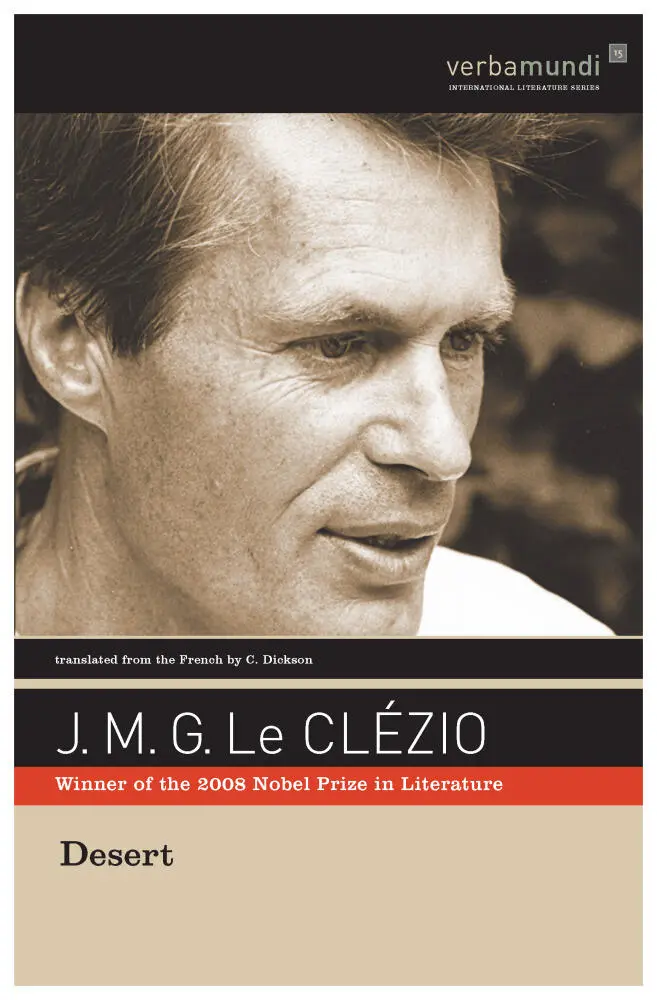
- Название:Desert
- Автор:
- Издательство:Verba Mundi Books
- Жанр:
- Год:2009
- Город:Jaffrey
- ISBN:978-1-56792-386-5
- Рейтинг книги:5 / 5. Голосов: 1
-
Избранное:Добавить в избранное
- Отзывы:
-
Ваша оценка:
Desert: краткое содержание, описание и аннотация
Предлагаем к чтению аннотацию, описание, краткое содержание или предисловие (зависит от того, что написал сам автор книги «Desert»). Если вы не нашли необходимую информацию о книге — напишите в комментариях, мы постараемся отыскать её.
Available for the first time in English translation, Desert is a novel composed of two alternating narratives, set in counterpoint. The first takes place in the desert between 1909 and 1912 and evokes the migration of a young adolescent boy, Nour, and his people, the Blue Men, notorious warriors of the desert. Driven from their lands by French colonial soldiers, Nour's tribe has come to the valley of the Saguiet El Hamra to seek the aid of the great spiritual leader known as Water of the Eyes. The religious chief sends them out from the holy city of Smara into the desert to travel still further. Spurred on by thirst, hunger, and suffering, Nour's tribe and others flee northward in the hopes of finding a land that can harbor them at last.
The second narrative relates the contemporary story of Lalla, a descendant of the Blue Men. Though she is an orphan living in a shantytown known as the Project near a coastal city in Morocco, the blood of her proud, obstinate tribe runs in her veins. All too soon, Lalla must flee to escape a forced marriage with an older, wealthy man. She travels to France, undergoing many trials there, from working as a hotel maid to becoming a highly-paid fashion model, and yet she never betrays the blood of her ancestors.
Desert — читать онлайн бесплатно полную книгу (весь текст) целиком
Ниже представлен текст книги, разбитый по страницам. Система сохранения места последней прочитанной страницы, позволяет с удобством читать онлайн бесплатно книгу «Desert», без необходимости каждый раз заново искать на чём Вы остановились. Поставьте закладку, и сможете в любой момент перейти на страницу, на которой закончили чтение.
Интервал:
Закладка:
But Aamma listens to what he says. It doesn’t matter to her that Naman was a cook over there, and a fisherman here. She asks him diVerent questions each time, in order to hear the story of the journey again, the border, and life in Marseille. Then Naman also talks about street battles in which men attack Arabs and Jews in the dark streets, and you have to defend yourself with a knife, or by throwing stones and running as fast as you can to get away from the police vans that pick people up and take them off to prison. He also talks about the people who cross the borders illegally, in the mountains, walking by night and hiding during the day in caves and in the bushes. But sometimes the police dogs follow their trail and attack them when they come down on the other side of the border.
Naman talks about all of that in a gloomy way, and Lalla can sense a cold shadow pass over the man’s eyes. It’s a strange feeling that she’s not very familiar with, but it’s frightening, threatening, like the passage of death, of malediction. Maybe that was something Old Naman had also brought back from over there, from those cities on the other side of the sea.
When he’s not talking about his travels, Old Naman tells stories he heard long ago. He tells them just for Lalla and for the very young children because they’re the only ones who listen without asking too many questions.
On certain days, he sits down facing the sea in the shade of his fig tree and repairs his nets. That’s when he tells the most beautiful stories, those that take place out on the ocean, on boats, in storms, those in which people are shipwrecked and end up on desert islands. Naman can tell a story about almost anything, that’s what’s so great. For example, Lalla is sitting next to him in the shade of the fig tree and she’s watching him repair his nets. His long brown hands with broken nails work swiftly, know how to tie knots nimbly. At one point there is a big tear in the mesh of the net, and Lalla of course asks, “Did a big fish do that?”
Instead of answering, Naman thinks for a while and says, “I didn’t tell you about the day we caught a shark, did I?”
Lalla shakes her head, and Naman starts a story. As in most of his stories, there is a storm, with lightning flashing from one end of the sky to the other, waves as high as mountains, torrential rain. The net is heavy, so heavy to pull up that the boat is leaning to one side and the men are afraid of capsizing. When the net comes up, they see that a gigantic blue shark is caught in it and is thrashing around and opening its jaws full of terrifying teeth. So the fishermen must fight against the shark that is trying to swim away with the net. They hack at it with gaffs, with hatchets. But the shark bites the edge of the boat and tears it apart as if it were just crate wood. Finally the captain manages to kill the shark with a club, and they hoist the beast onto the deck of the boat.
“Then we cut him open to see what was inside, and we found a golden ring set with a deep-red precious stone that was so beautiful no one could take his eyes from it. Naturally we each wanted the ring for ourselves, and soon everyone was ready to kill one another to possess that cursed ring. That was when I suggested we throw dice for it because the captain had a pair of bone dice. So we played dice on the deck in spite of the raging storm that threatened to turn the boat over at any minute. There were six of us, and we tossed the dice six times, the winner being the one who threw the highest number. After the first round, only the captain and I remained because we had both thrown eleven, six and five. Everyone was pushing close around us to see who would win. I threw, and I got a double six! So I was the one who won the ring, and for a few minutes I was happier than I’d ever been in my life. But I looked at the ring for a long time, and its red stone shone like the fires of hell, with a lurid glimmer, like blood. Then I saw that the eyes of my companions were glowing with that same evil light, and I realized the ring was cursed, as was the person who had worn it and had been eaten by the shark, and I knew that whoever kept the ring would be cursed in turn.
“After I had looked at it well, I took it off my finger and threw it into the sea. The captain and my companions were furious and wanted to throw me into the sea as well. So I asked them, ‘Why are you angry with me? That which came from the sea has returned to the sea, and now it’s as if nothing happened.’ At that same moment the storm suddenly subsided and the sun started shining on the sea. So then the sailors also calmed down, and the captain himself who had so coveted the ring forgot about it at once and told me I had done the right thing in throwing it back into the sea. We threw the body of the shark overboard as well and returned to port to repair the net.”
“Do you really think the ring was cursed?” asks Lalla.
“I don’t know if it was cursed,” answers Naman, “but what I do know is that if I hadn’t thrown it back into the sea, one of my shipmates would have killed me that very day in order to steal it, and we would have all died in the same way, right down to the very last.”
They’re stories that Lalla loves to hear, sitting next to the old fisherman like that, facing out to sea, in the shade of the fig tree, when the wind is blowing and making the leaves rustle. It’s sort of as if she could hear the voice of the sea, and Naman’s words weigh on her eyelids and cause drowsiness to well up in her body. So then she curls up in the sand, her head against the roots of the fig tree, while the fisherman continues repairing his red twine nets, and the wasps hum above drops of salt.
HEY-O HARTANI!”
Lalla shouts very loudly into the wind as she nears some rocky, briar-filled hills. Out here, there are always a fair number of lizards that go skittering off between the stones. Sometimes there are even snakes that dart away with a swish. There are tall grasses as sharp as knives and lots of those dwarf palms that are used for making baskets and mats. You can hear insects chirping everywhere because there are tiny waterholes between the rocks and great deep wells hidden in the sinkholes where cold water sits. In passing, Lalla throws stones into the crevices and listens to the sound echoing deeply into the darkness.
“Harta-a-ni!”
He often hides, to make fun of her, simply stretching himself out at the foot of a thorn bush. He’s always wearing his long homespun robe, frayed at the sleeves and at the hem, and the long white cloth that he wraps around his head and neck. He is long and thin like a vine, with lovely brown hands and ivory-colored fingernails, and feet made for running. But it’s his face that Lalla likes most of all because it doesn’t resemble any of the people who live here in the Project. It’s a very thin, smooth face, a rounded forehead and very straight eyebrows, and large dark eyes that are the color of metal. His hair is short, almost frizzy, and he doesn’t have a mustache or a beard. Yet he seems strong and sure of himself, with a very direct way of looking at you, fearlessly examining you, and he knows how to laugh when he wants to, with a laughter that rings out and makes you happy right away.
Today Lalla finds him easily because he isn’t hiding. He’s simply sitting on a large rock, staring straight ahead in the direction of the herd of goats. He’s not moving. The wind lightly flares his brown tunic away from his body, lifts the end of his white turban. Lalla walks over to him without calling out because she knows he heard her coming. The Hartani has a sharp ear, he can hear the leap of a hare on the far end of a hill and he will point out planes in the sky to Lalla long before she has detected the sound of their motors.
When she’s very near to him, the Hartani stands up and turns around. The sun shines on his black face. He smiles and his teeth also shine in the light. Even though he’s younger than Lalla, he’s just as tall as she is. He’s holding a small blade with no handle in his left hand.
Читать дальшеИнтервал:
Закладка:
Похожие книги на «Desert»
Представляем Вашему вниманию похожие книги на «Desert» списком для выбора. Мы отобрали схожую по названию и смыслу литературу в надежде предоставить читателям больше вариантов отыскать новые, интересные, ещё непрочитанные произведения.










Обсуждение, отзывы о книге «Desert» и просто собственные мнения читателей. Оставьте ваши комментарии, напишите, что Вы думаете о произведении, его смысле или главных героях. Укажите что конкретно понравилось, а что нет, и почему Вы так считаете.