J.M. le Clézio - Desert
Здесь есть возможность читать онлайн «J.M. le Clézio - Desert» весь текст электронной книги совершенно бесплатно (целиком полную версию без сокращений). В некоторых случаях можно слушать аудио, скачать через торрент в формате fb2 и присутствует краткое содержание. Город: Jaffrey, Год выпуска: 2009, ISBN: 2009, Издательство: Verba Mundi Books, Жанр: Современная проза, на английском языке. Описание произведения, (предисловие) а так же отзывы посетителей доступны на портале библиотеки ЛибКат.
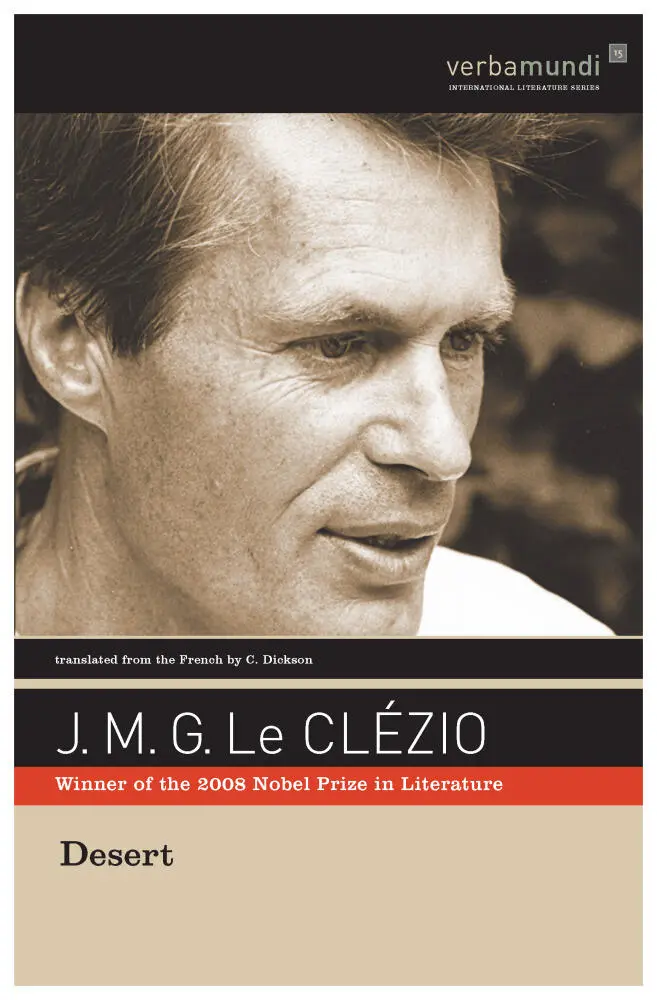
- Название:Desert
- Автор:
- Издательство:Verba Mundi Books
- Жанр:
- Год:2009
- Город:Jaffrey
- ISBN:978-1-56792-386-5
- Рейтинг книги:5 / 5. Голосов: 1
-
Избранное:Добавить в избранное
- Отзывы:
-
Ваша оценка:
Desert: краткое содержание, описание и аннотация
Предлагаем к чтению аннотацию, описание, краткое содержание или предисловие (зависит от того, что написал сам автор книги «Desert»). Если вы не нашли необходимую информацию о книге — напишите в комментариях, мы постараемся отыскать её.
Available for the first time in English translation, Desert is a novel composed of two alternating narratives, set in counterpoint. The first takes place in the desert between 1909 and 1912 and evokes the migration of a young adolescent boy, Nour, and his people, the Blue Men, notorious warriors of the desert. Driven from their lands by French colonial soldiers, Nour's tribe has come to the valley of the Saguiet El Hamra to seek the aid of the great spiritual leader known as Water of the Eyes. The religious chief sends them out from the holy city of Smara into the desert to travel still further. Spurred on by thirst, hunger, and suffering, Nour's tribe and others flee northward in the hopes of finding a land that can harbor them at last.
The second narrative relates the contemporary story of Lalla, a descendant of the Blue Men. Though she is an orphan living in a shantytown known as the Project near a coastal city in Morocco, the blood of her proud, obstinate tribe runs in her veins. All too soon, Lalla must flee to escape a forced marriage with an older, wealthy man. She travels to France, undergoing many trials there, from working as a hotel maid to becoming a highly-paid fashion model, and yet she never betrays the blood of her ancestors.
Desert — читать онлайн бесплатно полную книгу (весь текст) целиком
Ниже представлен текст книги, разбитый по страницам. Система сохранения места последней прочитанной страницы, позволяет с удобством читать онлайн бесплатно книгу «Desert», без необходимости каждый раз заново искать на чём Вы остановились. Поставьте закладку, и сможете в любой момент перейти на страницу, на которой закончили чтение.
Интервал:
Закладка:
Then suddenly, as if in a breath of wind, everything is gone. It’s just that al-Ser’s eyes are no longer upon her, they have glanced away from the plateau of white stone. Then Lalla is looking through her own eyes again, can feel her heart again, her lungs, her skin. She can make out each detail, each stone, each crack, each tiny little pattern in the dust.
She turns back. She climbs down toward the bed of the dry torrent, avoiding the sharp rocks and the thorn bushes. When she gets to the bottom, she is very weary from all of that light, from the barrenness of the incessant wind. Slowly, she walks along the sand paths till she reaches the Project where the shadows of men and women are still moving around. She walks over to the fountain and bathes her face with her hands, kneeling on the ground, as if she were returning from a long journey.
WHAT’S ALSO NICE are the wasps. They’re all over the town with their long yellow bodies with black stripes and their transparent wings. They go everywhere, flying about heavily without paying any attention to people. They’re hunting for food. Lalla really likes them, she often watches them hanging in the sunbeams over heaps of garbage, or around the meat stalls at the butcher’s market. Sometimes they come close to Lalla when she’s eating an orange; they try to land on her face, on her hands. Sometimes too, one of them stings her on the neck or on the arm, and it burns for several hours. But it doesn’t matter, Lalla really likes the wasps anyway.
The flies aren’t as nice. First of all they don’t have that long yellow and black body, or the waist that is so slender when they’re standing on the edge of a table. The flies go fast, they alight suddenly, all flat with their big red-gray eyes goggling on their heads.
In the Project, there’s always a lot of smoke hanging over the plank shacks, along the alleys of tamped earth. There are women cooking meals on clay braziers, there are fires for burning garbage, fires for heating tar to put on the roofs.
When she has time, Lalla likes to stop and look at the fires. Or sometimes she goes over to the dried torrents to gather acacia twigs, she ties them together with a piece of string and brings the bundle back to Aamma’s house. The flames flare up joyfully among the twigs, making the stems and thorns burst open and the sap boil. The flames dance in the cold morning air, making fine music. If you look into the flames, you can see genies, at least that’s what Aamma says. You can also see landscapes, cities, rivers, all sorts of extraordinary things that appear and then hide, sort of like clouds.
Then the wasps come out, because they smell the odor of mutton cooking in the iron pot. The other children are afraid of the wasps, they want to drive them away, they try to kill them by throwing stones. But Lalla lets them fly around her hair and tries to understand what they are singing when they make their wings buzz.
When it’s mealtime, the sun is high in the sky, burning hotly. Whites are so white that you can’t look directly at them, shadows are so dark that they seem like holes in the ground. So first Aamma’s sons come. There are two of them, one who is fourteen, named Ali, and the other who is seventeen, whom everyone calls Bareki, because he was blessed on the day of his birth. Aamma serves them first, and they eat rapidly, greedily, without speaking. They always shoo the wasps away with the backs of their hands as they eat. Then Aamma’s husband comes; he works in the tomato fields, to the south. His name is Selim, but he’s called the Soussi, because he is from the Souss River region. He’s very small and thin, with lovely green eyes, and Lalla really likes him, even though it’s rumored almost everywhere that he’s a little lazy. He doesn’t kill the wasps; on the contrary, he sometimes holds them between his index finger and thumb and plays at making their stingers come out, then he sets them delicately back down and lets them fly away.
There are always people who are far from their homes, and Aamma puts a piece of meat aside for them. Sometimes Naman the fisherman comes to eat at Aamma’s house. Lalla is always very pleased when she knows he’s going to come, because Naman likes her too, and he tells her nice stories. He eats slowly, and from time to time he says something funny just for her. He calls her little Lalla because she’s the descendent of a true sharifa. When she looks into his eyes, Lalla feels as if she were looking at the color of the sea, going across the sea, as if she were on the other side of the horizon, in those big cities where there are white houses, gardens, fountains. Lalla loves to hear the names of the cities, and she often asks Naman to say them for her, just like that, just their names, slowly, to have time to see the things they hide:
“Algeciras.”
“Granada.”
“Sevilla.”
“Madrid.”
Aamma’s boys want to know more. They wait for Old Naman to finish eating, and they ask all sorts of questions about life over there, across the sea. They want to know serious things, not names to dream about. They ask Naman about the money that can be earned, the work to be had, how much clothes cost, food, the price of a car, if there are a lot of movie theaters. Old Naman is too old, he doesn’t know those kinds of things, or maybe he’s forgotten them, and anyway, life must have changed since he lived over there, before the war. So the boys shrug their shoulders, but they don’t say anything because Naman has a brother who still lives in Marseille and who might be useful one day.
On certain days Naman feels like talking about everything he’s seen, and Lalla is the one to whom he tells it all because she’s his favorite and because she doesn’t ask any questions.
Even if they’re not exactly true, Lalla loves the tales he tells. She listens carefully to him when he speaks of large white cities by the sea, with all those rows of palm trees, gardens filled with flowers, with orange and pomegranate trees climbing all the way up to the hilltops, and those towering buildings as high as mountains, those avenues that are so long you can’t see the end. She also likes it when he talks about the black automobiles driving along slowly, especially at night, with their headlights turned on, and the multicolored lights of the shop windows. Or the huge white ships that arrive in Algeciras in the evening, slipping slowly along the damp wharves, while the crowd shouts and waves to welcome the newcomers. Or even the railroad leading northward, from city to city, traveling through the misty countryside, over rivers, mountains, going into long dark tunnels, just like that, with all the passengers and their baggage, all the way to the big city of Paris. Lalla listens to all of that and she feels a little fretful shiver, but at the same time she thinks she’d like to be on that railroad, going from town to town, toward unfamiliar places, toward the lands where everyone has forgotten all about dust and starving dogs, about plank shacks through which the desert wind blows.
“Take me with you when you leave,” says Lalla.
Old Naman shakes his head, “I’m too old now, little Lalla, I won’t be going back again, I’d die on the way.”
To console her, he adds, “You’ll go. You’ll see all those cities, and then you’ll come back here, like I did.”
She simply stares into Naman’s eyes to see what he’d seen, like when you stare into the deep sea. She thinks of the lovely names of the cities for a long time, she hums them in her head as if they were the words to a song.
Sometimes it’s Aamma who asks him to talk about those foreign lands. So then, once again, he tells all about his journey through Spain, the border, then the road along the coast, and the great city of Marseille. He talks about all the houses, the streets, the stairways, the endless wharves, the cranes, boats as big as houses, as big as cities, from which trucks, freight cars, stones, cement are unloaded, and which then glide away on the dark waters of the port, blowing their horns. The two boys don’t listen much to that because they don’t believe Old Naman. When Naman leaves, they say that everyone knows he was a cook in Marseille, and they call him Tayyeb, to make fun of him, because it means “he was a cook.”
Читать дальшеИнтервал:
Закладка:
Похожие книги на «Desert»
Представляем Вашему вниманию похожие книги на «Desert» списком для выбора. Мы отобрали схожую по названию и смыслу литературу в надежде предоставить читателям больше вариантов отыскать новые, интересные, ещё непрочитанные произведения.











Обсуждение, отзывы о книге «Desert» и просто собственные мнения читателей. Оставьте ваши комментарии, напишите, что Вы думаете о произведении, его смысле или главных героях. Укажите что конкретно понравилось, а что нет, и почему Вы так считаете.