J.M. le Clézio - Desert
Здесь есть возможность читать онлайн «J.M. le Clézio - Desert» весь текст электронной книги совершенно бесплатно (целиком полную версию без сокращений). В некоторых случаях можно слушать аудио, скачать через торрент в формате fb2 и присутствует краткое содержание. Город: Jaffrey, Год выпуска: 2009, ISBN: 2009, Издательство: Verba Mundi Books, Жанр: Современная проза, на английском языке. Описание произведения, (предисловие) а так же отзывы посетителей доступны на портале библиотеки ЛибКат.
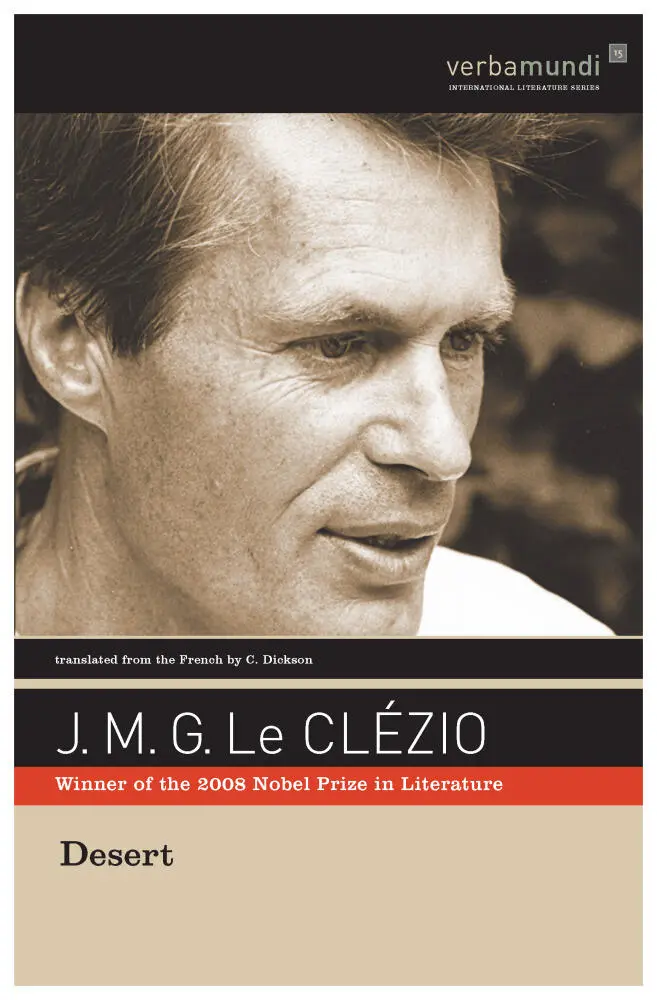
- Название:Desert
- Автор:
- Издательство:Verba Mundi Books
- Жанр:
- Год:2009
- Город:Jaffrey
- ISBN:978-1-56792-386-5
- Рейтинг книги:5 / 5. Голосов: 1
-
Избранное:Добавить в избранное
- Отзывы:
-
Ваша оценка:
Desert: краткое содержание, описание и аннотация
Предлагаем к чтению аннотацию, описание, краткое содержание или предисловие (зависит от того, что написал сам автор книги «Desert»). Если вы не нашли необходимую информацию о книге — напишите в комментариях, мы постараемся отыскать её.
Available for the first time in English translation, Desert is a novel composed of two alternating narratives, set in counterpoint. The first takes place in the desert between 1909 and 1912 and evokes the migration of a young adolescent boy, Nour, and his people, the Blue Men, notorious warriors of the desert. Driven from their lands by French colonial soldiers, Nour's tribe has come to the valley of the Saguiet El Hamra to seek the aid of the great spiritual leader known as Water of the Eyes. The religious chief sends them out from the holy city of Smara into the desert to travel still further. Spurred on by thirst, hunger, and suffering, Nour's tribe and others flee northward in the hopes of finding a land that can harbor them at last.
The second narrative relates the contemporary story of Lalla, a descendant of the Blue Men. Though she is an orphan living in a shantytown known as the Project near a coastal city in Morocco, the blood of her proud, obstinate tribe runs in her veins. All too soon, Lalla must flee to escape a forced marriage with an older, wealthy man. She travels to France, undergoing many trials there, from working as a hotel maid to becoming a highly-paid fashion model, and yet she never betrays the blood of her ancestors.
Desert — читать онлайн бесплатно полную книгу (весь текст) целиком
Ниже представлен текст книги, разбитый по страницам. Система сохранения места последней прочитанной страницы, позволяет с удобством читать онлайн бесплатно книгу «Desert», без необходимости каждый раз заново искать на чём Вы остановились. Поставьте закладку, и сможете в любой момент перейти на страницу, на которой закончили чтение.
Интервал:
Закладка:
Then all at once, as if he were afraid of something, the young shepherd jumps to his feet, lets go of Lalla’s hand. Without even looking at her, he starts running fast, like a dog, jumping over the rocks and the dried ravines. He leaps over the drystone walls, and Lalla sees his pale silhouette disappearing between the thorn bushes.
“Hartani! Hartani! Come back!”
Lalla shouts, standing up on the boulder, and her voice cracks because she knows it won’t do any good. The Hartani disappears suddenly, swallowed up by one of those dark hollows in the limestone. He won’t show himself again today. Maybe tomorrow, or some other time? So then Lalla also goes down the hill, slowly, from one rock to another, clumsily, and she looks back from time to time to try to catch a glimpse of the shepherd. She leaves the fields of stone and the drystone walls, makes her way back down toward the valley bottom, not far from the sea, where people live in houses made of planks, sheet metal, and tarpaper.
DAYS ARE THE SAME every day, here in the Project, and sometimes you’re not really sure what day you happen to be living. It’s an already remote time, and it’s as if there were nothing written in the cards, nothing certain. As a matter of fact, no one really thinks about it here, no one really wonders who he is. Yet Lalla thinks about it often, when she goes up to the plateau of stones where the Blue Man dwells, the man she calls al-Ser.
It might be due to the wasps as well. There are so many wasps in the Project, many more than there are men and women. From dawn to dusk they go humming through the air searching for food, dancing in the sunlight.
Yet in one sense, the hours are never the same, like the things Aamma says, like the faces of the girls who gather around the fountain. There are torrid hours, when the sun burns your skin through the clothing, when the light sticks pins in your eyes and makes your lips bleed. That’s when Lalla wraps herself up in blue cloth, ties a large handkerchief behind her head that covers her face up to the eyes, and wraps another thin blue cloth around her head that hangs down to her chest. The burning wind comes in from the desert, blowing hard grains of dust. Outside, the streets of the Project are empty. Even the dogs are hiding in holes in the earth, at the foot of the houses, against empty oil drums.
But Lalla loves being outdoors on days like that, maybe precisely because there is no one around. It’s as if there were nothing left on earth, nothing that belonged to humans. That’s when she feels most divorced from herself, as if nothing she had ever done could count, as if all memory had been erased.
So she goes over toward the sea, to the place where the dunes begin. She sits down in the sand, wrapped in the blue cloths; she looks at the dust rising in the air. Above the earth, at the zenith, the sky is a very deep blue, almost the color of night, and when she looks over at the horizon just above the line of dunes, she can see that pink ashen color, like at dawn. On those days you are free too from flies and wasps because the wind has driven them back into the hollows in the rocks, into their nests of dried mud, or into the dark corners of the houses. There are no men, or women, or children. There are no dogs, no birds. There is only the wind whistling in the branches of the shrubs, in the leaves of the acacias and the wild fig trees. There are only the thousands of stone particles lashing at your face, parting around Lalla, forming long ribbons, snakes, plumes. There is the sound of the wind, the sound of the sea, the swishing sound of sand, and Lalla leans forward to breathe, the blue veil plastered against her nostrils and lips.
It’s great because it’s as if you’d sailed away on a boat, like Naman the fisherman and his companions, lost in the middle of a huge storm. The sky is blank, extraordinary. The earth has disappeared, or almost, barely visible through the cracks in the sand, ragged, worn, a few dark patches of reefs surrounded by the sea.
Lalla doesn’t know why she goes out on those days. She just can’t help it, she can’t stay closed up in Aamma’s house, or even go walking through the narrow streets of the Project. The burning wind dries out her lips and her nostrils; she can feel the flame descending inside her. It might be the flame of the light in the sky, the flame that comes from the East and that the wind is forcing into her body. But light doesn’t only burn, it also liberates, and Lalla can feel her body getting lighter, swifter. She resists, clinging to the sand dune with both hands, her chin against her knees. She barely breathes, in short little gasps, so as not to become too light.
She tries to think of the people she loves, because that can keep the wind from blowing her away. She thinks of Aamma, of the Hartani, of Naman most of all. But on those days, nothing really counts, not even any of the people she knows, and her thoughts slip immediately away, escape, as if the wind had torn them from her and carried them out among the dunes.
Then suddenly she feels the eyes of the Blue Man from the desert upon her. It’s the same look that was up there on the plateau of stones at the edge of the desert. It is a blank, imperious gaze that pushes down on her shoulders with all the weight of the wind and the light, a look filled with unbearable dryness that is painful, a look that has been hardened like the particles of stone that are hitting her face and clothing. She doesn’t understand what he wants, what he’s asking for. Maybe he wants nothing of her, he’s just simply passing over the coastline, the river, the Project, and he’s going even farther out, to burn up the cities and the white houses, the gardens, the fountains, the wide avenues in the lands on the other side of the sea.
Now Lalla is frightened. She would like to stop that gaze, to stop it on herself, so that it wouldn’t go out beyond that horizon, so it would cease its revenge, its flames, its violence. She doesn’t understand why the storm of the man from the desert wants to destroy those cities. She closes her eyes to block out the sight of the snakes of sand coiling around her, those dangerous plumes. Then she hears the voice of the desert warrior in her ears, the one she calls al-Ser, the Secret. She’s never heard him so clearly, even when he appeared before her on the plateau of stones wearing his white cloak, his face veiled in blue. It’s a strange voice that she hears inside of her head, mingling with the sound of the wind and the hissing of the sand. It’s a distant voice that is saying words she doesn’t really understand, endlessly repeating the same sounds, the same words.
“Make the wind stop!” says Lalla out loud, without opening her eyes. “Don’t destroy the cities, make the wind stop and the sun stop burning, make everything be at peace!”
Then again, in spite of herself, “What do you want? Why do you come here? I’m nothing to you, why do you talk to me, and only to me?”
But the voice is still murmuring, still fluttering inside of Lalla’s body. It is only the voice of the wind, the voice of the sea, of the sand, the voice of the light that dazzles and numbs people’s willpower. It comes at the same time as the stranger’s gaze, it shatters and uproots everything on earth that resists it. Then it goes farther out, toward the horizon, gets lost out at sea on the mighty waves, it carries the clouds and the sand toward the rocky coasts on the other side of the sea, toward the vast deltas where the smokestacks of refineries are burning.
TELL ME ABOUT the Blue Man,” says Lalla.
But Aamma is busy kneading bread on the large earthenware platter. She shakes her head. “Not now.”
Lalla insists. “Yes, now, Aamma, please.”
“I already told you everything I know about him.”
Читать дальшеИнтервал:
Закладка:
Похожие книги на «Desert»
Представляем Вашему вниманию похожие книги на «Desert» списком для выбора. Мы отобрали схожую по названию и смыслу литературу в надежде предоставить читателям больше вариантов отыскать новые, интересные, ещё непрочитанные произведения.








Обсуждение, отзывы о книге «Desert» и просто собственные мнения читателей. Оставьте ваши комментарии, напишите, что Вы думаете о произведении, его смысле или главных героях. Укажите что конкретно понравилось, а что нет, и почему Вы так считаете.